



When it comes to Life Cycle Assessment (LCA), the End-of-Life (EoL) stage often considered the “final destination” of a product, is a critical phase. Although the term might sound grim, it plays a vital role in understanding the environmental impact of a product once it’s no longer in use.
EoL poses two key challenges:
Determining the fate of a product after disposal.
Accurately modeling the environmental benefits of material recycling.
By grasping the principles of EoL modeling, you can confidently navigate this stage in your LCA process. In this article, you'll learn how EoL is typically modeled, how to gather relevant data, and how recycling scenarios especially in construction are integrated.
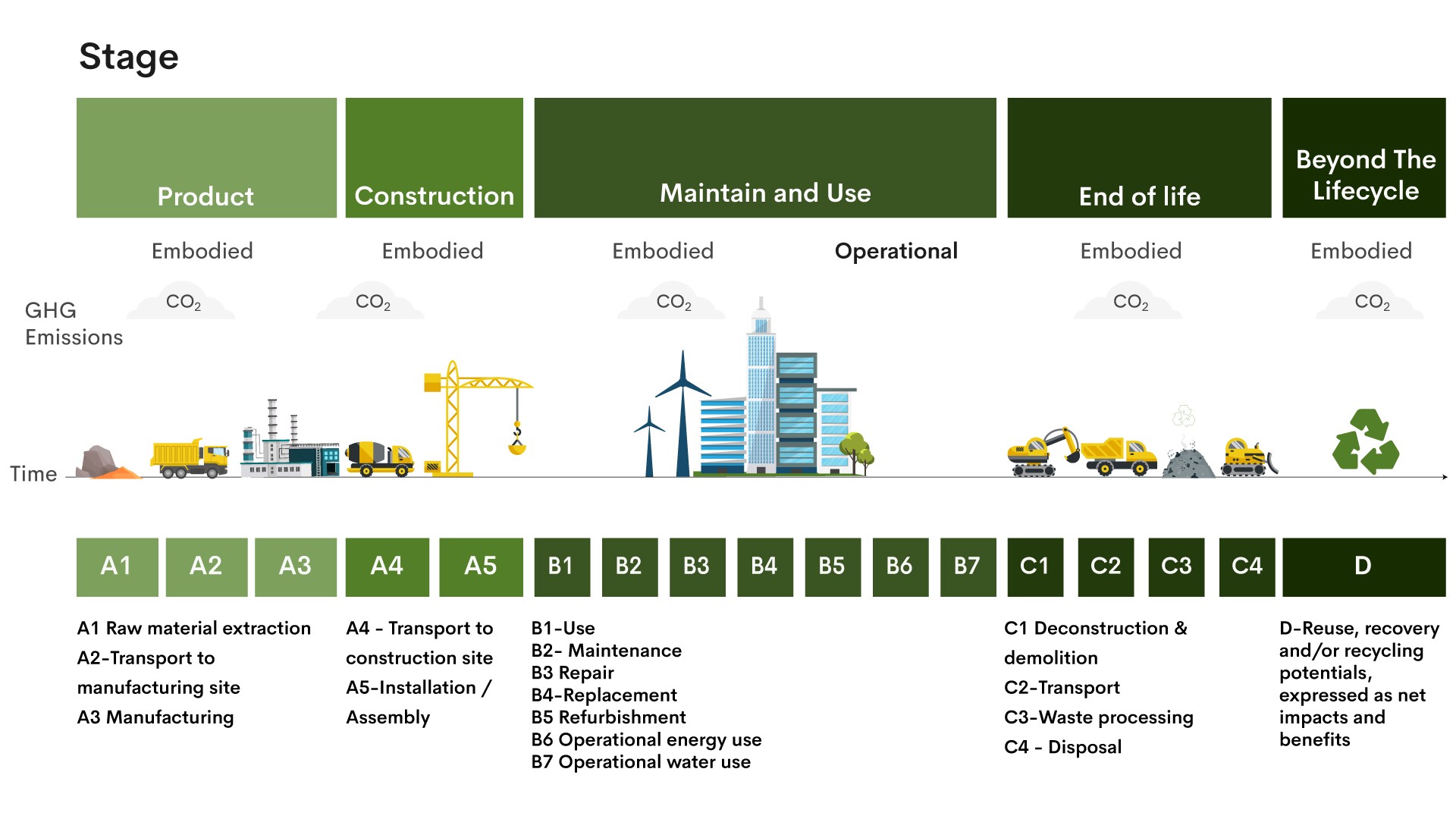
Below is an image illustrating the End-of-Life (EoL) pathways for various construction materials;
Understanding the End of Life stage in LCA
End-of-Life Stage | C1 Deconstruction & Demolition | Dismantling or deconstructing the product/building. | Labour and equipment for deconstruction; waste generation during dismantling. |
|---|---|---|---|
C2 Transport | Transporting deconstructed materials to disposal/recycling. | Transportation modes and emissions; energy use for logistics. | |
C3 Waste Processing | Processing and treatment of waste materials from deconstruction. | Sorting, recycling, incineration, composting; energy and resources used. | |
C4 Disposal | Final disposal of non-reusable/recyclable materials. | Landfilling or other disposal methods; environmental impacts of disposal. |
What Does End-of-Life Include?
A product enters the EoL phase once it is no longer in use. It may:
Be treated as waste through incineration, landfilling, composting, or other disposal methods.
Be recycled or reused as part of another product.
To begin modelling EoL, you must:
Map the product system to determine how various components are handled post-use.
Connect these outcomes to environmental data using LCA software.
Let’s break this process down further.
Step 1: Mapping Your Product's EoL Pathways
Start by identifying what happens to each part of the product at EoL. Determine what percentage is recycled, incinerated, landfilled, or otherwise processed. If the EoL process is managed through a take-back or closed-loop system, direct data can be used for the most accurate results.
If primary data isn’t available, make informed assumptions using:
Industry-specific averages (e.g., from the Construction sector’s Environmental Database)
National or regional waste statistics
Broader continental-level data
Even rough estimates can be useful, especially if grounded in credible sources.
Step 2: Linking Processes to Environmental Data
Once the likely EoL scenarios are identified, the next step is to link these to Life Cycle Inventory (LCI) data. Many LCI databases include standardized datasets for common waste and recycling processes, allowing you to model environmental impacts effectively.
That covers the basics. But one aspect that often requires deeper attention is recycling; let’s explore that next.
Modelling the Environmental Benefits of Recycling
Recycling and energy recovery processes can create useful by-products. For instance:
Incineration may generate energy and heat.
Recycling transforms waste into secondary materials that substitute for new (primary) materials.
These secondary materials start their own life cycles and must be accounted for separately in your LCA. This can improve the product’s environmental profile if modelled correctly.
However, the methodology varies depending on the LCA framework that is used.
Modelling the Environmental Benefits of Recycling
Recycling and energy recovery processes can create useful by-products. For instance:
Incineration may generate energy and heat.
Recycling transforms waste into secondary materials that substitute for new (primary) materials.
These secondary materials start their own life cycles and must be accounted for separately in your LCA. This can improve the product’s environmental profile if modelled correctly.
However, the methodology varies depending on the LCA framework that is used.
EoL Recycling and the "Cut-off" System Model
Different system models define where the original product ends and the new one begins. The "Cut-off" approach, which is also employed in standards like EN15804 for construction.
Here’s how it works:
The environmental impact of producing a secondary product (e.g., recycled plastic pellets) is attributed to the initial product up to the point where the recycled material gains economic value.
Any downstream use of the recycled material is considered "burden-free", as if it had no prior environmental load.
For example, while mixed plastic waste cannot be sold, it can be sold once processed into granules. All environmental impacts up to that point (collection, sorting, reprocessing) are assigned to the original product. The use of recycled materials is incentivized by this model, as they carry fewer impacts than virgin equivalents.
How Desapex Supports EoL Modeling and Net Zero Pathways
Desapex’s Net Zero Energy Consulting bridges the gap between sustainability goals and technical execution. Leveraging advanced LCA techniques and digital engineering, we help you:
Establish accurate carbon baselines
Simulate energy consumption and embodied carbon
Model Net Zero strategies for buildings and infrastructure
Evaluate cost-effective carbon reduction opportunities
Support procurement with LCA-driven material insights
Whether you’re designing a carbon-neutral building or a Net Zero campus, Desapex equips you with the tools and expertise to lead with impact.
Start Your EoL Journey with Confidence
Understanding and modelling EoL is essential for any meaningful sustainability strategy. With the right data and system models, you can turn the “end” of your product’s life into a valuable opportunity for environmental gains.