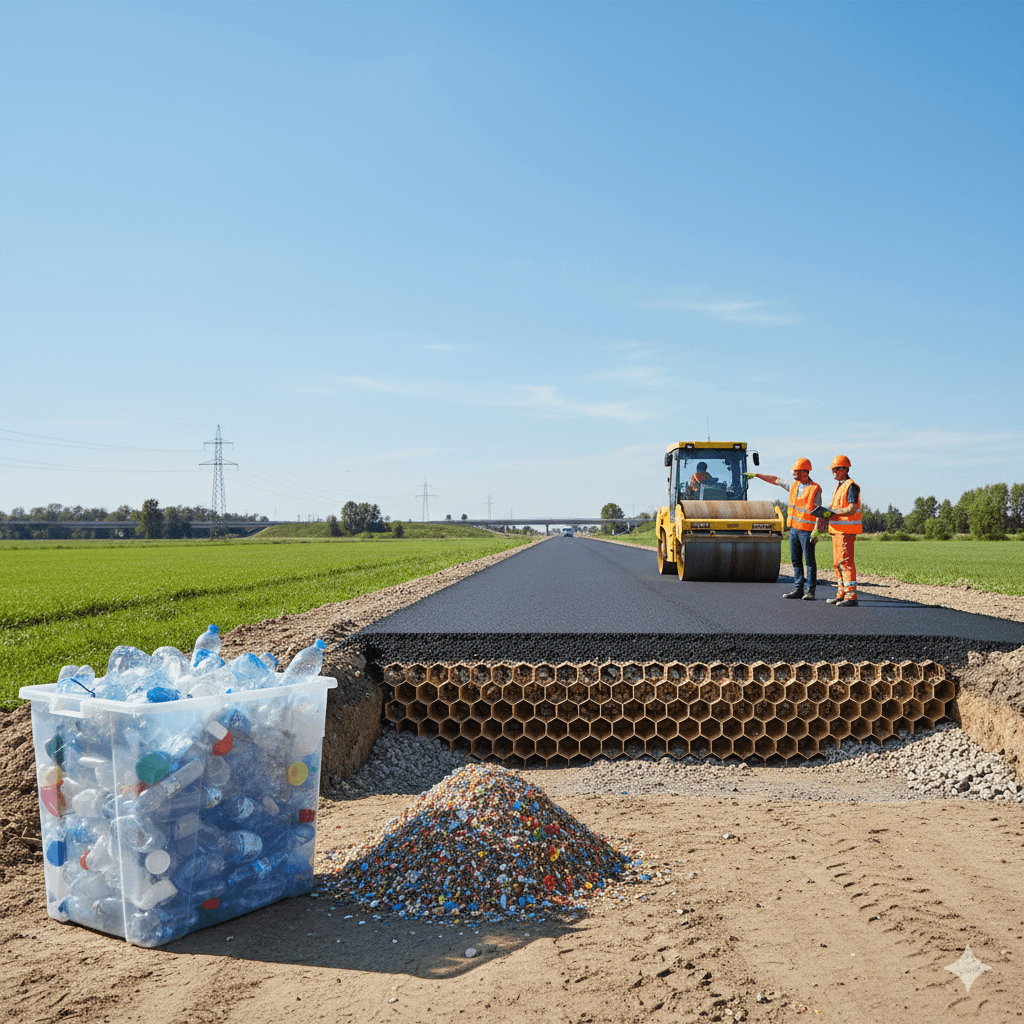




Waste, Reimagined as a Resource
India generates more than 3.4 million tonnes of plastic waste every year, and much of it ends up clogging drains, rivers, or landfills. For years, this seemed like an unmanageable problem. But what if the same waste choking our environment could help us build stronger, greener roads?
That’s exactly what’s happening now. With plastic-modified roads already transforming cities and a new wave of plastic geocell technology emerging, India is proving that sustainability and innovation can travel the same road literally.
Plastic Roads: The First Big Leap
The idea behind plastic roads is beautifully simple.
Shredded plastic waste from bags and packaging to disposable cutlery is mixed with hot bitumen (tar). The melted plastic coats the stone aggregates, creating a stronger, more water-resistant bond.
Why It Works So Well
💪 More Durable: Plastic roads last 2–3 times longer, withstanding heat, heavy traffic, and monsoon damage.
💰 Cost-Efficient: They reduce bitumen use by 10–15%, cutting costs without compromising quality.
🌿 Eco-Friendly: Each kilometer of road uses about 1 tonne of plastic waste, turning trash into infrastructure.
🛠 Low Maintenance: Fewer potholes, fewer repairs especially in waterlogged regions.
This breakthrough came from Dr. R. Vasudevan, often called The Plastic Man of India, whose research turned plastic from pollutant to pavement.
Where India Is Already Leading
Chennai: Over 1,000 km of plastic roads since 2004.
Indore: Converts segregated municipal waste directly into road material.
National Highways: Plastic use is now mandatory within 50 km of cities with over 5 lakh population.
And the results?
Tamil Nadu reports major reductions in road repair costs.
Indore has become a circular economy model for waste-to-road recycling.
NHAI has already reused over 1,00,000 tonnes of plastic in national highway projects.
What started as a pilot experiment has now become a national movement, reshaping how India views waste.
The Next Step: Plastic Geocells
Plastic roads are a big win but challenges remain in rural, hilly, and flood-prone areas, where traditional roads often collapse due to weak soil or erosion.
Enter Plastic Geocells India’s next sustainable infrastructure breakthrough.
What Exactly Are Plastic Geocells?
Imagine a 3D honeycomb grid made from recycled plastic.
When these grids are laid on the ground and filled with soil, sand, or gravel, they lock the material in place preventing it from spreading and providing a stable base. Once topped with a road surface, geocells act like a reinforcing skeleton that evenly distributes vehicle loads.
Why Geocells Are Game-Changers
♻ Dual Benefit: Reduce plastic waste and strengthen roads at the same time.
⚖ Better Load Distribution: Prevent rutting, potholes, and road collapse.
🌧 Climate-Resilient: Stand strong against floods, erosion, and landslides.
🧱 Resource-Efficient: Use local soil instead of expensive imported aggregates.
🚚 Fast to Build: Lightweight, modular, and perfect for remote or disaster-hit zones.
How India Is Adopting Them
2025 Field Trials: India’s first plastic geocell road trials launched in flood-prone and hilly terrains.
PMGSY Rural Roads: Lower-cost, longer-lasting rural connectivity.
Highway Embankments: Preventing slope erosion and canal washouts.
Disaster Relief Roads: Rapid-deployment routes for emergency and military use.
These early applications show immense promise especially for regions where climate and geography challenge traditional construction.
Challenges on the Road Ahead
Like every innovation, there are hurdles to overcome:
Sorting Plastic: Only certain plastics (not PVC) are safe for use.
Supply Chain Readiness: Need stronger collection and processing systems.
Training Needs: Engineers and contractors must be equipped to implement correctly.
Long-Term Studies: Monitoring microplastic effects and long-term durability.
But with government push, private partnerships, and digital oversight, these barriers can be overcome.
Building Roads, Building Futures
Plastic roads proved that what we throw away can literally pave our future. Now, plastic geocells are taking that lesson further creating roads that are not just strong, but also climate-resilient and circular by design.
If scaled nationwide, these two technologies could recycle millions of tonnes of plastic annually, slash infrastructure costs, and reduce emissions while giving India smoother, smarter, and longer-lasting roads.
At Desapex, we see sustainable infrastructure not as a single innovation, but as an ecosystem of digital, material, and operational intelligence. From BIM-based design and simulation to net-zero assessments and green material integrations, we help clients embed these innovations within a digital sustainability framework.
Because the road ahead isn’t just about where we’re going
It’s about how we build it.
And with forward-thinking partners like Desapex, India is driving toward a future where every road tells a story of innovation, sustainability, and resilience.