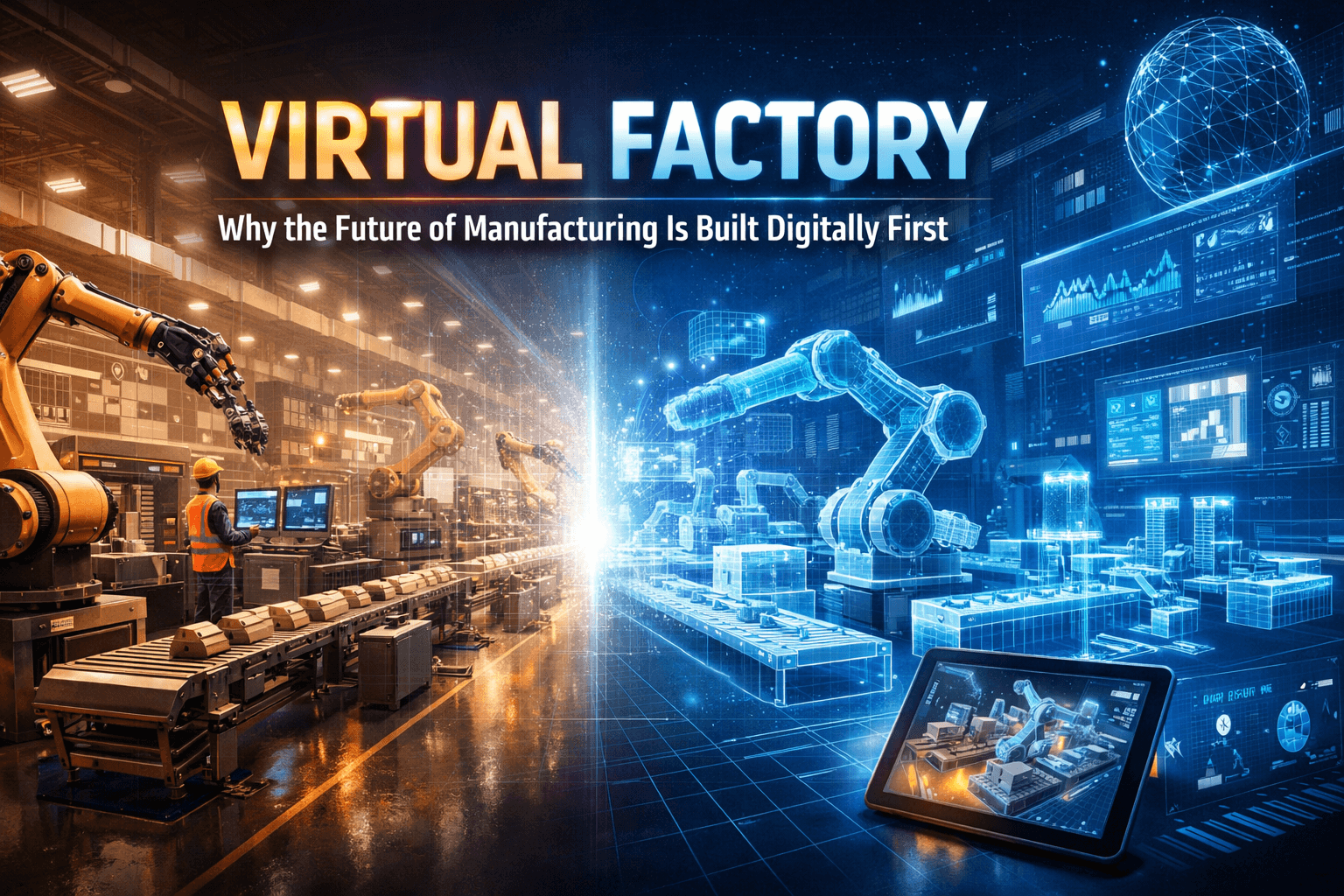


Manufacturing is entering a new phase where factories are no longer designed only on paper or spreadsheets. They are first created, tested, and optimized in a digital world. This concept is known as the Virtual Factory a digital replica of a real manufacturing facility that mirrors machines, layouts, material flow, production logic, and even human and robot interactions.
A virtual factory uses 3D modeling, simulation, artificial intelligence, and real-time operational data to answer critical questions before changes are made on the shop floor. Manufacturers can simulate new layouts, validate automation strategies, test “what-if” scenarios, and train robots or operators safely in a virtual environment.
In simple terms, a virtual factory allows organizations to design and operate factories digitally before committing physically.
Why Is a Virtual Factory Needed Now?
Manufacturing today faces rising complexity, shorter product life cycles, labor shortages, and strong pressure to reduce costs while improving quality and sustainability. Traditional planning methods cannot keep pace with this speed and scale of change.
A virtual factory helps manufacturers to:
Reduce risk by testing layouts and processes digitally before physical implementation
Accelerate commissioning and ramp-up of new production lines
Identify bottlenecks and inefficiencies early through simulation
Improve collaboration between engineering, operations, and leadership teams
Enable safer robot training and workforce upskilling
Support Industry 4.0, digital twin, and smart manufacturing initiatives
NVIDIA CEO Jensen Huang has emphasized that every physical system will eventually have a digital twin and that factories will be “built and optimized digitally before they exist in the real world.” Platforms such as NVIDIA Omniverse are enabling physically accurate virtual factories that combine 3D engineering data with AI and real-time simulation.
Early Adopters vs Late Joiners
Industries such as electronics manufacturing and automotive have already demonstrated the value of virtual factories. Companies like Foxconn, Wistron, and Hyundai Motor Group are using digital factory environments to optimize layouts, shorten commissioning time, improve productivity, and reduce defects.
Early implementers are gaining:
Faster time to market
Lower operational risk
Better use of automation and robotics
Higher return on capital investments
Organizations that delay adoption may face steeper learning curves, higher costs of correction, and competitive disadvantage. For late joiners, the challenge will not only be technology adoption but also building digital skills, data maturity, and cross-functional collaboration. The impact is clear: those who start early shape standards; those who start late must catch up.
India’s Growing Momentum
India is showing strong momentum toward virtual factory and digital twin adoption as part of its broader push for advanced manufacturing and Industry 4.0. Collaborations between global technology providers and Indian engineering and IT services companies are accelerating the use of simulation, AI, and digital twins for factory planning and operations.
The emergence of dedicated AI infrastructure and AI factory initiatives in India signals readiness for large-scale industrial digitalization. Indian manufacturers in sectors such as automotive, heavy engineering, and electronics are increasingly exploring virtual factory models for predictive maintenance, production optimization, and sustainability goals. Government strategies on advanced manufacturing and digital infrastructure further reinforce this direction.
Conclusion
A virtual factory is no longer a futuristic concept it is becoming a strategic foundation for modern manufacturing. By building and testing factories digitally first, organizations can innovate faster, reduce costs, improve safety, and operate with greater confidence in an increasingly complex industrial environment.
The shift is not about replacing physical factories, but about making them smarter through digital intelligence. Those who embrace this change early are already seeing measurable benefits. Those who wait will need to move faster and invest more to remain competitive.