Author:

Nikhil Madavampattu
Share on Social Media:
Over 80% of mobile data consumption in India happens indoors, yet the very materials shaping modern buildings reinforced concrete, low-emissivity glass, and metal facades are actively weakening 4G and 5G signals. This makes digital connectivity not just a telecom concern, but a core design and engineering challenge that must be addressed at the planning stage rather than after construction. Recognizing this gap, TRAI introduced the Rating of Properties for Digital Connectivity Regulations in October 2024, followed by a detailed Rating Manual in August 2025. Together, they establish a standardized framework to assess and publicly rate buildings based on their Digital Connectivity Infrastructure (DCI), bringing much-needed structure and accountability to an often-overlooked aspect of building performance.
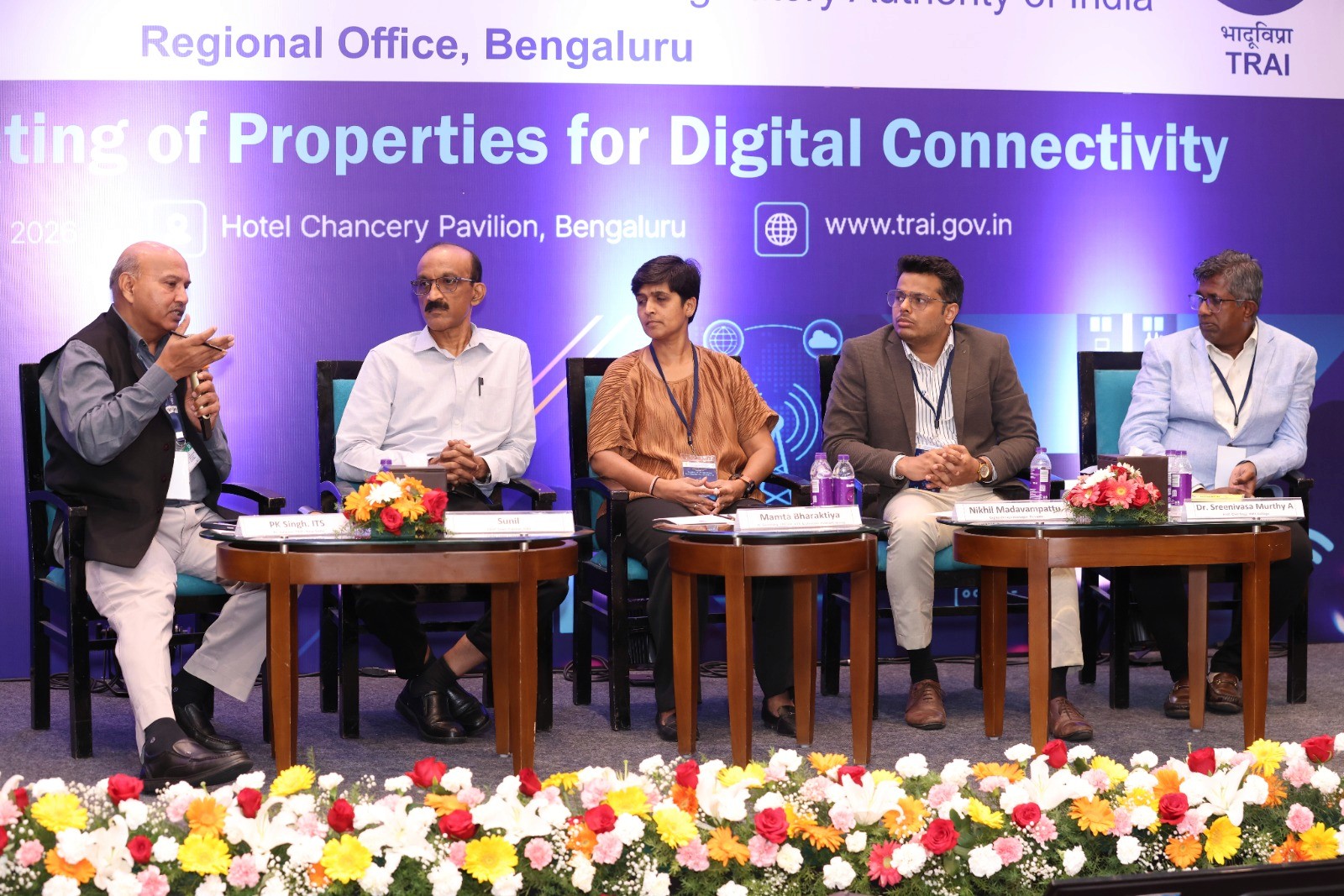
The panel discussion highlighted how existing frameworks like the National Building Code (NBC) and Model Building Bye-Laws (MBBL) already define baseline provisions for digital connectivity but lack enforcement during design approvals. Unlike fire safety or structural compliance, ICT requirements are rarely verified by local authorities at the planning stage. This creates a critical disconnect: while NBC and MBBL set the minimum standards, TRAI’s rating system evaluates actual performance. Bridging this gap requires shifting focus to the design phase, where early integration of DCI can significantly reduce costs compared to post-construction retrofits. The discussion also emphasized the need to formally include ICT/ELV consultants in design teams especially for Category A buildings and to account for the impact of building materials on signal strength right from the design brief stage.
The seminar also shed light on TRAI’s evolving framework, particularly the February 2026 consultation paper, which proposes several progressive enhancements. These include moving from a five-star to a more granular nine-level rating system, introducing design-stage certification, and enabling optional pre-rating audits. It also proposes expanding Category A to include hospitals, hotels, and educational institutions. However, a key gap remains the absence of incentives such as additional FAR (Floor Area Ratio) for DCI-compliant buildings. While similar benefits already exist for green-certified developments in several states, extending such incentives to high-performing digital infrastructure could play a crucial role in accelerating adoption and embedding connectivity as a standard expectation in future-ready buildings.