Author:

Lakshmisagar Shetty
Share on Social Media:
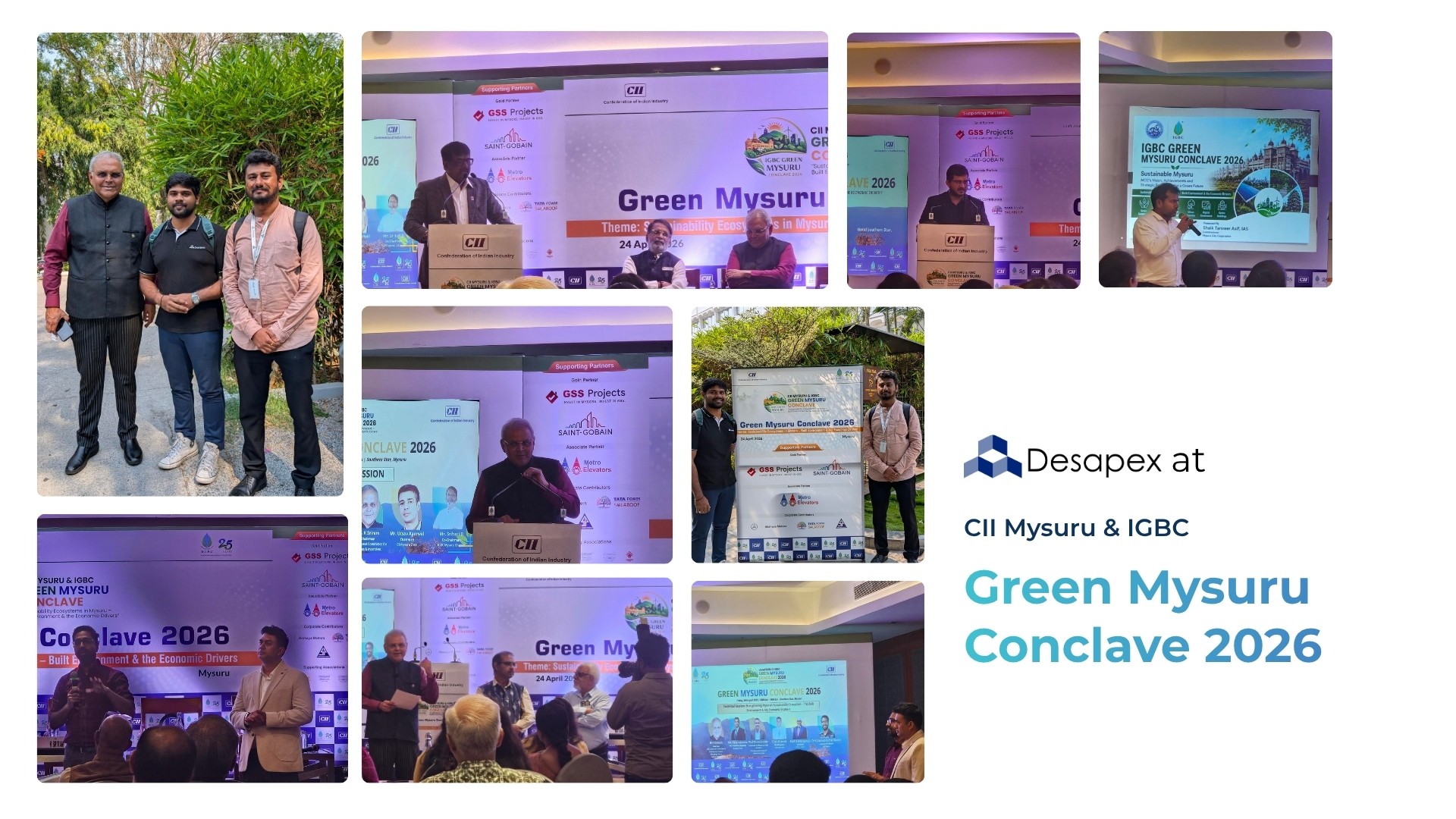
At the recent Indian Green Building Council Green Mysuru Conclave 2026 held in Mysuru, a clear and compelling message emerged: sustainability in the built environment is no longer about intent it is rapidly transitioning into measurable, on-ground implementation.
Representing Desapex, Lakshmi Sagar and Kaushik attended the conclave, engaging with a diverse ecosystem of developers, policymakers, solution providers, and academic institutions. The discussions reflected a strong shift in mindset across the industry where sustainability is now being treated as a core business and operational priority.
A Shift Toward Early-Stage Integration
One of the most prominent themes was the critical role of design-stage decision-making. Industry leaders emphasized that sustainability cannot be retrofitted into projects. Instead, it must be embedded from the earliest stages of planning and design, where the maximum impact can be achieved in terms of energy performance, material selection, and lifecycle efficiency.
From Concepts to Scalable Solutions
The conclave highlighted a move away from theoretical sustainability frameworks toward practical, scalable implementations. Solutions such as biogas systems, rainwater harvesting, and waste-to-energy models were showcased as viable, real-world applications already being adopted across projects.
Policy and Incentives Driving Momentum
Government policies and incentives are playing a key role in accelerating adoption. Discussions included green property tagging, tax rebates, and circular waste management systems all contributing to a more structured and incentivized sustainability ecosystem.
Sustainability Becomes a Business Imperative
A significant shift observed was the integration of sustainability into core business decision-making. Environmental, Social, and Governance (ESG) considerations, along with carbon disclosures, are no longer optional they are increasingly becoming mandatory criteria influencing investments, design choices, and project approvals.
Key Developments in Green Building Frameworks
The conclave also introduced and emphasized emerging frameworks within the IGBC ecosystem:
Growing traction of the IGBC Hospitality Rating system
Increased focus on campus and institutional rating frameworks
Recognition of educational institutions as critical drivers for widespread sustainability adoption
Identifying the Gaps and the Opportunity
While the intent across the industry is strong, a noticeable gap remains between sustainability goals and measurable performance outcomes. Limited adoption of Lifecycle Assessment (LCA), Environmental Product Declarations (EPDs), and lifecycle-based decision-making continues to be a challenge.
This gap presents a significant opportunity particularly in early-stage carbon optimization, material strategy, and data-driven design interventions.
The Desapex Perspective
For Desapex, the insights from the conclave reinforce a clear direction: the next phase of green buildings will be driven by data, not declarations.
The focus is now on:
Embedding LCA and EPDs directly into design workflows
Transitioning clients from certification-driven approaches to performance-driven outcomes
Enabling carbon-informed decision-making at scale
Looking Ahead
The conversations at the conclave made one thing clear the ecosystem is ready. With the right alignment of policy, technology, and industry intent, the foundation for sustainable transformation is firmly in place.
The differentiator going forward will not be awareness or ambition it will be execution.