


Webinar
Inside the Data Center
Discover the structural engineering behind the mission-critical digital world.
Friday, 30 Oct 2026
11:30 AM CET | 4:00 PM IST

Nine out of ten construction projects run late. The average one is 20% over schedule and 27% over budget. The industry loses $1.85 trillion every year to bad project data. And yet, most EPCM firms are treating AI as a science experiment not the lever that finally attacks the root cause. Here's what actually working looks like.
The problem no one wants to talk about
A project manager opens Monday morning to a fifty-page monthly report. Somewhere in it is the reason the client is unhappy. Somewhere in it is the risk that will become next month's delay. But by the time she finds either, both are past tense.
This is the everyday reality of Engineering, Procurement, and Construction Management. Not a lack of data there's more of that than ever but a lack of intelligence extracted from it in time to matter.
Why this matters right now
India's EPCM market is projected to grow from roughly $70 billion in 2025 to $112 billion by 2031 a 62% expansion in six years. Construction management holds 56% of that market. Infrastructure holds another 35%. But the fastest-growing sliver is the AI-adjacent one: BIM and digital-twin services are compounding at 9.4% CAGR, well ahead of traditional execution work.
Two things follow. First, the value is migrating from moving dirt to moving information. Second, the supply side hasn't kept up.
In recent AEC-firm surveys, 32% cite a lack of digital skills, 31% cite high investment cost, and 25% say there aren't enough qualified providers to hire. High demand, thin supply. That gap is the first-mover window, and it will close.
The core problem: fragmented data, reactive decisions
Construction has always been an information-processing business dressed up as a physical one. Engineering data, BIM models, schedules, cost sheets, procurement records, site logs, quality inspections, stakeholder inputs every project generates enormous volumes of it. Traditional practice moves that information through spreadsheets, PDFs, weekly meetings, and human judgment.
The result: information exists, but decisions still reference last month's version of it. Rework runs at 15%. Material wastage runs at 30%. Supply-chain delays account for 25% of cost overruns. The industry employs 7% of the world's workforce and accounts for 20% of its fatal workplace accidents. The root cause under every one of these numbers is the same decisions made without a reliable, real-time picture of the project.
What AI in EPCM actually is
AI in EPCM is not a chatbot that summarises meeting notes. It's a decision-support layer that sits above the entire project lifecycle processing enormous volumes of unstructured project information, identifying relationships and patterns human eyes cannot see, and converting that into predictions and recommendations the team can act on today, not next month.
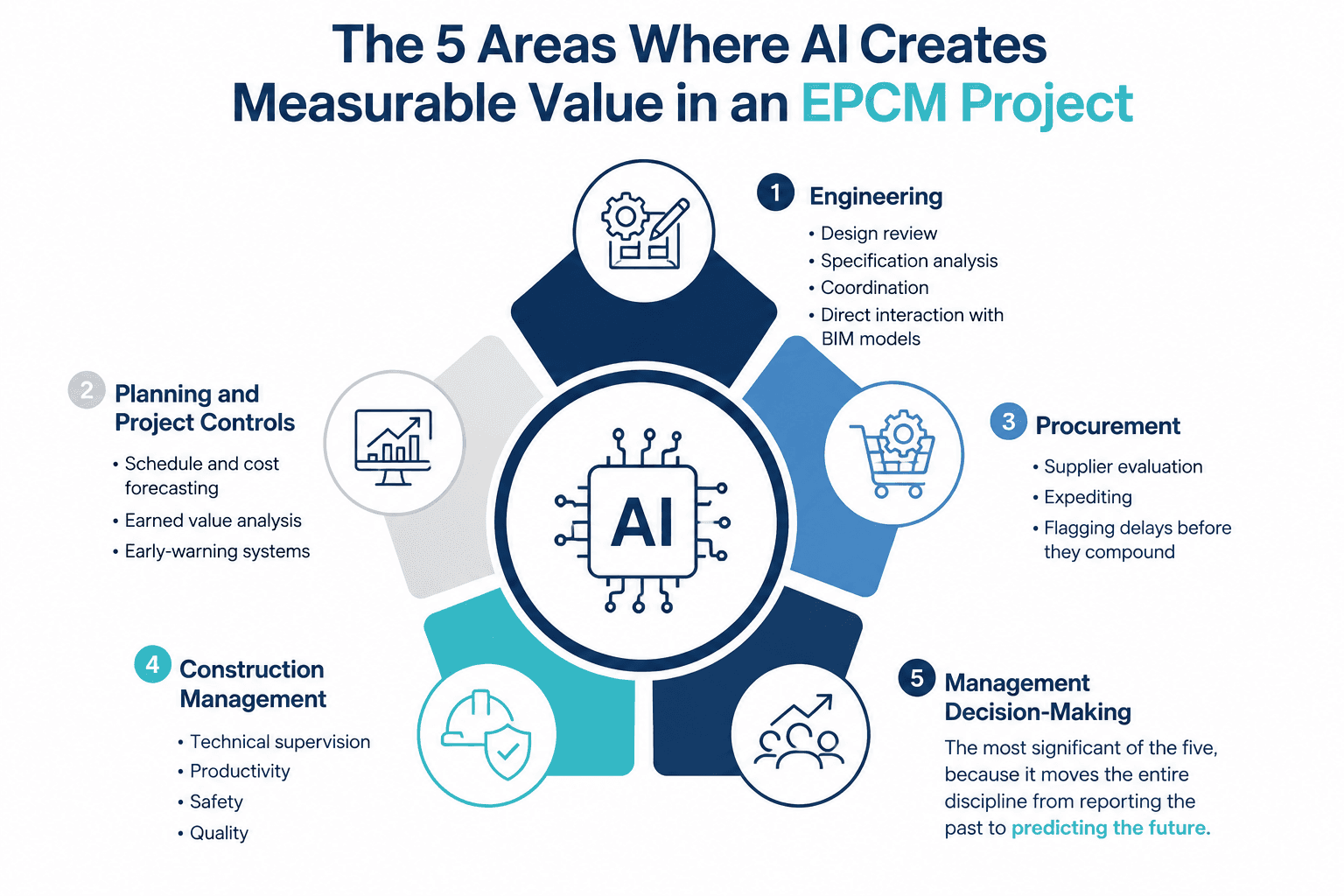
The five areas where AI creates measurable value in an EPCM project:
Engineering - design review, specification analysis, coordination, direct interaction with BIM models
Planning and project controls - schedule and cost forecasting, earned value analysis, early-warning systems
Procurement - supplier evaluation, expediting, flagging delays before they compound
Construction management - technical supervision, productivity, safety, quality
Management decision-making - the most significant of the five, because it moves the entire discipline from reporting the past to predicting the future
The 6-layer AI operating architecture
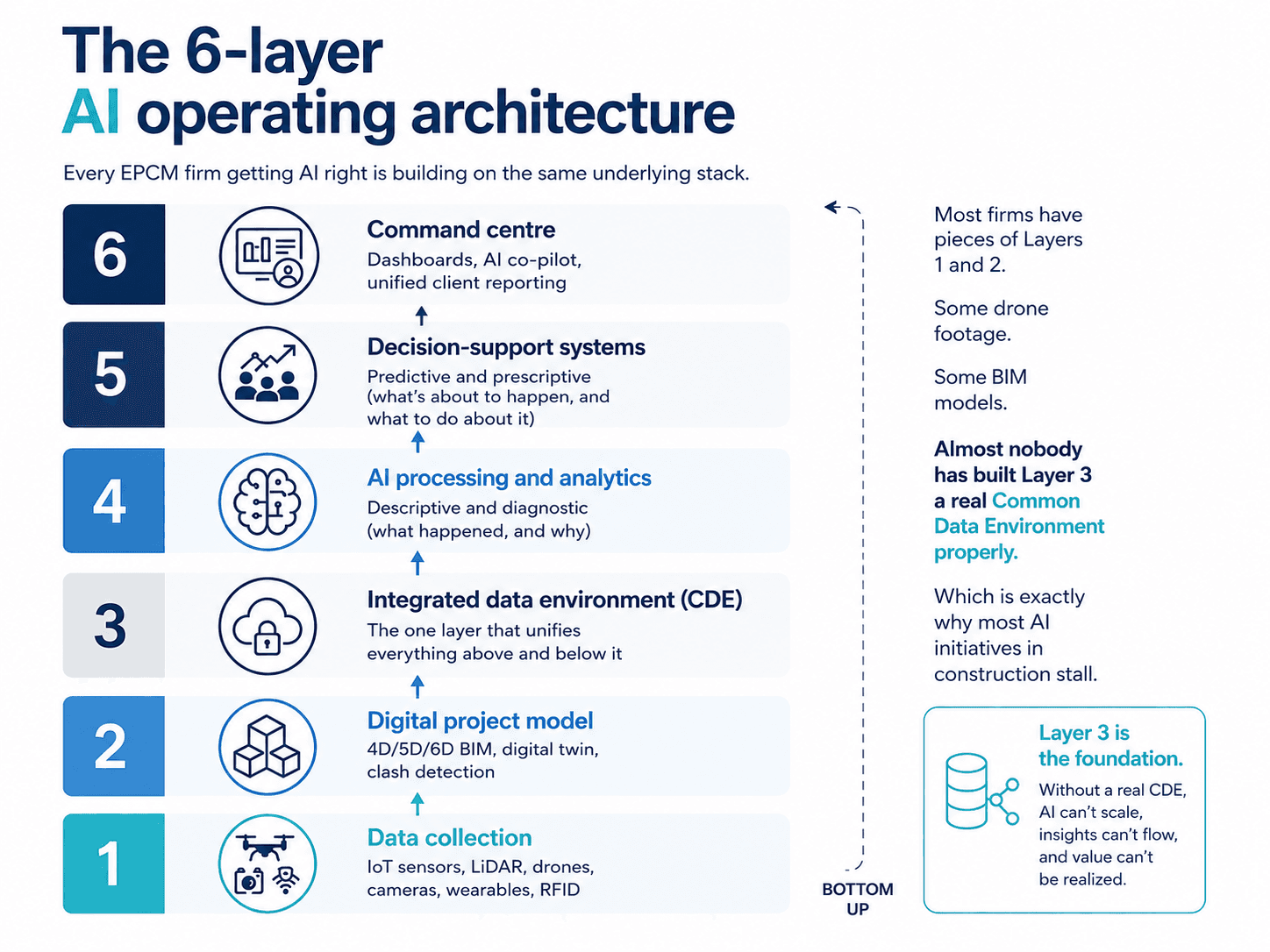
Every EPCM firm getting AI right is building on the same underlying stack. Six layers, bottom up:
Data collection - IoT sensors, LiDAR, drones, cameras, wearables, RFID
Digital project model - 4D/5D/6D BIM, digital twin, clash detection
Integrated data environment (CDE) - the one layer that unifies everything above and below it
AI processing and analytics - descriptive and diagnostic (what happened, and why)
Decision-support systems - predictive and prescriptive (what's about to happen, and what to do about it)
Command centre - dashboards, AI co-pilot, unified client reporting
Most firms have pieces of Layers 1 and 2. Some drone footage. Some BIM models. Almost nobody has built Layer 3 a real Common Data Environment properly. Which is exactly why most AI initiatives in construction stall.
Why Layer 3 is where every firm gets stuck
The Common Data Environment isn't glamorous. It doesn't demo well. It doesn't come with a marketing brochure. But without it, everything above it is trying to learn from fragmented, contradictory, and stale sources. Ask an AI model, "show me every system this equipment change affects," and it can only answer if the data underneath is unified. Otherwise you get confident-sounding nonsense.
The honest reason AI hasn't transformed construction yet is that most firms haven't built Layer 3 properly they're bolting AI onto disconnected data instead of fixing the foundation. It's the least visible investment and the most decisive one.
What AI actually did to the numbers a 2024 field view
A 2024 study of construction and EPCM firms already using AI in production found consistent gains across the metrics that matter to a client:
Metric | Improvement |
|---|---|
Project completion time | −23.7% |
Cost overruns | −50% |
Quality scores | +31.2% |
Safety incidents | −45.8% |
Project managers reporting improved decision-making | 89.3% |
That was 2024 the early days of adoption in this industry. Given how fast the underlying technology has moved in the two years since, the real impact today is almost certainly higher.
The 5-stage roadmap for EPCM firms starting now
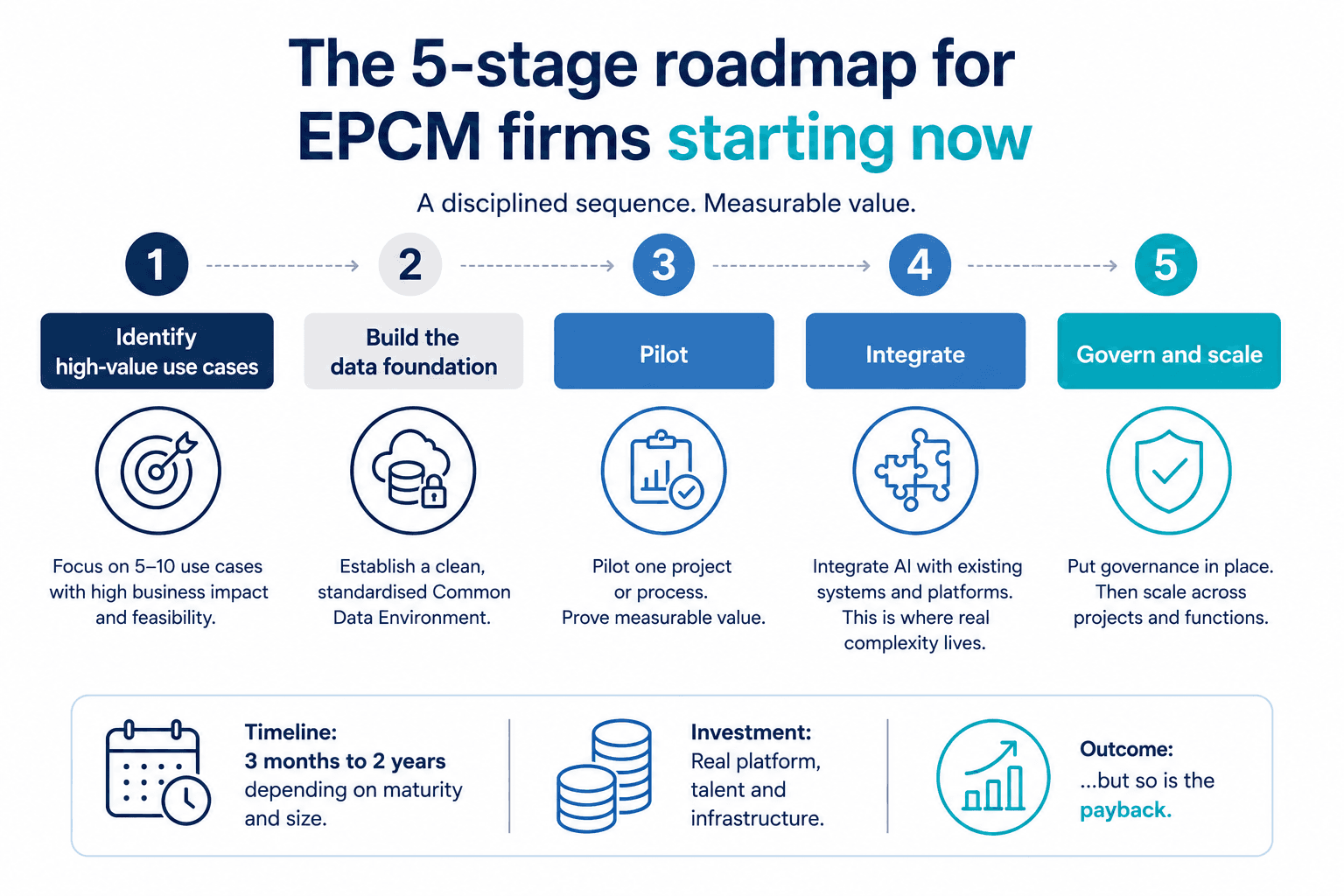
The firms getting this right are not doing everything at once. They follow a disciplined sequence:
Identify high-value use cases - Five to ten, not fifty. Schedule risk prediction. Automated reporting. Document intelligence. Procurement risk flagging. Quality prediction. BIM model intelligence. Pick the ones with business impact and feasibility.
Build the data foundation - Standardise project data, document structures, naming conventions, coding structures, schedules, cost data, BIM information. This is the Common Data Environment. Nothing above works without it.
Pilot - Take one project or one process. Prove measurable value. Choose something important but not catastrophic if it takes longer.
Integrate - Connect the AI layer with the existing ecosystem BIM, CDE, ERP, scheduling, document management, BI platforms. This is where real complexity lives.
Govern and scale - Put governance in place covering data quality, cybersecurity, privacy, model performance, human oversight, accountability. Then roll it out to other projects.
Depending on the firm's size and starting maturity, this cycle runs anywhere from three months to two years. The budget is real platform, talent, infrastructure but so is the payback.
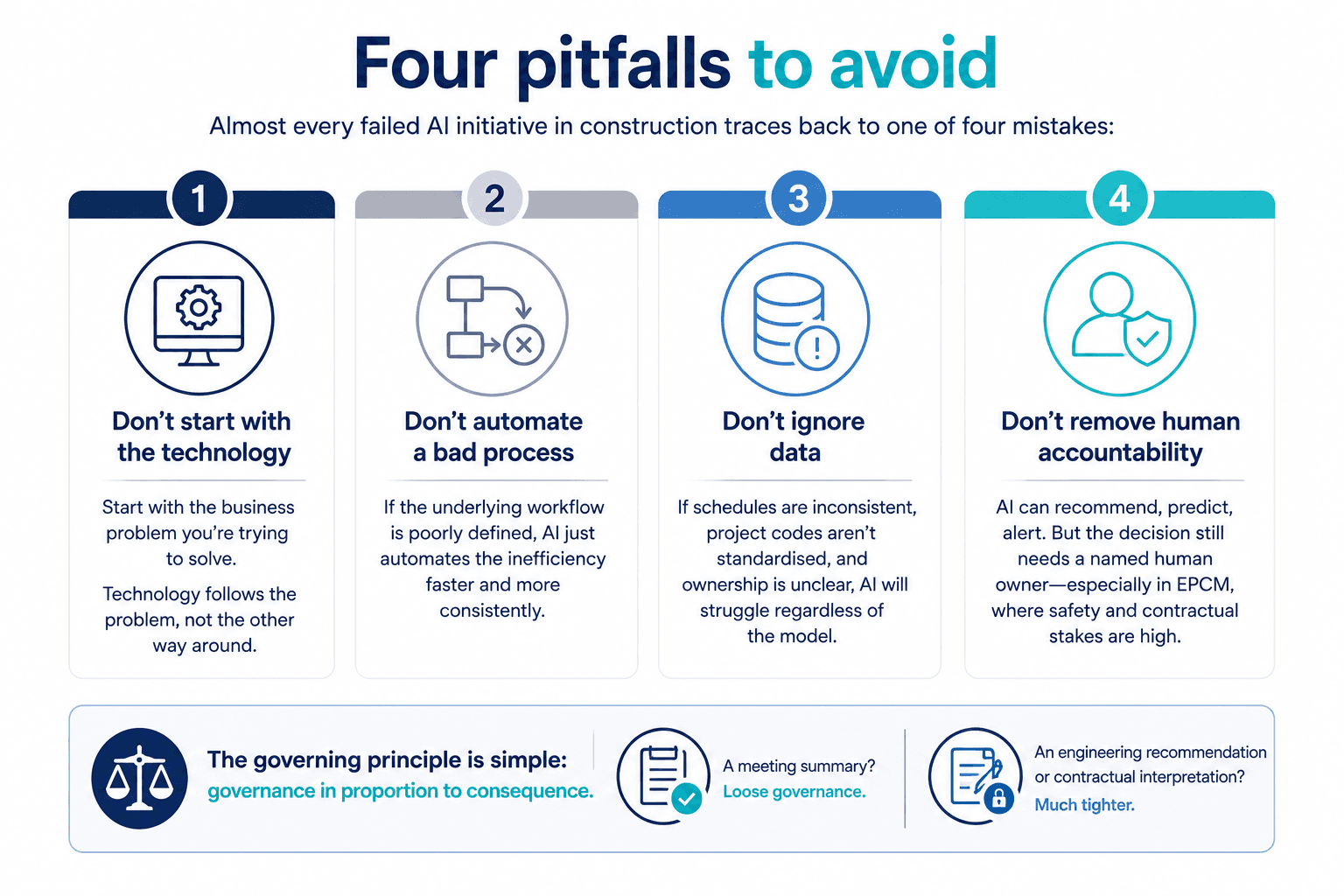
Four pitfalls to avoid
Almost every failed AI initiative in construction traces back to one of four mistakes:
Don't start with the technology - Start with the business problem you're trying to solve. Technology follows the problem, not the other way around.
Don't automate a bad process - If the underlying workflow is poorly defined, AI just automates the inefficiency faster and more consistently.
Don't ignore data - If schedules are inconsistent, project codes aren't standardised, and ownership is unclear, AI will struggle regardless of the model.
Don't remove human accountability - AI can recommend, predict, alert. But the decision still needs a named human owner especially in EPCM, where safety and contractual stakes are high.
The governing principle is simple: governance in proportion to consequence. A meeting summary? Loose governance. An engineering recommendation or contractual interpretation? Much tighter.
The future: human-led, AI-augmented not autonomous
The far horizon isn't a project manager replaced by an algorithm. It's a project manager freed from asking "where's the report?" and spending that time on "what is the project telling us, and what should we decide?"
Projects involve contracts, people, safety, commercial interests, and regulatory requirements. The human stakes are too high for autonomy. The realistic future is human-led, AI-augmented project management where the PM stays accountable and AI becomes the continuous analytical layer supporting them.
The AEC industry will lag consumer tech in AI adoption. That's by design, not by lack of appetite. You want to move carefully when people's safety and firm liability are on the line. The firms that build slowly and get it right will own the market. The firms chasing every AI trend will end up with expensive failures.
The question every EPCM leader is now facing
Don't think of AI as a software investment. Think of it as an operating-model transformation. The organisations that benefit most won't be the ones that buy the most sophisticated tools. They'll be the ones with good processes, reliable data, integrated information systems, strong governance, and people who actually know how to use AI well.
The $112 billion opportunity in India is real. The first-mover window is open right now. The technology exists. The question isn't whether AI belongs in EPCM. It's this: are you going to build this now, or are you going to be playing catch-up in three years?
How Desapex helps
Desapex's Project Management Division helps EPCM firms turn that operating-model shift into a working project intelligence system from picking the right first use cases and building the Common Data Environment, to piloting on a live project, integrating with your BIM/CDE/ERP stack, and putting governance in place to scale across your portfolio.
If you're an EPCM leader trying to figure out where AI actually fits in your firm or you're already partway through and stalled at Layer 3 talk to our team. We'll walk you through what a first stage looks like for a project of your size and where the highest-value wins are hiding in your current process.