


Introduction
A new data centre can take years to move from planning to operational capacity.
Yet the demand driving that capacity is moving much faster.
AI and GPU workloads are increasing rack densities. Utilities are under pressure to provide power. Skilled labour remains constrained. Operators are being asked to bring additional megawatts online faster while maintaining resilience, safety, efficiency and maintainability.
The International Energy Agency estimates that data centres consumed around 415 TWh of electricity in 2024, approximately 1.5% of global electricity consumption, and projects demand to reach approximately 945 TWh by 2030 in its base case.
This changes the question for data centre owners.
It is no longer simply:
How do we build a data centre?
It is:
How do we repeatedly design, manufacture, deploy and commission data centre capacity fast enough to keep up with demand?
One answer is modular data centre design and construction.
But modular does not simply mean putting equipment inside a container.
The real opportunity comes from combining DfMA, BIM, 4D planning, off-site manufacturing, factory acceptance testing, controlled site integration, commissioning and digital handover into one connected delivery system.
What Is a Modular Data Center?
A modular data centre is a facility where one or more functional systems are standardised, manufactured or assembled off site, factory tested, transported as defined units and connected through controlled site interfaces.
It can support enterprise IT, edge computing, colocation, hyperscale cloud and high-density AI workloads.
The important point is that modularity exists on a spectrum.
Level of modularity | Typical examples | What it means |
|---|---|---|
Component | UPS line-ups, CDUs, rack power systems | Individual equipment selections or assemblies are standardised |
Skid | Pump skids, power skids, water-treatment packages | Equipment, pipework and cabling are assembled on structural frames |
Panelised / multi-trade | Corridor racks, busways, cable containment, MEP frames | Multiple trades are combined into repeatable assemblies |
Volumetric | Electrical rooms, battery rooms, chiller modules, data hall pods | Complete enclosed spaces are manufactured off site |
Fully integrated | IT, power, cooling, controls, fire and security | Multiple systems are delivered as a coordinated product |
Hybrid campus | Site-built shell + factory-built infrastructure blocks | Site-specific construction is combined with repeatable modular systems |
For many hyperscale and colocation projects, the hybrid modular data centre approach can provide a practical balance: the building and external works respond to the site, while high-value MEP systems are developed as repeatable capacity blocks.
Why Modular Data Center Construction Matters Now
Four changes are making modular delivery increasingly relevant.
Industry pressure | What is changing | How modularisation can respond |
|---|---|---|
AI & GPU computing | Higher rack densities and more complex cooling requirements | Repeatable power and cooling blocks can support standardised capacity deployment |
Speed-to-capacity | Owners need operational megawatts sooner | Factory production can overlap with site enabling works |
Labour constraints | Skilled site labour remains limited | More controlled fabrication can shift work into specialist manufacturing environments |
Phased investment | Demand may grow in stages rather than all at once | Repeatable capacity blocks allow phased deployment |
The key word is parallel.
Instead of waiting for foundations, utilities and the building to be complete before major equipment work begins, selected systems can be fabricated and tested off site while site works progress simultaneously.
That creates an opportunity to compress the overall programme.
But there is an important qualification:
A factory-built module waiting for grid power is not an accelerated data centre.
The utility energisation date can still control the project completion date.
How Much Faster Is a Modular Data Center?
Published figures should be treated as benchmarks rather than guarantees.
The source guide references supplier-reported research indicating that prefabricated delivery can potentially shorten the time to bring a facility online by up to 30%. Schneider Electric guidance referenced in the document reports potential savings of up to 50% in design and engineering time for pre-designed and pre-integrated subsystems.
However, actual project performance depends on the entire delivery chain.
Factor | Why it matters |
|---|---|
Design freeze | Manufacturing cannot reliably proceed against continuously changing information |
Approvals | Regulatory delays can eliminate schedule gains |
Factory capacity | A module is not faster if manufacturing slots are unavailable |
Long-lead equipment | Switchgear, transformers and other equipment can remain critical-path items |
Transport | Route constraints can affect delivery dates |
Site readiness | Foundations and interfaces must be ready before dispatch |
Grid energisation | Utility availability can remain the controlling milestone |
Commissioning | Factory testing does not replace site and integrated testing |
So the right question is not “Can modular construction save 30%?”
It is:
“Which activities on this specific project can be removed, overlapped or shortened through modularisation?”
The answer should come from an integrated, resource-loaded master schedule not a marketing percentage.
Where Does the Value Actually Come From?
Modular construction creates value through more than direct construction cost.
Value driver | How value is created |
|---|---|
Parallel working | Factory fabrication overlaps with foundations and site enabling works |
Reference design reuse | Validated capacity blocks reduce repetitive engineering |
Earlier testing | Defects can be identified during FAT before site installation |
Reduced field assembly | Fewer site fabrication activities can simplify sequencing |
Repeatable commissioning | Standard test scripts can be reused across identical modules |
Phased capacity | Owners can deploy capacity as demand develops |
Production learning | Repeated manufacturing can improve consistency |
Reduced field rework | Controlled factory conditions can reduce exposure to site congestion and weather |
Earlier revenue capacity | Earlier operational capacity can have significant commercial value |
Standardised lifecycle support | Repeatable modules can simplify spares, training and maintenance |
The business case therefore needs to look beyond capex.
The source guide proposes evaluating:
Installed cost + financing/escalation + risk-adjusted change/rework + logistics + commissioning + operational impact − schedule acceleration value − deferred capital value.
This is important because modularisation also introduces costs that conventional construction estimates may not fully capture.
Potential hidden cost | Example |
|---|---|
Productisation | Engineering and first-of-a-kind development |
Logistics | Freight, route surveys and abnormal-load permits |
Site handling | Cranes, rigging and laydown areas |
Cross-border delivery | Duties, taxes and currency exposure |
Storage | Temporary storage and preservation |
Certification | Local certification or duplicated testing |
Interface remediation | Correcting civil-to-module tolerance issues |
Late changes | Rework after factory release |
Vendor dependency | Proprietary interfaces and lock-in |
The strongest business case may therefore be schedule certainty and earlier capacity, rather than simply lower capital expenditure.
What Can Be Modularised in a Data Center?
Not every part of a data centre should be modularised.
The best candidates are usually systems that are repeatable, highly engineered and capable of being manufactured and tested under controlled conditions.
System | Typical modular form | Critical design considerations |
|---|---|---|
MV/LV electrical distribution | E-house, switchgear room, power skid | Protection, arc flash, earthing, cable entry, fire rating |
UPS & batteries | UPS skid, enclosed power module | Runtime, battery chemistry, ventilation, fire protection, replacement |
Generators | Generator package, controls module, day-tank skid | Fuel autonomy, emissions, vibration, acoustics, synchronisation |
Cooling generation | Chiller module, heat-rejection module | Ambient conditions, redundancy, water quality, heat recovery |
Cooling distribution | Pump skid, CDU, water-treatment skid | Hydraulic separation, pressure, filtration, leak detection |
Liquid cooling | CDU and manifold modules | Rack density, supply temperature, water chemistry, condensation |
Data halls | Pod, container, volumetric room | Rack density, airflow, fire, egress, security, cable topology |
MEP corridors | Multi-trade racks, service modules | Tolerances, lifting, fire stopping, connection accessibility |
Controls | BMS/EPMS/DCIM module | Point naming, network architecture, cybersecurity, alarms |
Fire protection | Pump skid, valve/pre-action package | Authority approval, hydraulic calculations, fire-water interface |
Security/network | Prefabricated room or rack module | Access control, telecom interfaces, resilience and data retention |
Operations | Modular NOC, workshop or spares room | Maintainability, secure access and future expansion |
Elements such as earthworks, foundations, below-ground utilities and the main structural shell often remain site-built because they depend heavily on ground conditions, planning constraints and site geometry.
However, they still need to be digitally coordinated against the modular interface model.
The Engineering Challenge: Interfaces
This is where modular data centre projects can become complicated.
A module does not exist independently.
It connects to foundations, structure, electrical systems, pipework, fire protection, controls, networks and operational systems.
Consider a simple module-to-site connection.
A few millimetres of tolerance may sound insignificant during design.
At installation, however, that tolerance can affect:
Alignment
Cable termination
Pipe connections
Fire stopping
Equipment access
Testing
Commissioning
That is why the source SOP recommends a single interface register, where every physical, functional and data interface has an owner, acceptance criterion and due date.
An Interface Control Document should capture:
Interface parameter | What needs to be controlled |
|---|---|
Geometry | Dimensions, datum and tolerances |
Structural | Loads, moments and anchorage |
Electrical | Voltage, fault level, protection and earthing |
Mechanical | Flow, pressure, temperature and fluid quality |
Fire | Fire rating and penetration treatment |
Digital | Protocols, point lists, naming and cybersecurity boundaries |
Responsibility | Factory-side vs site-side ownership |
Testing | Method and acceptance evidence |
Modularisation therefore turns interface management into an engineering discipline.
DfMA: Designing the Data Center as a Repeatable Product
Traditional design often focuses on making systems work within a building.
Modular design adds another question:
Can the system be manufactured, transported, lifted, installed, tested, maintained and eventually replaced?
That is the role of Design for Manufacture and Assembly (DfMA).
A modular capacity block needs a defined:
System boundary
Module size
Configuration
Standard component set
Variant strategy
Lifting method
Transport envelope
Replacement route
Maintenance clearance
Future interface
The SOP recommends creating a product breakdown structure, configuration matrix, module data sheets and Interface Control Documents before freezing the reference architecture.
This is what transforms modularisation from prefabrication into productisation.
BIM + 4D Planning: Connecting Design to Delivery
A 3D BIM model tells the project team what is being built.
A 4D BIM model adds when it will be built.
For modular data centre construction, that distinction is significant.
The model can connect design objects with:
Procurement → Manufacturing → Transport → Crane setup → Installation → Hook-up → Testing → Energisation → Commissioning
The resulting 4D environment allows teams to rehearse the sequence before physical work begins.
Imagine this scenario
A 4 MW power and cooling module has passed factory testing.
It is ready for shipment.
The team now needs to know:
Can it physically reach the site?
The answer depends on more than the module itself.
The project team needs to understand the transport route, crane position, laydown area, foundation readiness, connection points and installation sequence.
A 4D model can bring these elements together before the module arrives.
That changes BIM from a design coordination tool into a construction planning and risk-management tool.
The 15-Stage SOP for Modular Data Center Design and Construction
The source document provides an owner-side governance framework covering the entire modular data centre lifecycle.
Stage | Core activity | Primary output | Decision gate |
|---|---|---|---|
0. Business requirement | Define workload, capacity, rack density, availability, sustainability and budget | OPR, capacity roadmap | Approve business assumptions |
1. Site & utility due diligence | Validate land, grid, fibre, water, climate, logistics and permits | Technical due diligence + constraints model | Confirm delivery feasibility |
2. Delivery strategy | Compare conventional, hybrid and prefabricated options | Option study + risk-adjusted cost plan | Select modularisation strategy |
3. Basis of Design | Define electrical, cooling, redundancy, water, fire, controls and expansion | BoD + system diagrams | Independent design review |
4. Productise capacity block | Define repeatable MW block, dimensions, variants and interfaces | Product breakdown + ICDs | Freeze reference architecture |
5. Digital information management | Establish EIR/AIR, BEP, CDE, naming, revision and asset-data rules | ISO 19650-aligned information plan | Approve information protocol |
6. Procurement | Prequalify manufacturers and evaluate performance, quality, certification and integration | Tender package + responsibility matrix | Resolve interface/certification gaps |
7. Detailed design | Coordinate architecture, structure, MEP, fire, controls, ICT and security | Manufacturing/construction models | Release for manufacture |
8. 4D manufacturing & installation | Link BIM to procurement, production, transport, lifting and installation | 4D model + logistics plan | Constructability review |
9. Manufacturing | Execute fabrication under project quality controls | ITPs + manufacturing records | Confirm baseline configuration |
10. FAT | Test visual, dimensional, electrical, mechanical, controls and functional performance | FAT results + release certificate | No critical open items |
11. Site enabling works | Build foundations, utilities, roads, drainage, fibre and fire infrastructure | Readiness checklist + surveys | Verify interfaces |
12. Delivery & installation | Transport, lift, align, connect, seal, bond and preserve | Installation QA + updated model | Safe-to-energise review |
13. SAT & integrated commissioning | Test installed systems and facility-level failure/recovery sequences | SAT + commissioning records | Owner/commissioning acceptance |
14. Digital handover | Validate as-built model, assets, warranties, settings and O&M data | Asset information model + digital twin dataset | Accept operational information |
15. Operate & replicate | Monitor performance and feed lessons into the reference design | Updated reference design | Approve next module/version |
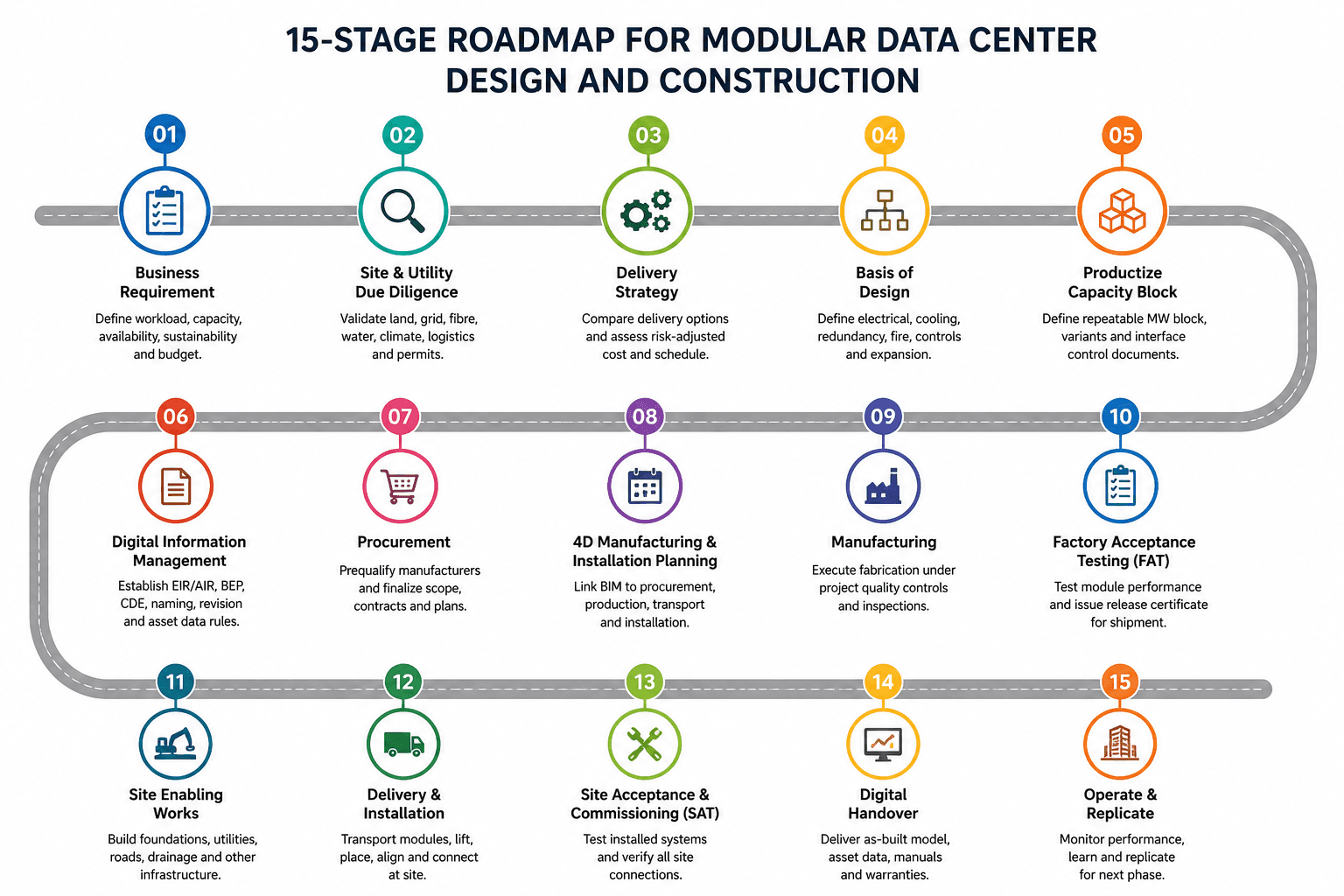
This is the central idea of the SOP:
The modular data centre should be governed as one connected lifecycle not as separate design, factory and construction activities.
FAT vs SAT vs Integrated Systems Testing
Factory testing is one of the major benefits of modular delivery, but it does not eliminate site testing.
Test stage | What it proves | Typical examples |
|---|---|---|
Factory inspection | Workmanship and configuration | Dimensions, labels, coatings, fire seals, certificates |
Component testing | Individual equipment operation | UPS, breakers, pumps, valves, sensors, CDUs |
FAT | Module-level functional performance | Controls, alarms, interlocks, simulated utility loss |
SAT | Installed condition and site interfaces | Phasing, insulation, pressure testing, flushing, communications |
System functional testing | System-level performance | Cooling staging, UPS modes, generator sequence, fire cause-and-effect |
Integrated Systems Testing | Whole-facility response | Utility loss, equipment failure, redundant-path isolation, recovery |
The distinction is fundamental:
FAT proves the manufactured module.
SAT proves the installed module.
Integrated Systems Testing proves how the facility behaves as a system.
A 12 MW Modular Data Center Scenario
Consider an illustrative colocation campus with an ultimate 12 MW IT load, delivered through three 4 MW capacity blocks.
The owner could compare three approaches:
Option | Delivery strategy | Characteristics |
|---|---|---|
A — Conventional | Primarily site-built | Bespoke plant and data halls |
B — Hybrid modular | Site-built shell + repeatable infrastructure | 4 MW electrical and cooling modules |
C — Highly prefabricated | Integrated modules | Power, cooling and IT delivered as coordinated units |
For the hybrid option, the project sequence could be:
4 MW reference block → Long-lead procurement → Site enabling works → Factory fabrication → Interface verification → FAT → 4D logistics rehearsal → Delivery → Installation → SAT → Integrated commissioning → Digital handover → Phase 2 replication
The important point is that the project team should not simply assume that modularisation makes the project “30% faster”.
The schedule needs to determine what actually controls completion:
Manufacturing
Grid energisation
Permits
Long-lead equipment
Site integration
Commissioning
The source document explicitly positions this as an illustrative scenario, not a measured project result.
When Is Modular Construction the Right Choice?
Modular construction is particularly suited to projects where repeatability and schedule acceleration have measurable value.
Strong candidate | Warning sign |
|---|---|
Repeatable hyperscale capacity blocks | IT load is not sufficiently defined |
Colocation expansion | Cooling strategy is still changing |
Remote or labour-constrained sites | Utility capacity is uncertain |
Brownfield expansion | Only one module will ever be built |
Edge data centre networks | Transport geometry is unsuitable |
High-density AI deployments | Site cannot accommodate lifting/staging |
Multi-country replication | Local codes require major redesign |
Programmes with phased capacity | Owner expects extensive changes after design freeze |
The most important consideration is not whether modular construction is technically possible.
It is whether productisation, logistics and integration create more value than they cost.
Regional Modular Data Center Design: Europe, USA and India
A global reference design is valuable only when it is deliberately localised.
Region | Key considerations | Modular design implications |
|---|---|---|
Europe | ISO/IEC 22237, EN 50600, IEC standards, local building/fire requirements, sustainability reporting | Metering, asset information and environmental performance need early consideration |
Nordics | Snow, ice, low ambient temperatures, free cooling, heat recovery, winter logistics | Freeze protection, low-load operation and severe-weather maintainability become important |
USA | State/local AHJ, NEC/NFPA, ASHRAE, UL/NRTL, seismic/wind, utility requirements | Factory-built assemblies may require specific listings, field evaluation or AHJ acceptance |
India | NBC, BIS/IEC, CEA, fire authorities, electrical approvals, environmental requirements | Heat, monsoon, flooding, water availability, grid stability and local logistics affect design |
The source guide emphasises that global modularisation should not mean copying the same module unchanged between countries. Codes, climate, utility practices, transport and operating conditions need to be localised.
A Digital-First Modular Data Center
The most effective modular data centre projects connect physical delivery with digital information from the beginning.
The workflow becomes:
Strategy
Define capacity, business requirements and delivery objectives.
↓
Digital Engineering
Develop BIM, DfMA and coordinated MEP systems.
↓
Productisation
Define the repeatable capacity block and its interfaces.
↓
4D Planning
Connect the model with manufacturing, logistics and installation.
↓
Manufacturing
Build against the approved digital baseline.
↓
FAT
Capture test results and configuration digitally.
↓
Site Integration
Verify physical interfaces through survey and reality capture.
↓
SAT + IST
Validate installed and integrated performance.
↓
Digital Handover
Connect verified asset information to operational systems.
↓
Digital Twin
Use operational information to support lifecycle management and future replication.
The source guide describes this approach as a way of moving from isolated modules towards a coordinated, operable facility.

What Should Be Included in Digital Handover?
A modular data centre generates a large amount of information before it becomes operational.
The handover should therefore be treated as an asset information acceptance process, rather than simply a document submission.
Information | Why it matters |
|---|---|
Verified as-built model | Represents actual installed conditions |
Asset IDs and tags | Enables asset tracking |
Manufacturer/model | Supports maintenance and replacement |
Serial numbers | Provides equipment traceability |
Warranties | Supports lifecycle management |
Test certificates | Provides performance evidence |
Commissioning records | Documents system acceptance |
Settings | Supports operational configuration |
Cause-and-effect | Supports system response understanding |
O&M information | Enables maintenance |
Spares | Supports operational readiness |
Training records | Supports operator capability |
Software/firmware versions | Controls digital configuration |
Approved deviations | Preserves the final project baseline |
This information can then support CMMS, DCIM and digital twin applications.
How Should You Select a Modular Data Center Partner?
A modular data centre partner should be evaluated as both a product manufacturer and systems-integration partner.
Evaluation area | Question to ask |
|---|---|
Reference design | What is standardised and what can vary? |
Configuration control | Who owns the baseline and revision process? |
Systems integration | Who owns performance across module/site interfaces? |
Factory capability | Can you demonstrate QA, ITPs, traceability and FAT capability? |
Local compliance | Who manages code localisation, listings, permits and AHJ engagement? |
4D & logistics | Can you prove transport, lifting, installation and maintenance feasibility? |
Commissioning | Are FAT, SAT and IST part of one commissioning strategy? |
Data interoperability | Will the owner receive usable BIM and asset information? |
Lifecycle support | Are spares, training, warranties, firmware and cybersecurity addressed? |
Commercial transparency | Are freight, craneage, certification and retesting included? |
Global-to-local capability | Can the reference design be adapted for Europe, USA or India? |
The source also identifies several red flags: undefined interfaces, generic claims of code compliance, component-only FAT, no transport study, poor maintenance access, uncontrolled software versions and a handover process that starts only after commissioning.
The Future: From Modular Buildings to Repeatable Capacity Platforms
The next evolution of modular data centre construction is unlikely to be about simply building more containers.
It will be about creating repeatable, configurable capacity platforms.
AI infrastructure is already pushing designers towards higher rack densities and more complex thermal-management strategies.
That means future modular reference designs need enough flexibility to accommodate:
Liquid cooling
Direct-to-chip cooling
Higher electrical densities
Changing server generations
New control requirements
Different rack-density configurations
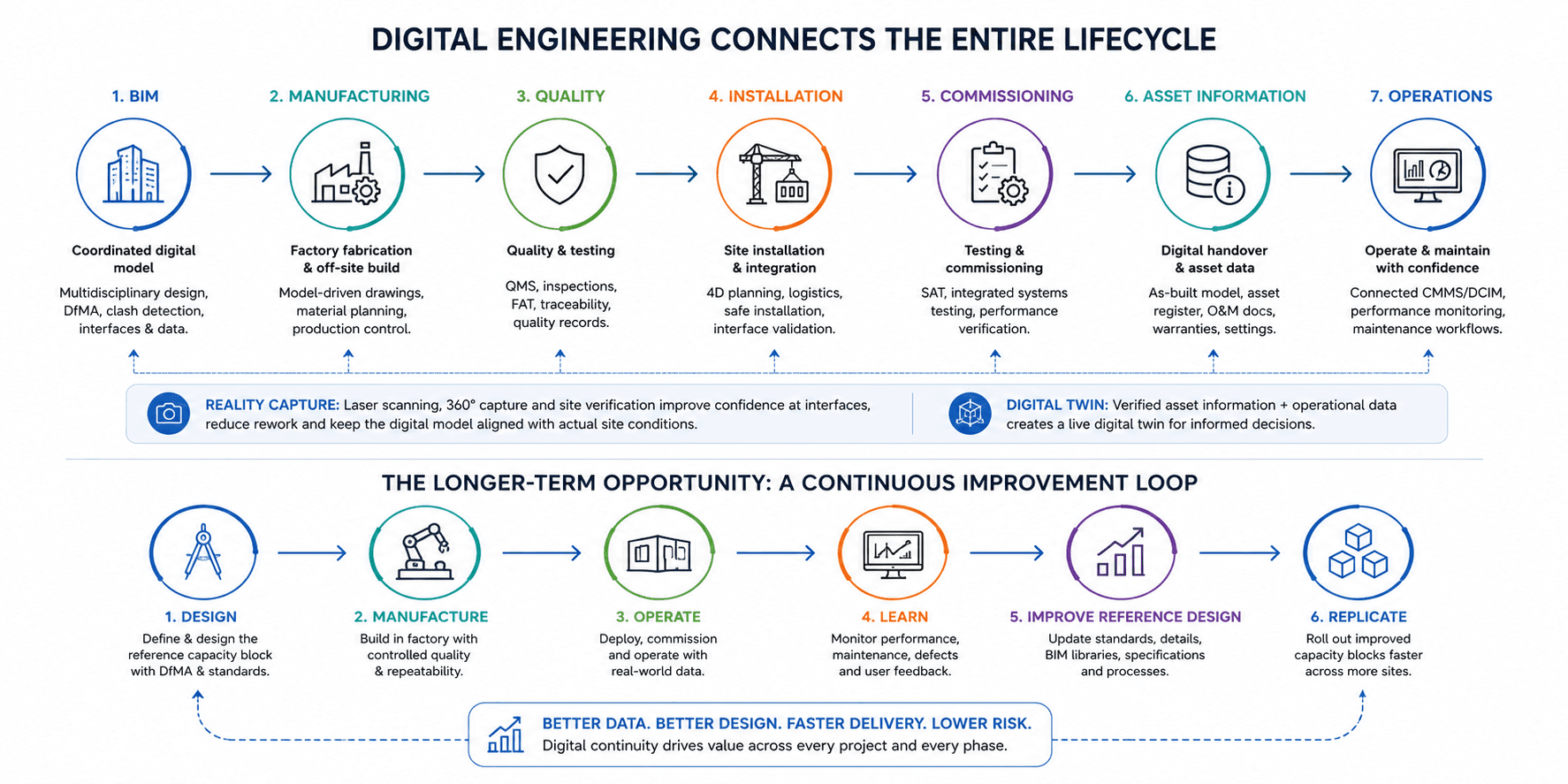
At the same time, digital engineering can connect:
BIM → Manufacturing → Quality → Installation → Commissioning → Asset Information → Operations
Reality capture can improve confidence at site interfaces, particularly in brownfield environments, while digital twins can connect verified asset information with operational data.
The longer-term opportunity is therefore a feedback loop:
Design → Manufacture → Operate → Learn → Improve Reference Design → Replicate
Conclusion: Modular Is a Delivery System, Not a Product Catalogue
A modular data centre is not simply a collection of prefabricated rooms.
Its success depends on what happens between the modules.
The foundation must align with the module.
The electrical and mechanical connections must work.
The transport route must be feasible.
The crane must reach the installation position.
The factory configuration must match the approved design.
The FAT evidence must connect to commissioning.
The as-built information must reach the operator.
And the next capacity block must be able to learn from the previous one.
That is why the strongest modular data centre strategies start with the business requirement and end with usable operational information.
The real question for data centre owners is therefore not:
“Should we build modular?”
It is:
“Which parts of our data centre can become repeatable, digitally controlled capacity blocks—and what delivery system will allow us to deploy them reliably?”
That is where modular data centre design and construction moves beyond prefabrication.
It becomes a strategy for speed, scalability, repeatability and lifecycle-ready digital delivery.
How Desapex Supports Modular Data Center Delivery
Desapex brings together data centre engineering, BIM, DfMA, 4D planning, reality capture, commissioning information and digital handover to support modular data centre delivery.
Its capabilities span:
Project stage | Desapex capability |
|---|---|
Strategy | Technical due diligence, capacity planning, modularisation studies |
Design | Mission-critical MEP design, multidisciplinary BIM, DfMA |
Information management | ISO 19650-aligned CDE and information workflows |
Coordination | Federated BIM, clash detection, constructability |
Planning | 4D BIM, logistics and installation simulation |
Cost & controls | 5D BIM and project controls where project data supports it |
Site verification | Reality capture, Scan-to-BIM and field verification |
Commissioning | FAT/SAT and integrated testing information coordination |
Handover | Asset information, O&M data and digital handover |
Operations | CMMS/DCIM integration and Autodesk Tandem-enabled digital twin implementation |
Desapex's ISO 19650 capability has been independently recognised through the BSI Kitemark process, supporting structured information exchange across owners, manufacturers, consultants, contractors and operators.
Planning a modular data centre?
Talk to Desapex about a modularisation study, digital-first data centre engineering and a scalable delivery strategy for your next project.