



Introduction
The race to build digital infrastructure has never been more intense.
Artificial Intelligence, cloud computing, hyperscale platforms and enterprise digital transformation are driving unprecedented demand for data centres across the world. What once took three to four years to deliver is now expected in as little as 18 months or even less.
For developers, investors and project teams, this shift isn't simply about accelerating construction. It's about completely rethinking how projects are planned, designed, procured and delivered.
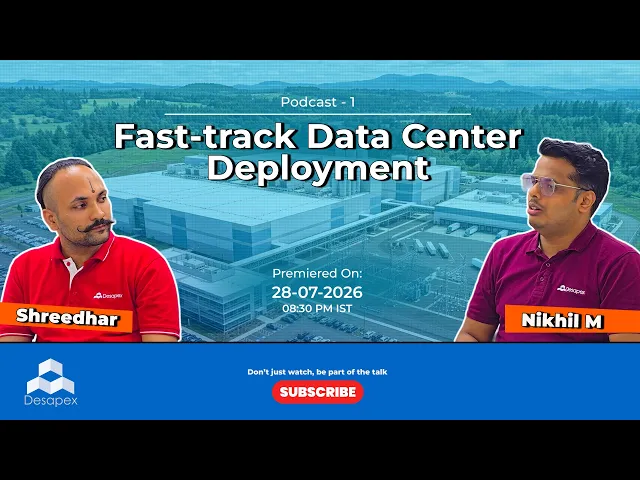
Fast-track data centre deployment has become a business necessity, but achieving aggressive timelines without increasing project risk requires far more than working faster. It demands better collaboration, smarter engineering and digital-first project delivery. These insights are drawn from Desapex experts discussing real-world experiences in delivering fast-track data centre projects.
The Challenge: Why Speed Alone Isn't Enough
Imagine investing hundreds of millions into a hyperscale data centre.
Every month of delay means:
Lost revenue opportunities
Delayed AI infrastructure deployment
Increased financing costs
Extended procurement timelines
Competitive disadvantage
Now imagine trying to compress a traditional 36–48 month construction programme into just 18 months.
Many organisations assume the solution is simple:
"Work faster."
In reality, that's where projects begin to fail.
Why Fast-Track Data Centre Delivery Matters More Than Ever
The rapid growth of AI applications has fundamentally changed the infrastructure landscape.
Every AI model, cloud application, streaming platform and enterprise workload relies on massive computational power. As demand for these digital services continues to grow, organisations need data centres operational much sooner than ever before.
The challenge extends beyond AI alone. Increasing data localisation regulations require organisations to store information within national borders, accelerating the need for local data centre capacity. India, with its growing digital economy and expanding internet population, has become one of the world's fastest-growing markets for hyperscale facilities, attracting major global cloud providers.
The Real Problem: Fast-Track Doesn't Mean Cutting Corners
One of the biggest misconceptions in the industry is that fast-track delivery simply means reducing project durations.
In reality, successful fast-track deployment is about running multiple critical activities in parallel.
Instead of following a traditional linear sequence:
Design → Procurement → Construction
Modern projects overlap these phases:
Design progresses while procurement begins.
Construction starts on approved packages while detailed engineering continues.
Site preparation advances alongside equipment manufacturing.
Commissioning planning starts long before construction is complete.
This parallel execution significantly reduces delivery time without sacrificing engineering quality provided decision-making keeps pace. As highlighted by the Desapex experts, owners must also be prepared to make decisions quickly enough to support accelerated delivery.
Story from the Field: The Cost of Slow Decisions
During fast-track projects, engineering teams often complete designs on schedule.
The real bottleneck is frequently client decision-making.
Equipment selections.
Power capacities.
Cooling strategies.
Design approvals.
Every delayed decision creates a ripple effect across procurement, fabrication and construction.
Fast-track projects succeed when both project teams and owners commit to rapid, informed decision-making.
Why Traditional Construction Models No Longer Work
Traditional project delivery assumes that every design detail is finalised before procurement begins.
That model is increasingly incompatible with modern data centre programmes.
Today's projects face:
Longer equipment lead times
Higher rack densities
Increasing power requirements
Greater cooling demands
Rapid technology evolution
Continuous client changes
By the time a conventional project reaches completion, portions of the original design may already require updating to accommodate newer technologies. The podcast notes how AI hardware evolves so quickly that design assumptions can become outdated within a project lifecycle.
Modular Construction Is Reshaping Data Centre Delivery
One of the strongest themes from the discussion is the growing role of modular and prefabricated construction.
Rather than assembling every component on-site, entire systems can be manufactured in controlled factory environments before arriving ready for installation.
Benefits include:
Shorter construction schedules
Improved quality control
Reduced site labour
Fewer installation errors
Better safety
Predictable project timelines
The experts also shared examples from Finland, where existing warehouses are repurposed and fitted with containerised data centre modules, dramatically reducing construction time while leveraging existing infrastructure.
BIM Is No Longer Optional It's the Foundation of Fast Delivery
Many organisations still associate Building Information Modelling (BIM) with 3D visualisation.
That view significantly underestimates its value.
For fast-track data centres, BIM becomes the single source of truth across the project lifecycle.
It enables:
Multi-disciplinary design coordination
Clash detection before construction
Construction sequencing
Procurement planning
Change management
Risk identification
Digital handover
Operational readiness
One memorable anecdote from the podcast captures a common misconception: a client questioned the need for BIM by saying, "The Taj Mahal was built without BIM." The experts responded by emphasising that the question today is no longer whether BIM should be used, but how effectively it can be applied to reduce risk and improve outcomes.
Real Project Scenario: Preventing Rework Before It Happens
Consider a contractor increasing the size of an electrical panel during execution.
That seemingly small modification may affect:
Cable routes
Structural openings
Mechanical services
Ceiling space
Installation sequencing
Without coordinated BIM workflows, these changes often lead to expensive site rework.
Using federated BIM models, teams can detect conflicts digitally, resolve them collaboratively and issue updated information before construction is affected. According to the panel, this coordination is carried out area by area, enabling execution to continue with fewer interruptions.
Integrated Project Delivery: Bringing Construction into Design
One recurring recommendation from the discussion is involving execution teams much earlier in the project lifecycle.
Rather than separating design and construction, Integrated Project Delivery (IPD) encourages collaboration between:
Designers
Engineers
Contractors
Procurement specialists
Owners
Operations teams
This approach ensures that construction realities inform engineering decisions from the outset, reducing redesign, minimising rework and improving manufacturability. The speakers identify IPD as a practical way to address many of the coordination challenges seen in fast-track programmes.
Supply Chain Has Become the New Critical Path
Fast-track delivery depends not only on engineering but also on securing long-lead equipment.
Critical components such as:
Transformers
Batteries
Switchgear
Cables
Cooling systems
IT infrastructure
often require months or even years for manufacturing and delivery.
This means procurement planning must begin much earlier than in conventional construction, with project management closely aligned to supplier capabilities.
Actionable Strategies for Data Centre Developers
Organisations looking to accelerate delivery should consider the following:
Plan infrastructure before the building
Assess power availability, substations and water infrastructure early.
Front-load critical decisions
Lock major design decisions before fabrication begins.
Use BIM as a project management platform
Move beyond visualisation and use BIM for coordination, planning and lifecycle management.
Adopt modular construction where feasible
Reduce on-site work through prefabricated systems.
Integrate project teams from day one
Align design, procurement and construction teams through Integrated Project Delivery.
Digitise operations early
Prepare for Digital Twin implementation during design not after handover.
These recommendations closely reflect the themes repeatedly emphasised throughout the podcast discussion.
Looking Ahead: The Future of Fast-Track Data Centres
The next five years promise even greater transformation.
Emerging trends include:
AI-driven infrastructure planning
Liquid cooling technologies
Ultra-high-density server racks
Containerised data centres
Edge computing
Advanced Digital Twins
Greater emphasis on power and water planning
Exploration of alternative energy sources
As the experts observed, technology is evolving so quickly that predicting the future of data centres is increasingly difficult. Flexibility and future-ready planning will become defining characteristics of successful projects.
Conclusion
Fast-track data centre deployment is not about compressing schedules at the expense of quality.
It is about transforming the way projects are delivered.
By combining early decision-making, Integrated Project Delivery, modular construction, BIM-enabled collaboration and digital lifecycle management, organisations can reduce risk while meeting the growing demand for AI-ready infrastructure.
In an industry where technology evolves faster than traditional construction cycles, the ability to deliver intelligently not just quickly will determine long-term success.
How Desapex Helps Deliver Fast-Track Data Centres
At Desapex, we help developers, hyperscalers and enterprise organisations accelerate data centre delivery through integrated digital engineering solutions.
Our expertise includes:
Data Centre Design & Engineering
Site Selection & Feasibility Assessment
BIM & Digital Engineering
Integrated Project Delivery Support
Construction Planning & Coordination
Digital Twin Implementation
Asset Information Management
Operations & Maintenance Enablement
Whether you're planning a greenfield hyperscale campus or upgrading an existing facility, our multidisciplinary teams help reduce delivery risk while enabling faster, smarter and more predictable project outcomes.
Ready to accelerate your next data centre project? Connect with Desapex to explore how digital engineering can help you deliver with confidence.