Webinar
Inside the Data Center
Discover the structural engineering behind the mission-critical digital world.
Friday, 30 Oct 2026
11:30 AM CET | 4:00 PM IST



Every year, priceless works of art are quietly destroyed not by thieves, fires, or vandals, but by something far more ordinary: the air around them. A humidity swing cracks a 500-year-old wood panel. A warm, crowded gallery accelerates the fading of irreplaceable pigments. Mold blooms across a canvas in a single humid week. Uncontrolled environments remain one of the leading causes of long-term damage to cultural heritage worldwide.
The world's great museums learned this lesson the hard way and their answer was some of the most demanding HVAC engineering on the planet. Behind the walls of the Louvre and the Vatican, a two-degree temperature swing is treated as an emergency, and humidity is monitored with the seriousness of a hospital operating theatre. This is the story of how climate control became the invisible bodyguard of human civilization's greatest treasures and what every engineering-minded organization can learn from it.
A two-degree swing is an inconvenience in an office. In a museum, it's an emergency.
Why This Matters
This isn't just a museum story. The same physics that destroys a Renaissance painting also degrades pharmaceutical stock, corrodes data-center hardware, warps precision manufacturing tolerances, and ruins archived documents. Museums simply face the problem in its most extreme form: their “product” is irreplaceable, their buildings are often centuries old, and their environments are flooded daily with thousands of heat- and moisture-emitting visitors.
That makes museum HVAC the ultimate proving ground. The techniques pioneered to protect the Mona Lisa microclimates, predictive controls, stability-first design are now shaping how forward-thinking companies protect anything sensitive to its environment.
The Core Problem: Why Air Is the Enemy of Art
Most people assume the biggest threats to a 500-year-old painting are theft, fire, or vandalism. In reality, the slowest and most relentless destroyer of art is ordinary air behaving badly through three mechanisms.

Humidity is threat number one
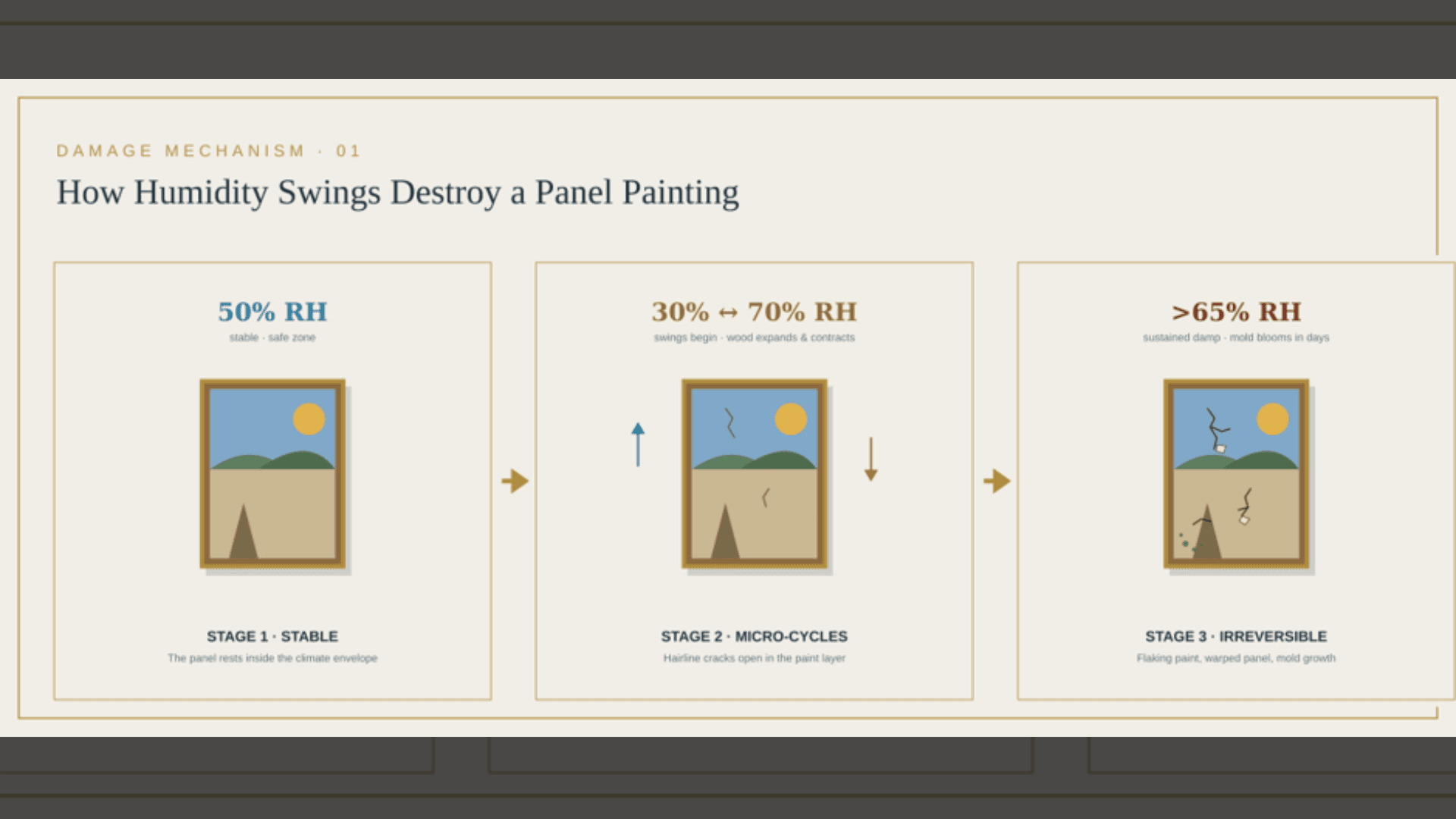
Wood panels, canvas, parchment, and ivory are hygroscopic they absorb and release moisture as the surrounding air changes. When relative humidity (RH) rises and falls repeatedly, these materials expand and contract in endless micro-cycles. Over years, paint cracks and flakes, wood panels warp, and varnish layers separate. Above roughly 65–70% RH, mold can bloom across a canvas in days; very low humidity makes organic materials brittle enough to crack under their own tension.
Temperature works as an accelerant
Chemical degradation the yellowing of varnish, the fading of pigments, the breakdown of paper follows the rules of chemistry: reaction rates increase as temperature rises. A manuscript stored at 25°C deteriorates measurably faster than one stored at 18°C. Temperature swings also drive humidity swings, because warm air holds more moisture than cool air.

Airborne pollutants finish the job
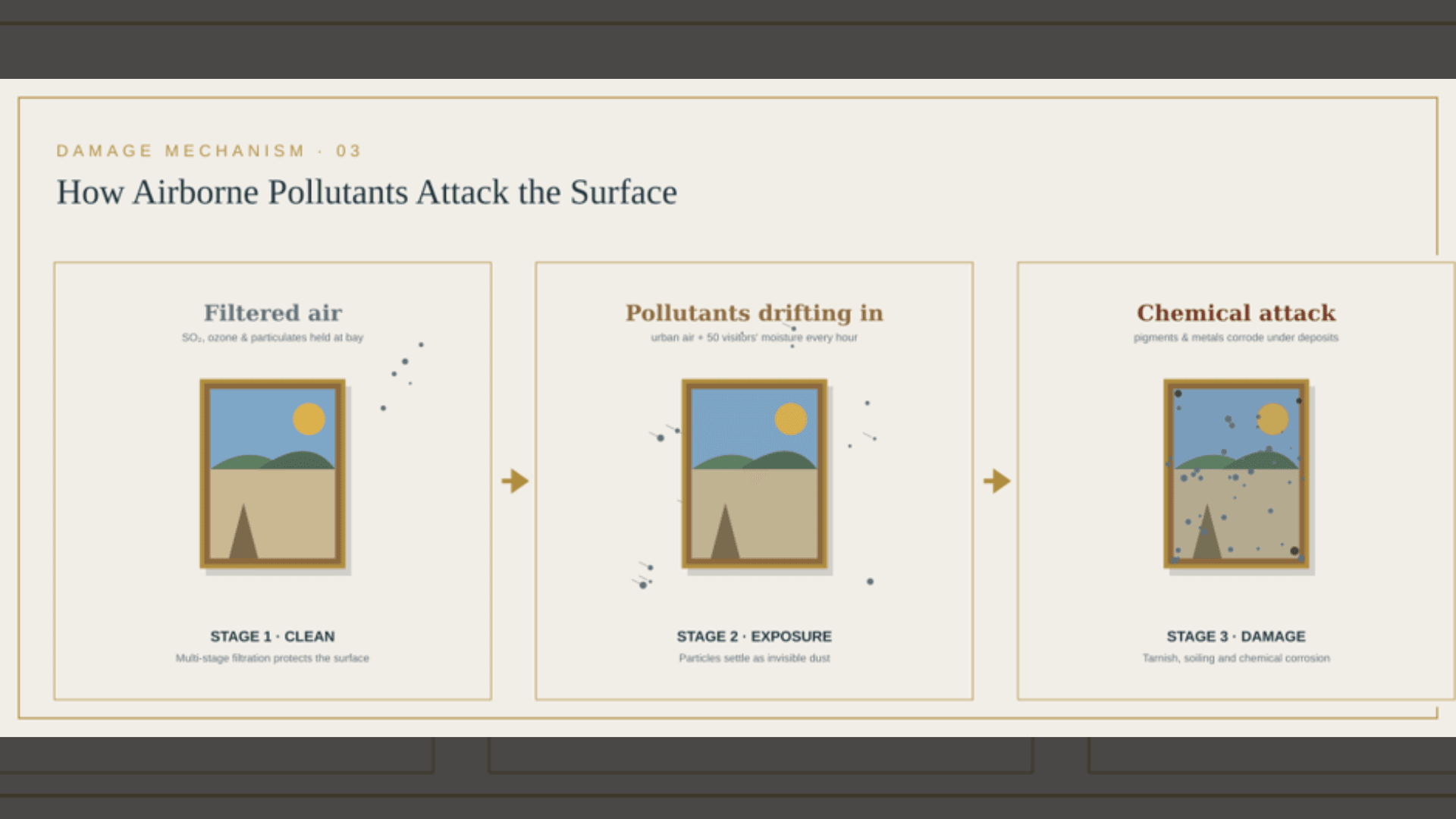
Sulfur dioxide, ozone, and fine particulates from city air chemically attack pigments and metals. Even visitors are a pollution source every human exhales water vapor, carbon dioxide, and heat. A single tour group of fifty people releases liters of moisture into a gallery every hour.
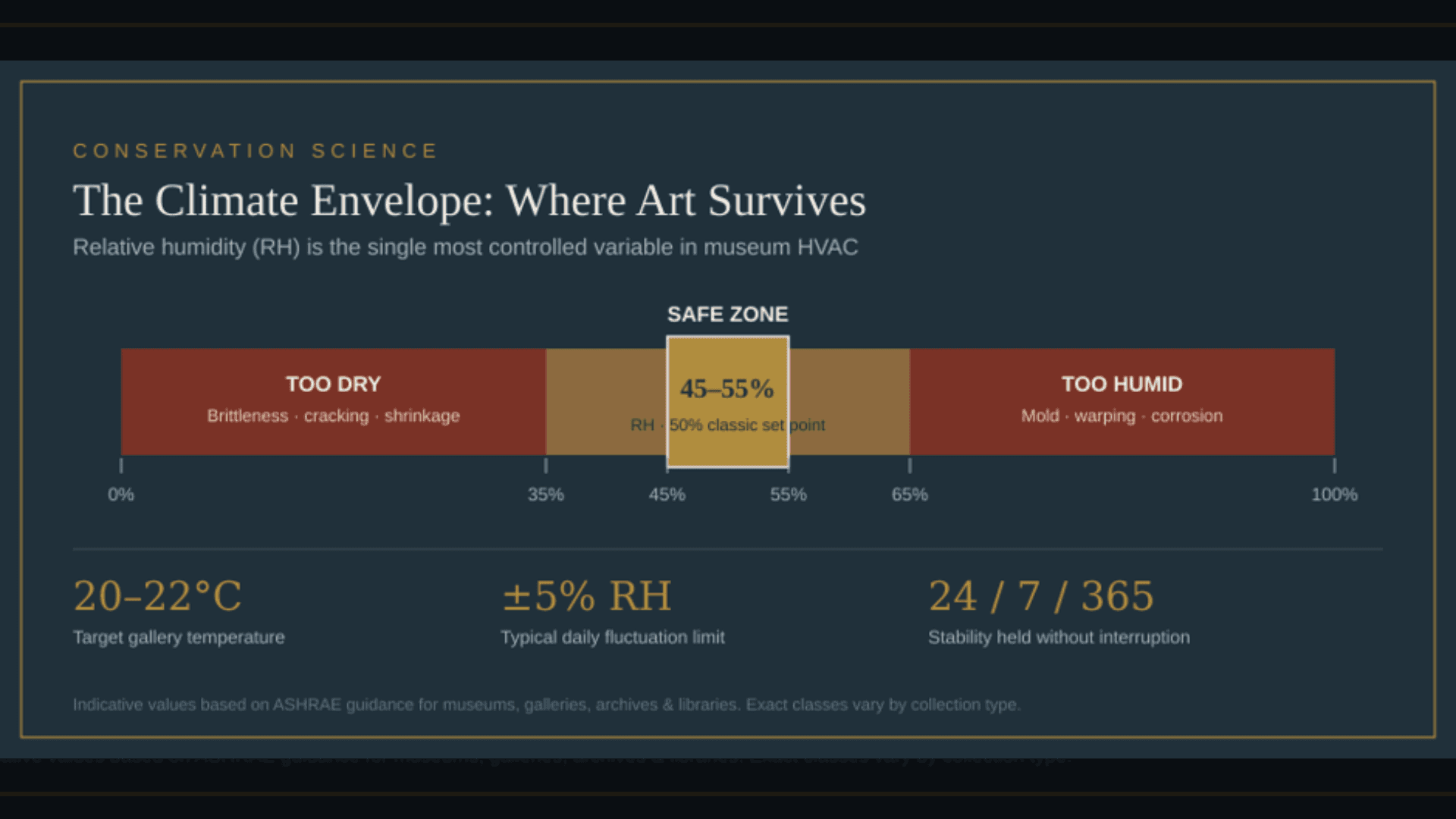
This is why conservators speak of the “climate envelope”: a narrow band of conditions inside which art can survive for centuries, and outside which it quietly dies.
The Gold Standard: What Museums Actually Aim For
For decades, the international benchmark shaped heavily by ASHRAE's dedicated guidance for museums, galleries, archives, and libraries has centered on a deceptively simple target: roughly 20–22°C, roughly 45–55% relative humidity with 50% as the classic set point, and above all, stability, with fluctuations limited to just a few percentage points of RH per day.
That last point is the part most people underestimate. Hitting 50% RH is not especially hard; any decent commercial system can do it occasionally. Holding 50% RH continuously, in a centuries-old stone building, with thousands of warm, breathing visitors flowing through, across four seasons that is elite-level engineering. ASHRAE's museum guidance defines multiple classes of climate control, from the tightest (for the most vulnerable collections) to more relaxed bands for hardier objects. The tighter the class, the more energy, redundancy, and precision instrumentation the building requires.
Case Study 1: The Louvre Fighting Physics in a Former Palace
The Louvre presents a nearly impossible brief: maintain laboratory-grade climate stability inside a sprawling former royal palace, portions of which date back to the 12th century, while hosting more visitors than any other art museum on Earth.
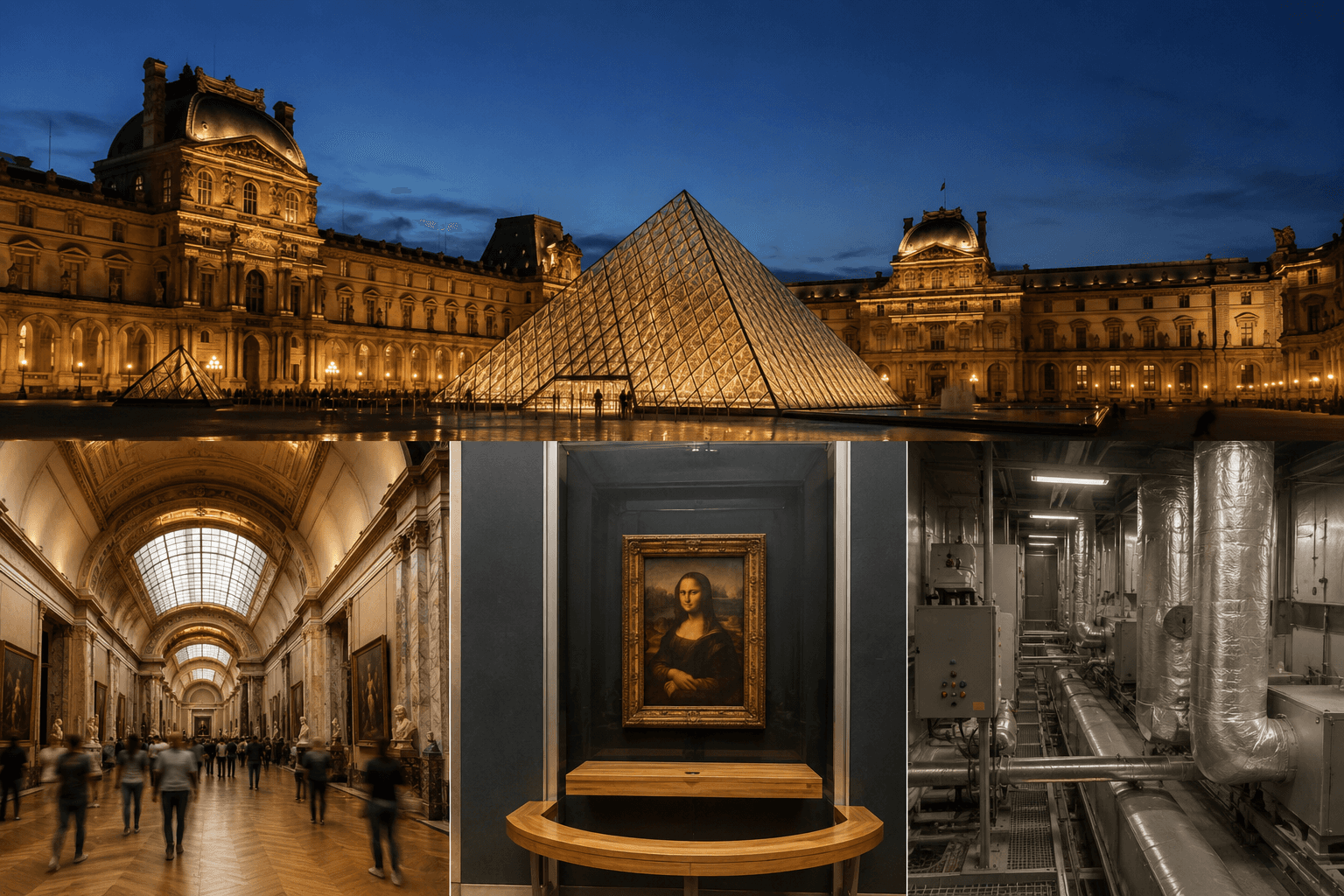
The museum's most famous resident gets the most extreme treatment. The Mona Lisa is not simply hung on a wall she lives inside a sealed, climate-controlled display case, an independent microclimate within the gallery's larger controlled environment. The case maintains its own tightly regulated temperature and humidity, isolating the fragile poplar wood panel (far more sensitive than canvas) from the crowd-generated heat and moisture just centimeters away.
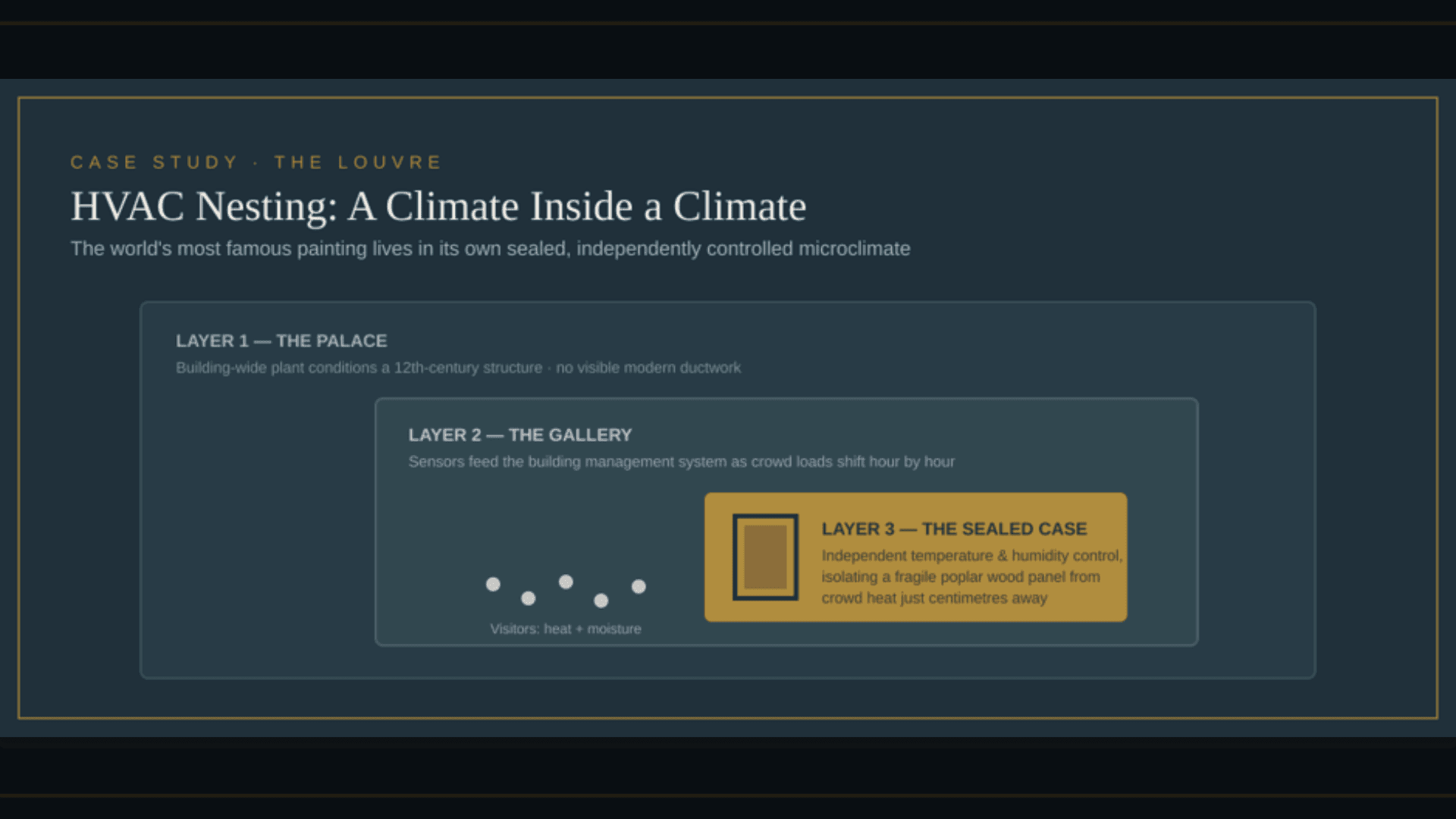
“The Mona Lisa doesn't live in a gallery. She lives in her own private climate.”
Throughout the wider museum, conditioned air must be delivered without visible modern ductwork disfiguring historic interiors, forcing engineers into creative routing through floors, existing voids, and discreet architectural elements. Sensors distributed through the galleries feed building management systems that adjust continuously as crowd loads shift through the day.
Case Study 2: The Vatican - Saving the Sistine Chapel from Its Own Visitors
Perhaps no space on Earth illustrates the visitor-versus-art battle better than the Sistine Chapel. Michelangelo's frescoes sit in a room that can receive well over 20,000 visitors in a single day each one radiating heat, humidity, and CO₂ directly beneath a 500-year-old painted ceiling.
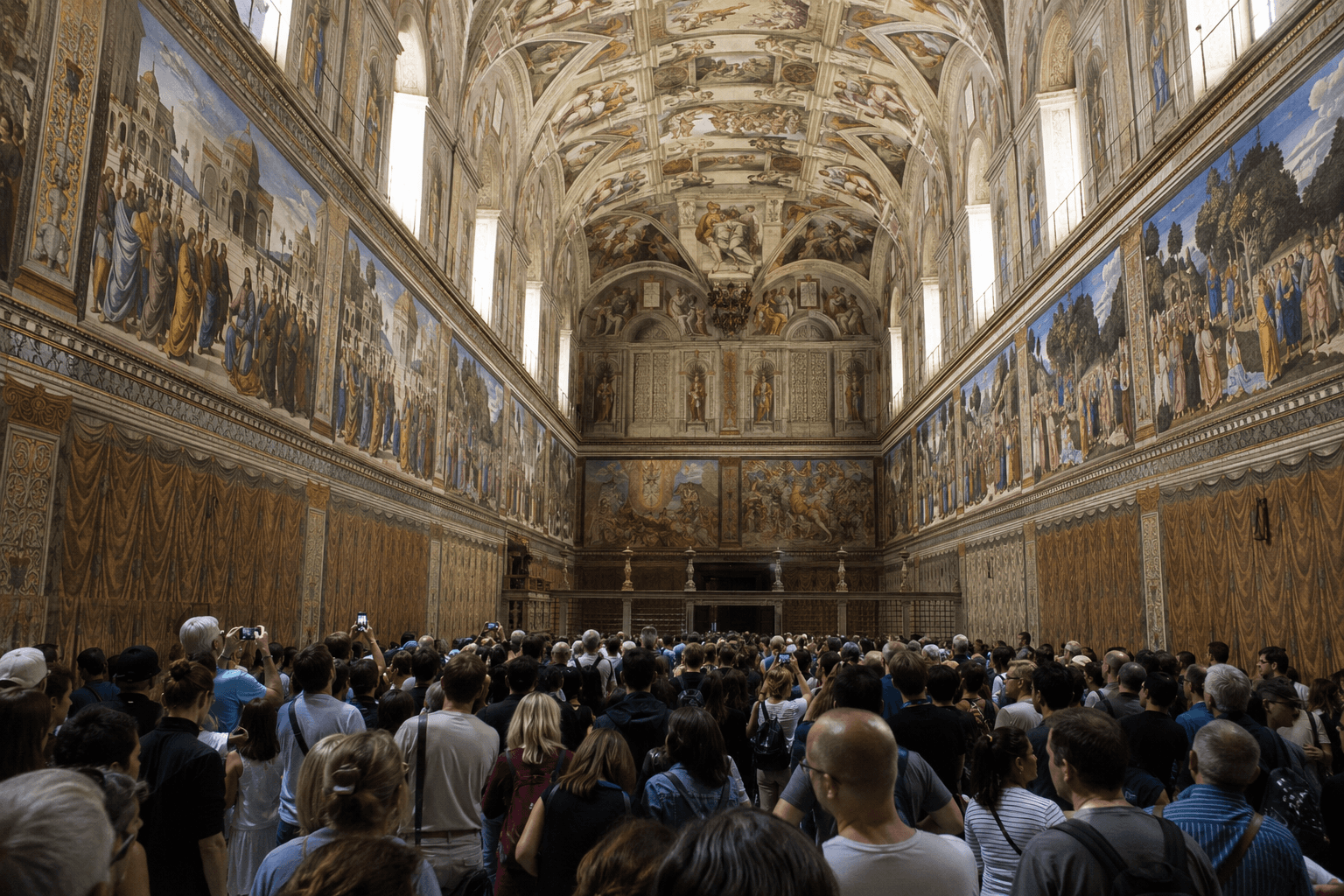
By the early 2010s, the chapel's original air-conditioning system, designed decades earlier for a fraction of the crowds, was overwhelmed. Dust and human-borne contaminants were settling on the frescoes; humidity spikes threatened the plaster itself. The solution, unveiled in 2014 and engineered by Carrier, is one of the most celebrated HVAC projects in history:
Invisible integration: the system delivers air through existing openings so nothing modern intrudes on Michelangelo's masterpiece.
Crowd-sensing intelligence: cameras and sensors count visitors and detect heat loads in real time, so the system anticipates surges before conditions drift.
Stratified air delivery: cool, filtered air is directed into the occupied zone where people stand, while gentler conditions are maintained at fresco level high above the ceiling is never blasted with airflow.
Massively increased capacity: the new system handles far larger crowds than its predecessor while running more efficiently and far more quietly.
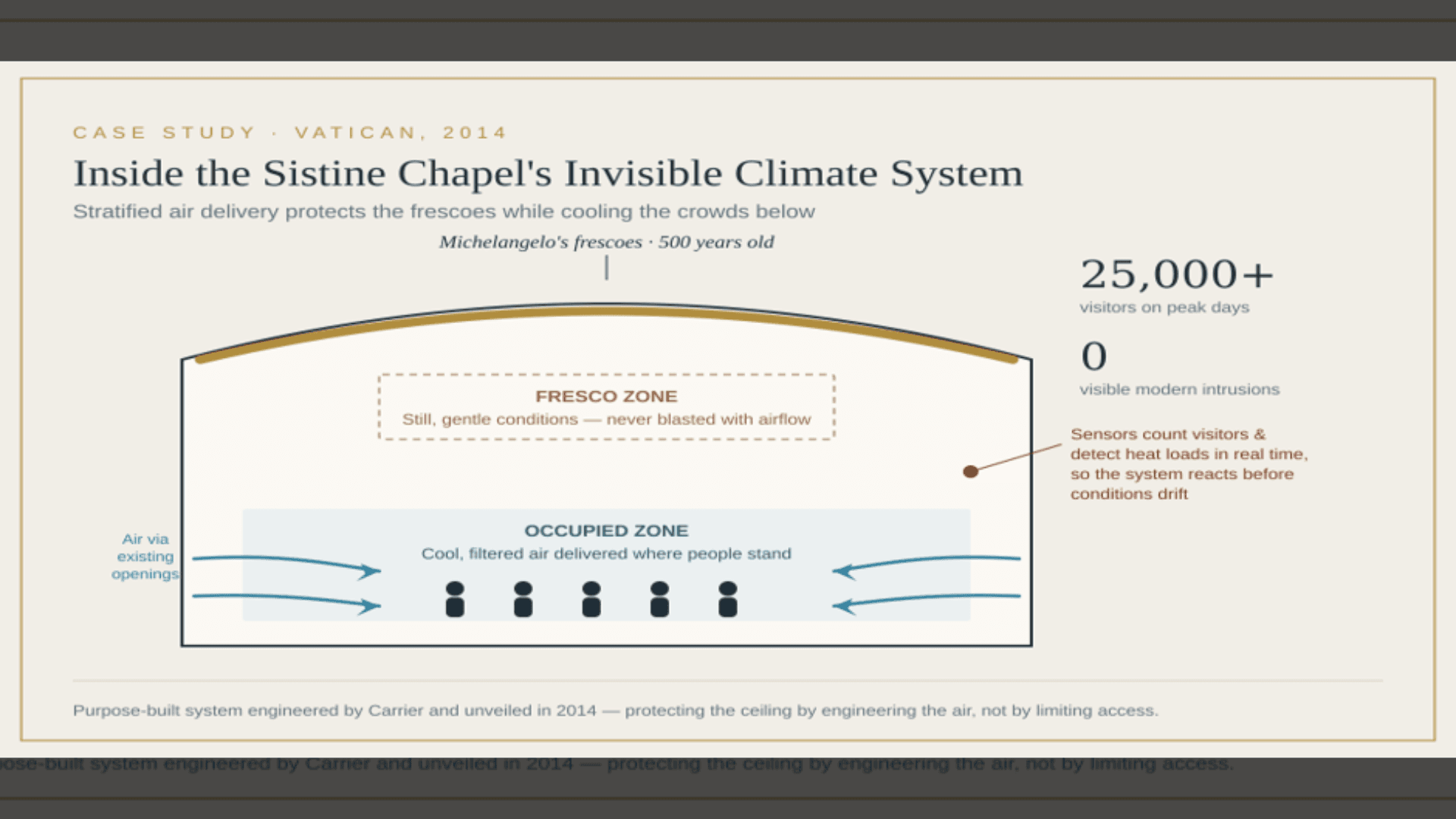
The result: the frescoes are protected not by limiting humanity's access to them, but by engineering the air so precisely that 25,000 daily visitors and a Renaissance ceiling can coexist.
25,000+ | 2014 | 0 | Real-time |
visitors on peak days | system unveiled | visible intrusions | crowd sensing |
The Hidden Engineering Playbook
Across the world's great institutions the British Museum, the Hermitage, the Prado, the Smithsonian — a common playbook has emerged, and it goes far beyond ordinary comfort cooling.
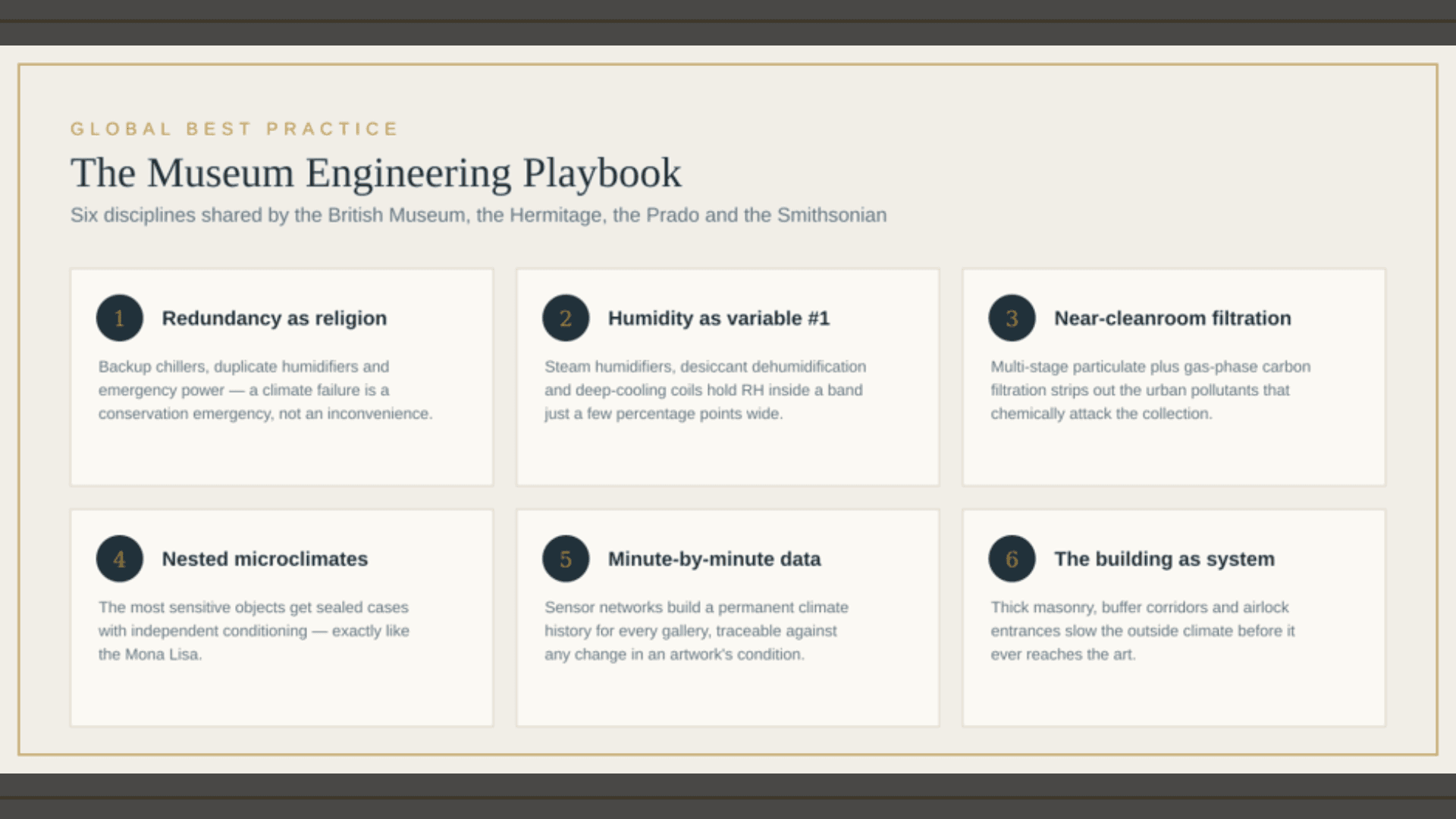
Two of these deserve special emphasis. Redundancy: museum plants run backup chillers, duplicate humidification systems, and emergency power, because a climate failure during a heatwave or a humid monsoon week is a conservation emergency, not an inconvenience. And data: sensor networks record conditions minute by minute, creating a permanent climate history for every gallery, so conservators can trace any change in an artwork's condition against the exact environmental record.
What Should Companies Do Next?
You don't need a Michelangelo on the ceiling to apply museum-grade thinking. Any organization with environment-sensitive assets pharma, data centers, archives, laboratories, luxury retail, precision manufacturing can follow the same six-step roadmap.
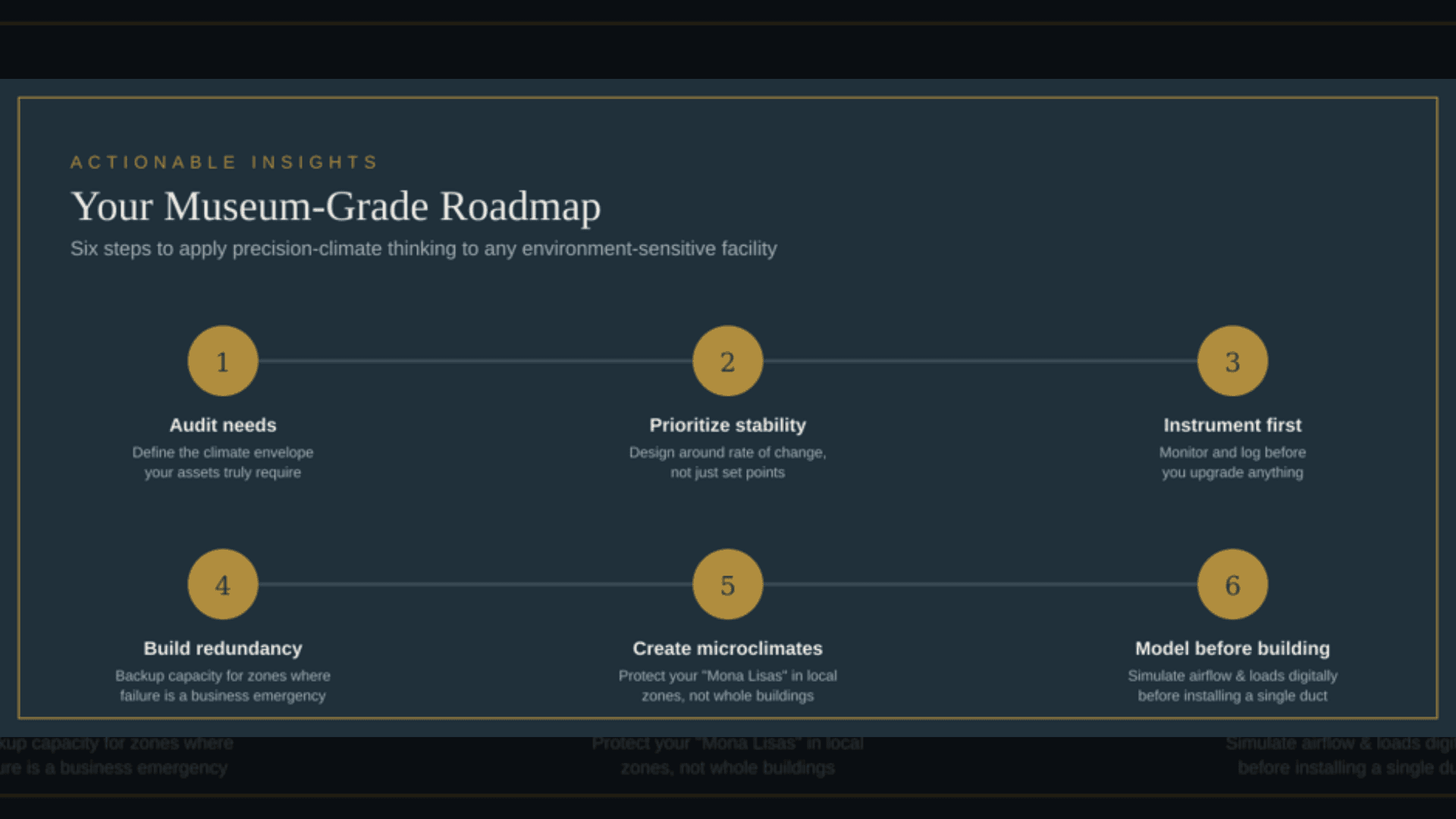
Audit what your assets actually need. Define the temperature and humidity envelope your products, equipment, or materials genuinely require and classify how tightly it must be held, just as ASHRAE's museum classes do.
Prioritize stability over set points. Design and commission systems around limiting the rate of change, not just hitting a number on a thermostat.
Instrument first, then engineer. Deploy continuous monitoring and data logging before upgrading plants you cannot control what you don't measure.
Build in redundancy for critical zones. Identify spaces where a climate failure is a business emergency, and specify backup capacity for them.
Create microclimates for your “Mona Lisa's”. Protect your most sensitive assets with localized, independently controlled environments instead of over-conditioning entire buildings.
Model before you build. Use digital simulation of airflow, thermal loads, and occupancy to validate designs before a single duct is installed exactly how the Sistine Chapel system was engineered.
The Future: Sustainability Meets Conservation
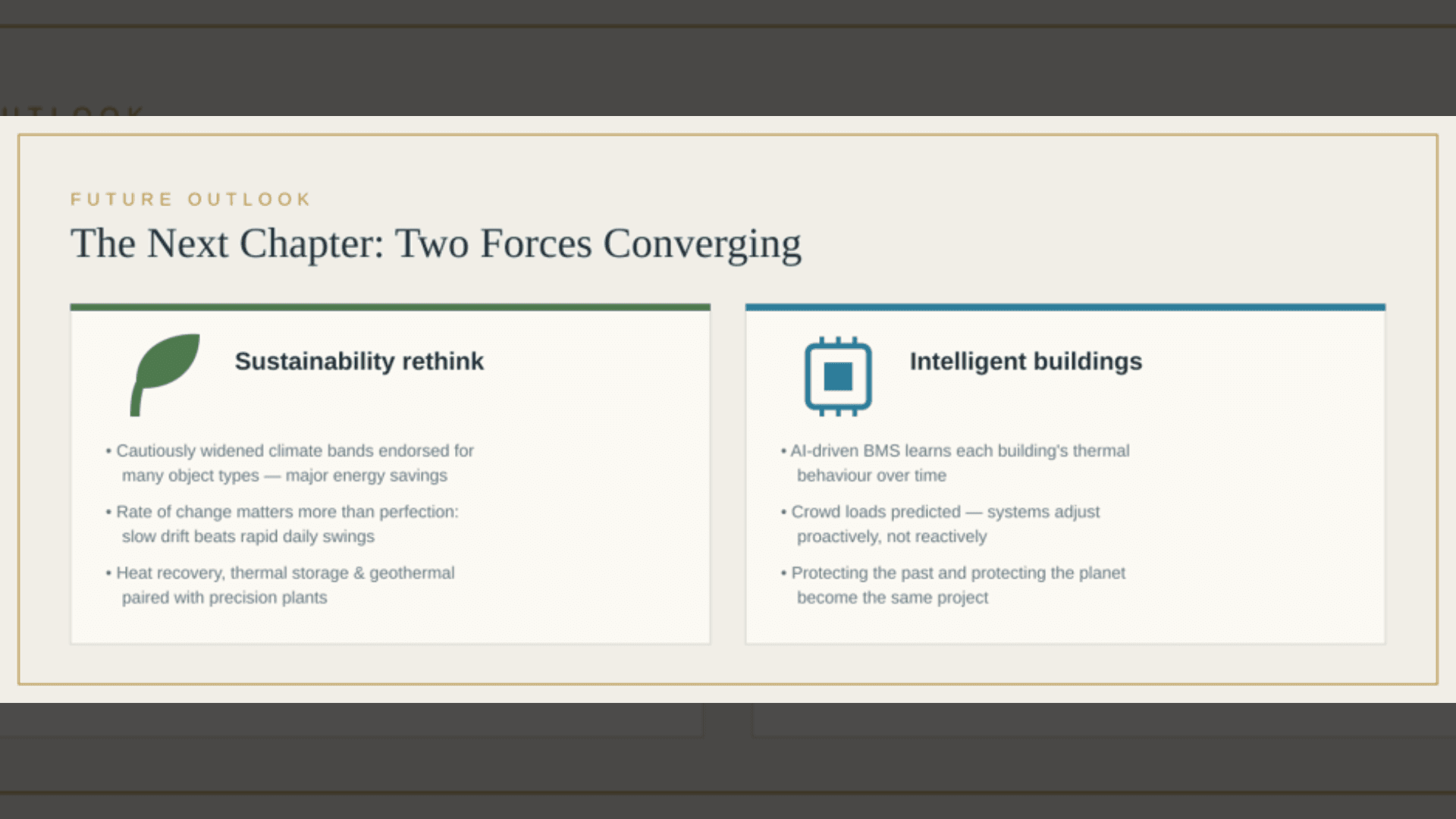
Keeping air within razor-thin tolerances 24/7/365 consumes enormous energy, and museums have become some of the most energy-intensive building types per square meter. That has triggered a global rethink. Leading conservation bodies have, in recent years, endorsed cautiously widened environmental bands for many object types accepting slightly broader but still slow, controlled fluctuations in exchange for major energy savings. Research increasingly shows that rate of change matters more than absolute perfection: a slow seasonal drift is far less damaging than rapid daily swings.
Meanwhile, technology is closing the gap from the other direction. AI-driven building management systems now learn a building's thermal behavior and predict crowd loads, adjusting proactively rather than reactively. Institutions are pairing heat recovery, thermal storage, and even geothermal systems with their precision plants proving that protecting the past and protecting the planet can be the same project.
The Silence Is Engineered
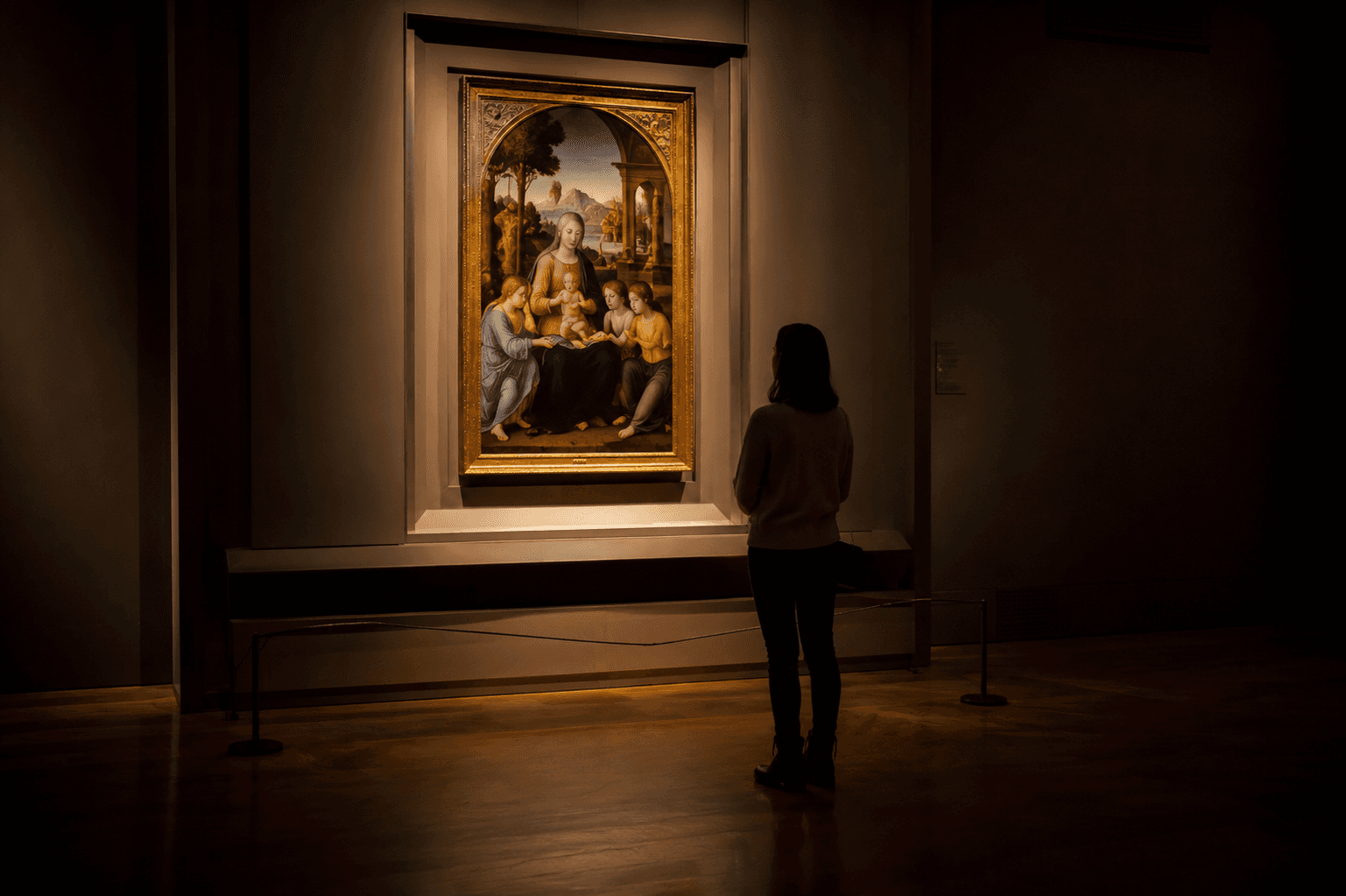
The next time you stand in a quiet gallery before a Renaissance masterpiece, remember that the silence is engineered. Somewhere behind the walls, chillers, humidifiers, sensors, and algorithms are waging a continuous, invisible campaign against physics itself so that a painting made before the invention of electricity can still be standing there, unchanged, five hundred years from now.
“If this level of engineering can hold back time itself for a 500-year-old painting, what could it do for the assets your business depends on?”
How Desapex can help
Precision climate control isn't only for the Louvre. At Desapex, we bring the same stability-first engineering philosophy to modern buildings and facilities from designing and modelling HVAC systems digitally before construction, to optimizing existing plants for tighter control and lower energy consumption. Whether you're protecting sensitive equipment, critical environments, or simply the comfort and productivity of the people inside your building, our team engineers air that works as hard as you do.