




Introduction: The Dual Mandate of Digitalization and Decarbonization
The built environment stands at the nexus of two historic imperatives digital transformation and decarbonization. Globally, buildings account for 40% of energy consumption and roughly 36% of CO₂ emissions. To stay within the 1.5°C climate trajectory, the construction industry must not only design greener assets but also manage existing ones intelligently.
This dual mandate has given rise to what Desapex calls the “Green Data Thread” a continuous, structured flow of information that connects design intent, construction execution, and operational performance through digital platforms like Building Information Modelling (BIM) and Digital Twins.
However, sustainability efforts often fail not for lack of ambition, but for lack of data structure. Without governance, the green transition becomes a disconnected patchwork of spreadsheets and certifications. The antidote lies in ISO 19650, the global standard for information management across the asset lifecycle
1. The Prerequisite: Why ISO 19650 is the Bedrock of Green Data
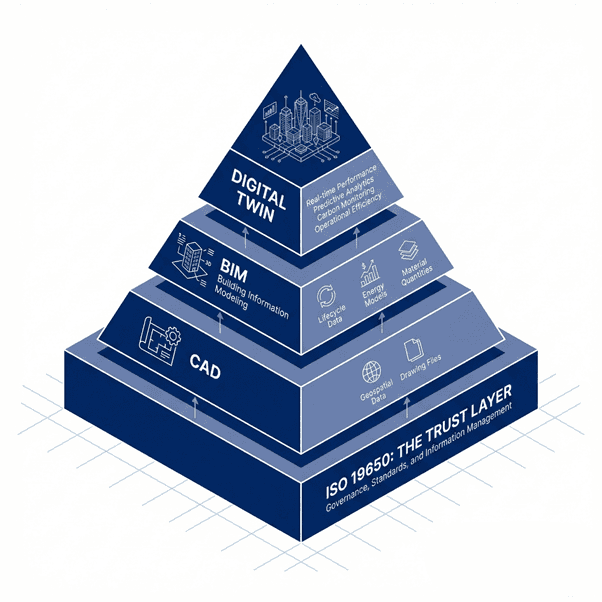
The Governance Foundation: The “Trust” Layer
At the heart of operationalizing sustainability is trustworthy data. Desapex, the world’s first ISO 19650-certified consulting organization, treats this not as a badge of compliance but as a structural prerequisite for sustainability workflows.
ISO 19650 provides the rules of engagement for how information is created, shared, and verified throughout the asset lifecycle. In practical terms, it defines the Exchange Information Requirements (EIR) and BIM Execution Plans (BEP) that govern sustainability datasets like embodied carbon, energy simulations, and Environmental Product Declarations (EPDs).
With this governance layer in place, BIM evolves from a design visualization tool into a carbon ledger one that tracks the environmental impact of every design decision.
Service Implication: Desapex’s Digital Project Management services ensure that sustainability data is as structured and auditable as financial data, eliminating duplication or omission errors in carbon reporting.
2. Fixing the Old: Scan-to-BIM and the Factory Digital Twin for Retrofitting
The Brownfield Challenge The “Reality” Layer
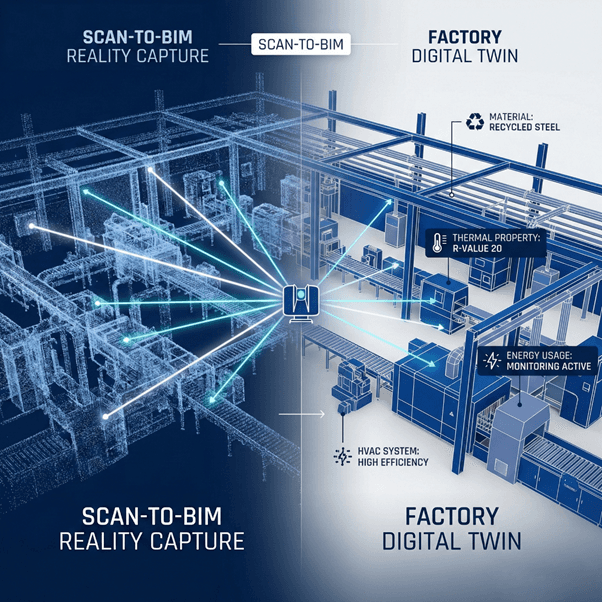
Roughly 80% of the buildings that will exist in 2050 already stand today. The sustainability crisis, therefore, is largely a brownfield problem. Retrofitting these assets demands precise, data-rich baselines a challenge solved through Scan-to-BIM workflows.
Desapex’s Reality Capture services transform disorganized, undocumented physical assets into intelligent digital twins. The process combines laser scanning, point cloud processing, and semantic BIM modelling, turning “dumb” geometry into query able sustainability data.
Technical Highlights
Terrestrial Laser Scanning (TLS): High-accuracy data capture for industrial and commercial assets.
Point Cloud Registration: Stitching of multi-scan datasets into a cohesive 3D environment.
Semantic Enrichment: Metadata tags for asset ID, thermal performance, and material classification foundations for embodied carbon analysis.
In industrial retrofits, these digital twins enable layout simulations, energy optimization, and waste avoidance during equipment upgrades. The model becomes the foundation for ISO 50001-compliant energy management and Scope 2 reduction strategies.
3. Managing the New: Operationalizing ESG with Granlund Manager
The Operational Reality The “Performance” Layer
Design is transient, operations last decades. Recognizing this, Desapex’s partnership with Granlund a Finnish leader in energy and property management software anchors sustainability in the operational phase.
The Manager Ecosystem
1. ESG and Carbon Module:
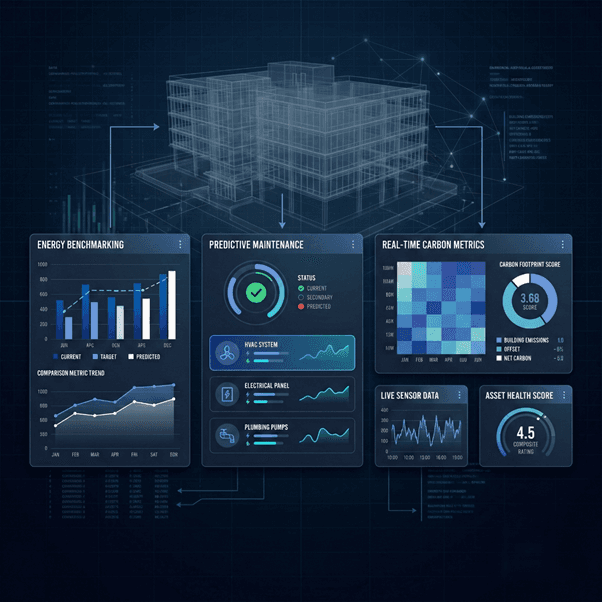
Automates data aggregation across electricity, water, and waste streams for Scope 1, 2, and 3 reporting. Outputs are CSRD- and GRESB-aligned, enabling audit-grade ESG reporting.
2. Energy AI Benchmarking:
Granlund’s AI benchmarks each asset against a peer portfolio, flagging underperformers and quantifying energy drift over time.
3. Predictive Maintenance (BIM-FM):
By integrating IoT and vibration sensors, Granlund Manager shifts maintenance from calendar-based to condition-based, extending equipment life and reducing embodied carbon.
Service Outcome: Clients receive a live Digital Carbon Dashboard a continuously updating interface for carbon and performance analytics across portfolios.
4. Counting the Cost: Automating LCA and EPDs the “Currency of Carbon”
The Embodied Carbon Frontier The “Material” Layer
Operational energy efficiency has matured; the next frontier is embodied carbon the emissions baked into materials themselves.
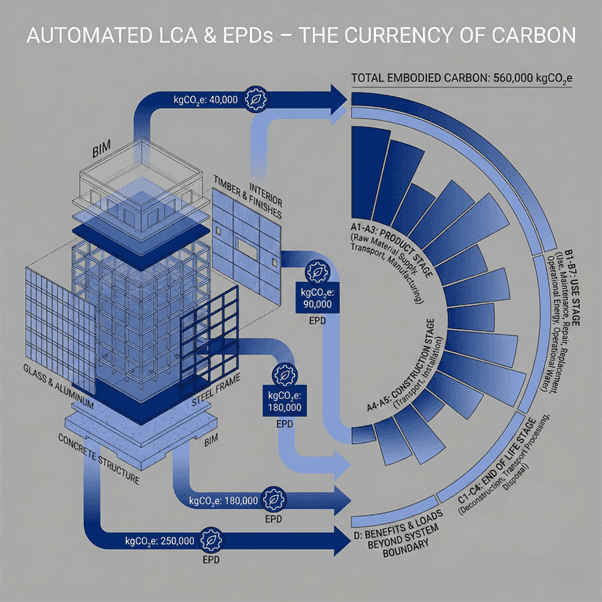
Desapex integrates Life Cycle Assessment (LCA) and Environmental Product Declarations (EPDs) directly into the BIM environment using One Click LCA, Tally, and Prodikt platforms.
Automated BIM-LCA Integration
One Click LCA: Extracts material quantities directly from Revit models, linking them to 250,000+ global LCA datasets.
Tally: Enables architects to assess design alternatives and see real-time carbon impacts.
Prodikt Partnership: Converts static EPD PDFs into machine-readable data embedded in BIM objects, creating “BIM-ready” products.
Why It Matters
Certification Credits: Automates LEED and BREEAM material credits.
Regulatory Compliance: Prepares clients for emerging Whole Life Carbon caps in the EU and Asia.
Circularity: Establishes the foundation for Digital Building Passports, enabling future reuse and recycling of materials.
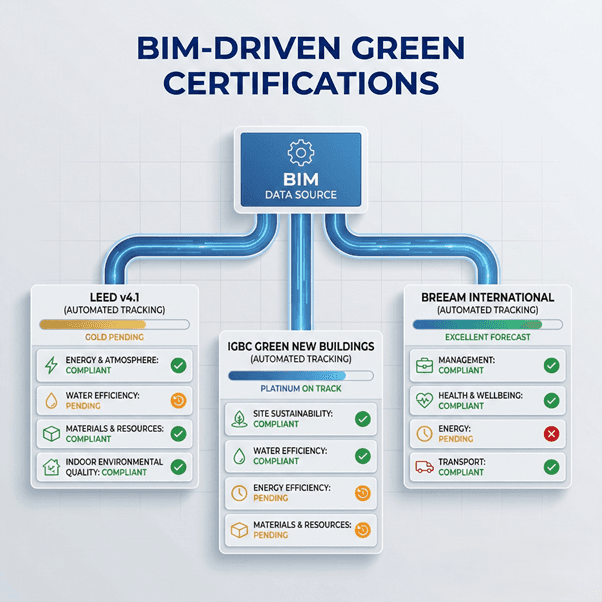
5. Streamlining Certification: How BIM Automates LEED, IGBC, and BREEAM
Certifications like LEED, IGBC, and BREEAM remain the lingua franca of sustainable construction, but their documentation burden can slow adoption.
Desapex’s BIM-integrated workflows automate much of this process:
LEED Energy & Atmosphere: Revit + Autodesk Insight simulations automate ASHRAE 90.1 compliance.
LEED Daylighting: Cloud-based daylight simulations produce the grid-based visual outputs (sDA, ASE) required for LEED v4.1.
IGBC Water and Passive Design: BIM-based plumbing analysis calculates water reuse potential; solar analysis optimizes orientation.
BREEAM Lifecycle Integration: Combines Life Cycle Costing (LCC) and LCA to link financial and environmental payback.
6. The Solution Menu:
Sustainable Design Optimizer
Target: Architects, Developers, Investors
Deliverables:
Early-stage solar and thermal massing analysis
“Shoebox” LCAs using Carbon Designer 3D
Passive design recommendations for IGBC/LEED
Outcome: Reduces embodied and operational carbon at concept stage
Green BIM Certification Engine
Target: Contractors, Green Consultants
Deliverables:
Automated LEED/IGBC documentation
4D BIM progress and waste tracking
Clash detection reports as waste-avoidance proof
Outcome: 20–30% reduction in certification overheads; verified construction sustainability
NetZero Digital Twin
Target: Facility Managers, REITs
Deliverables:
Scan-to-BIM for existing facilities
Granlund Manager implementation
Real-time Scope 1–2 dashboards
Outcome: 20% energy savings; automated ESG compliance reporting
Product Digitization Partner
Target: Product Manufacturers
Deliverables:
LCA & EPD creation per ISO 14025/EN 15804
Revit family creation with embedded EPD data
Prodikt platform integration
Outcome: Market differentiation through digitally verified low-carbon products
7. From Compliance to Competitive Advantage
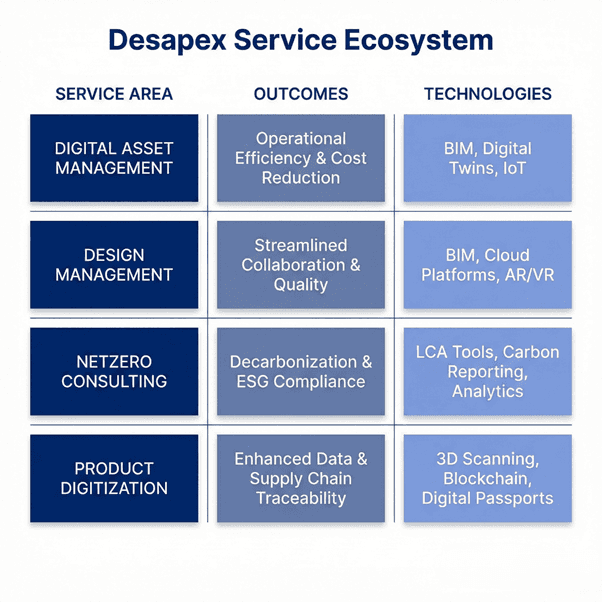
Sustainability in the built environment is moving from compliance to competition. In this transition, data is the currency of credibility. Firms that can measure, verify, and optimize their environmental performance through structured digital frameworks will outpace those relying on ad-hoc reporting.
Desapex’s integrated ecosystem spanning ISO 19650 governance, reality capture, automated LCA, and digital twin operations offers a blueprint for the next generation of NetZero assets.
The message for developers and asset owners is clear:
The path to sustainability is paved with structured data and the vehicle is the Digital Twin.
