Webinar
Inside the Data Center
Discover the structural engineering behind the mission-critical digital world.
Friday, 30 Oct 2026
11:30 AM CET | 4:00 PM IST


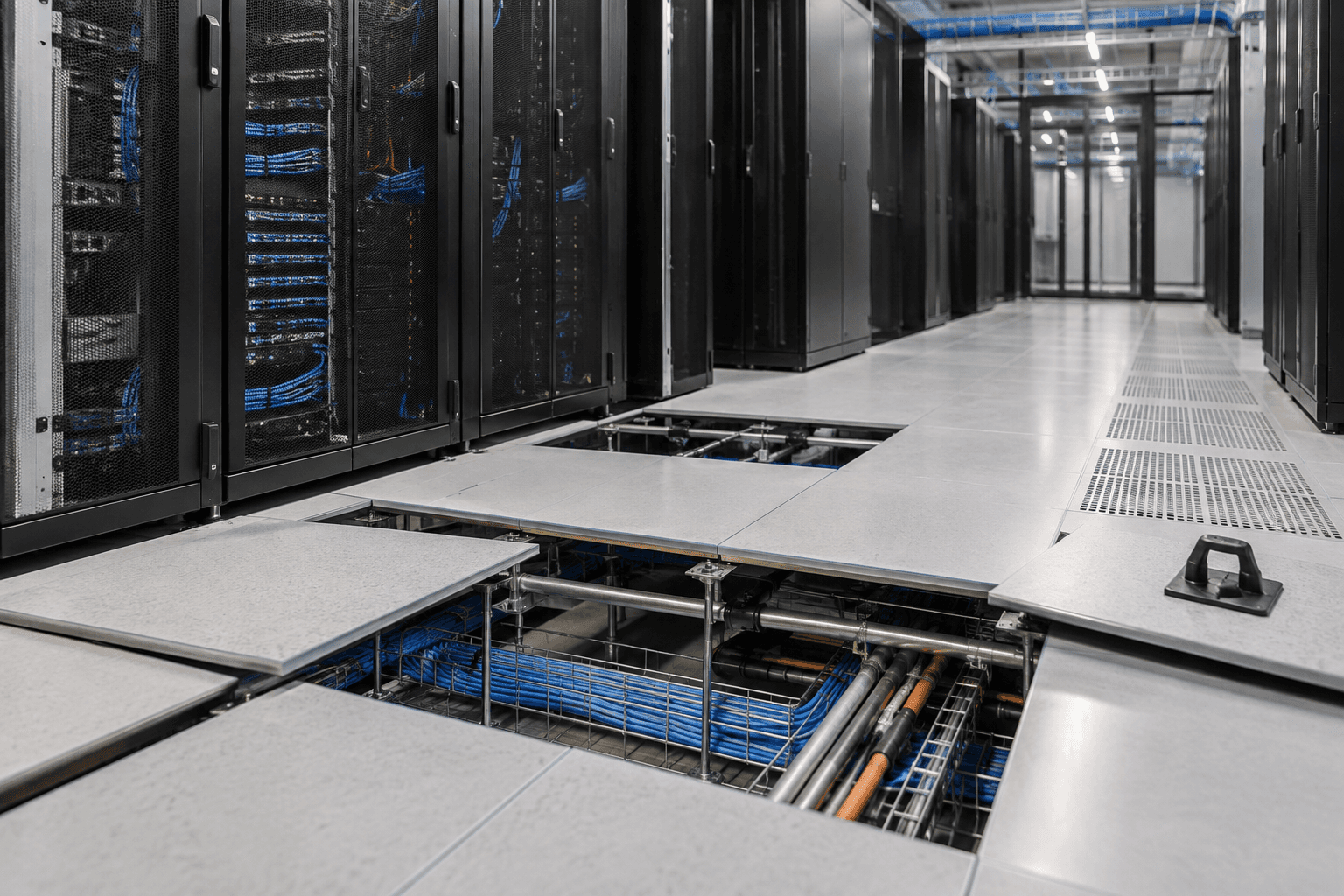
Imagine an engineer standing on the floor of a new data centre or advanced manufacturing facility. The BIM model shows exactly where every pipe, cable tray, duct and piece of equipment should be installed. Yet, on site, the engineer still has to move between drawings, tablets, model views and the physical environment to understand whether the design actually works in that space.
This disconnect between digital information and physical construction is one of the persistent challenges in complex projects.
Augmented reality is beginning to close that gap.
Rather than asking construction teams to interpret digital information separately from the physical environment, augmented reality in construction can bring BIM models, asset information and installation guidance directly into the space where work is taking place. For large industrial projects, where thousands of components must come together with millimetre-level coordination, this can change how teams visualise, install, inspect and eventually operate a facility.
And the opportunity goes beyond simply putting a 3D model on top of a building.
Why Augmented Reality Matters in Construction
Large industrial projects are becoming increasingly complex. Data centres require high-density power and cooling infrastructure. Semiconductor facilities combine highly controlled environments with intricate MEP systems. Manufacturing plants bring together structural, mechanical, electrical, process and automation systems.
As complexity increases, the consequences of a coordination error also increase.
A small discrepancy between the design model and the physical installation can trigger a chain of problems. An incorrectly positioned pipe may interfere with a cable tray. A piece of equipment installed without sufficient clearance may have to be relocated. An opening missed during structural construction can create additional work for several downstream trades.
Traditionally, teams have relied on drawings, BIM models, site measurements and experienced judgement to identify these issues.
AR adds another layer: spatial context.
Instead of looking at a model and imagining how it relates to the building, teams can potentially see the digital design aligned with the physical environment.
That shift from looking at information to experiencing information in context—is where AR becomes particularly valuable.
1. Bringing BIM Into the Physical Construction Environment
BIM has already transformed how complex buildings are designed and coordinated. However, the usefulness of a BIM model does not automatically continue onto the construction site.
An engineer may understand a federated model perfectly on a workstation, but the installation team still needs to translate that information into physical work.
AR can help bridge this gap.
Imagine an MEP installer standing inside a plant room. Instead of referring repeatedly to a drawing to determine where a pipe should pass, an AR interface could show the intended route aligned with the actual space. The installer can understand the relationship between the pipe, surrounding equipment and other services without mentally translating a two-dimensional drawing into three-dimensional space.
This does not replace BIM. It makes BIM more accessible at the point where construction decisions are being made.
2. Improving MEP Coordination Before Problems Become Rework
MEP coordination is one of the strongest applications for AR because mechanical, electrical and plumbing systems often compete for the same physical space.
Consider a congested ceiling zone in a data centre. The BIM model may show chilled-water piping, electrical containment, fire protection and ventilation systems correctly coordinated. But once construction begins, site conditions may differ from the assumptions in the model.
AR can help teams compare the planned installation against the physical environment and identify potential conflicts earlier.
The real value is not simply that the engineer can "see" the model. It is that the model becomes part of the decision-making process on site.
When combined with accurate BIM and reality-capture data, AR can create a more reliable connection between what was designed and what is actually being constructed.
3. Reducing Installation Errors and Rework
Rework is expensive because the cost is rarely limited to fixing one component. An installation error can affect sequencing, labour, materials and the work of other trades.
AR can provide visual guidance at the point of installation, helping teams understand where components belong and how they relate to surrounding systems.
For example, an installation team working on a complex plant room could use an AR workflow to understand the intended position of equipment, supports and services before physically installing them. When the digital model is accurately aligned with the site, discrepancies can become visible earlier in the process.
This creates an important principle for digital construction:
The earlier an error is identified, the cheaper it is to correct.
AR therefore has the potential to move construction teams from reactive problem-solving towards more proactive verification.
4. Making Inspections More Connected to the Digital Model
The construction site is constantly changing. A BIM model represents the intended or documented state, while reality capture technologies can provide information about the actual built condition.
AR can sit between these two worlds.
Imagine an engineer inspecting a newly installed MEP system. Instead of manually searching through drawings and equipment schedules, the engineer could use a spatial interface to identify the relevant element and compare it with the digital information associated with it.
This becomes particularly powerful when BIM, laser scanning, reality capture and AR are connected within a common information workflow.
The result is a more continuous feedback loop:
Design → Construction → Verification → Asset Information
That connection can also improve the quality of information available for handover.
5. Supporting Safer and More Effective Site Communication
Complex construction projects involve people from multiple disciplines, organisations and levels of technical experience. Communicating a spatial problem using drawings alone is not always easy.
AR provides another way to communicate.
A project engineer can show a planned installation directly within the physical environment rather than explaining its location through a series of drawings. Safety teams can use spatial information to explain work zones or planned activities. Supervisors can use visual references to communicate installation requirements with site teams.
The technology does not eliminate the need for engineering judgement or safety procedures. Instead, it can make technical information easier to understand and communicate in context.
6. Accelerating Commissioning and Handover
The value of digital information should not stop when construction is completed.
Commissioning teams need to verify systems, identify equipment and access relevant documentation before a facility can become operational. This is particularly important in mission-critical environments such as data centres and advanced manufacturing facilities.
An AR-enabled workflow could allow an engineer to identify an asset in the physical environment and access the corresponding digital information, documentation or inspection data.
This creates a bridge between construction information and operational information.
Over time, the same principle can support facilities management and digital twin applications, where physical assets are connected to continuously accessible digital information.
7. Connecting AR to the Digital Twin
This is perhaps the most important long-term opportunity.
AR should not be viewed as an isolated technology. Its real value increases when it becomes part of a larger digital engineering ecosystem.
A mature workflow could connect reality capture, BIM, AR, construction data, asset information and digital twins.
In this environment, the physical building becomes connected to a digital representation throughout its lifecycle. Construction teams can use AR for installation and verification, while operations teams can use connected asset information for maintenance and decision-making.
The technology therefore moves beyond visualisation and becomes part of the building's information infrastructure.
What Should Companies Do Before Adopting AR?
The biggest mistake is to begin with the technology rather than the problem.
Instead of asking, "Where can we use AR?", project teams should ask, "Where are our teams losing time because digital information is difficult to use in the physical environment?"
For one organisation, the answer might be MEP installation. For another, it could be quality inspections, commissioning or asset handover.
A focused pilot is usually the better starting point. Establish a reliable BIM model, connect the required project information, select one high-value site workflow and measure the outcome. If the pilot demonstrates improvements in coordination, productivity, inspection or rework, the approach can then be scaled.
The Future of Augmented Reality in Construction
The next stage of AR construction technology will likely involve much more than displaying BIM models.
AI-assisted visual recognition, reality capture, IoT sensors, digital twins and cloud-based project information can make AR interfaces increasingly intelligent. Instead of simply showing where an asset should be, future systems could understand what an engineer is looking at, retrieve the relevant information and provide context for the next action.
This points towards a construction environment where digital information becomes available at the exact location and moment it is needed.
The Bigger Opportunity
The future of construction is not simply about creating more sophisticated digital models. It is about making those models useful to the people who build, inspect, commission and operate physical assets.
Augmented reality can help close the gap between the digital model and the physical project.
For large industrial projects, that connection can support better coordination, fewer installation errors, more effective inspections and a smoother transition from construction to operations.
The real question is no longer whether AR can make construction look more futuristic.
It is whether we can use it to make construction more predictable, connected and efficient.
How Desapex Can Help
Desapex combines digital engineering, BIM, reality capture, AR/VR and digital twin capabilities to help organisations connect information across the building lifecycle.
For complex industrial and mission-critical projects, this can support workflows from design coordination and construction verification through to asset information and digital twin development.
The goal is not to introduce technology for its own sake. It is to connect the right digital information to the right decision at the right stage of the project.
Explore Desapex's Digital Engineering solutions →
Frequently Asked Questions
What is augmented reality in construction?
Augmented reality in construction is the use of AR technology to overlay digital information, such as BIM models, asset data or installation guidance, onto the physical construction environment. It helps teams understand design and project information in real-world context.
How is AR used in construction?
AR can support BIM visualisation, MEP coordination, installation, quality inspection, safety communication, construction verification, commissioning and asset handover.
How does AR work with BIM?
BIM provides the structured digital representation of the building, while AR provides a way to view that information in the physical environment. Together, they can connect digital design information with real-world construction activities.
Can augmented reality reduce construction rework?
AR can help reduce rework by allowing teams to identify discrepancies between the planned design and physical conditions earlier, particularly during installation and inspection.
Is AR useful for MEP coordination?
Yes. MEP is one of the strongest potential applications because AR can help teams understand complex services and their spatial relationships directly within the construction environment.
What is the relationship between AR and digital twins?
AR can serve as an interface for accessing digital twin information in the physical environment. While a digital twin focuses on representing and connecting information about a physical asset, AR can help people interact with that information spatially.