


Webinar
Inside the Data Center
Discover the structural engineering behind the mission-critical digital world.
Friday, 30 Oct 2026
11:30 AM CET | 4:00 PM IST

Your line is planned for 1,000 units a shift. It delivers 900.
Most plant teams discover the gap after the fact, on a shift report. Then the questions start. Is it a bottleneck? An operator struggling with a step? A line that was never balanced?
The factories pulling ahead answer those questions before the line exists, and keep answering them once it runs. That is what factory digitization really means.
Why factory digitization matters now
Manufacturing is changing faster than plant layouts can. Product life cycles are shorter, customers expect more variants, and every new line is a capital bet.
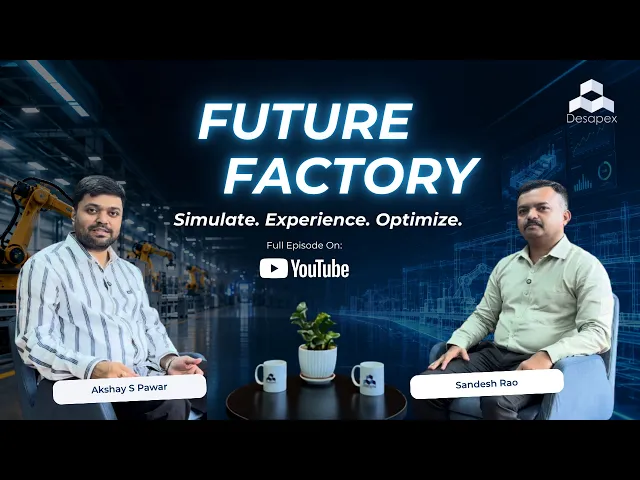
As manufacturing expert Sandesh put it on our Future Factories podcast, too many manufacturing decisions are still taken with too many uncertainties. Robots are expensive to move once they are bolted down. Decisions made digitally are cheap to change.
The core problem: decisions arrive after the concrete
Most factories still validate decisions in the physical world. The real throughput only shows up after the equipment is installed.
Late discovery. Bottlenecks, buffer shortages and logistics clashes appear after commissioning, when every fix means downtime.
Lost information. Engineering, manufacturing and operations each hold their own data. When it doesn't flow between them, changes get reworked.
Stuck pilots. Digital projects start as isolated pilots and never scale, so their value stays invisible.
Three tools, one decision cycle
Process simulation, virtual reality and a factory digital twin are not three separate projects. Each one answers a different question at a different stage.
Process simulation: test the factory before it exists
Factory simulation, usually built with discrete event simulation, models a line's real dynamics: cycle times, buffer stations and material logistics.
Find the bottleneck before you pour the foundation
Compare several layout scenarios side by side
Check whether a new line lifts output or just moves the bottleneck downstream
Virtual reality: walk the floor before it's built
VR puts engineers, operators and plant managers inside the factory at full scale. They check reach and tool access, run ergonomic and safety reviews, and agree on the design together. Unlike an animation, it is an early validation step.
Factory digital twin: learn while you operate
Once the plant runs, a digital twin connects live data from machines and sensors, including retrofitted legacy equipment, back to the plan. That is where a 900-unit shift gets explained, not just reported.
The digital thread ties it together
The digital thread carries information from design to process to operations, so a change in one team reaches the others. The result is less rework and faster decisions.
Each stage feeds the next, and operating data from the digital twin loops back into the next design decision.
A real scenario: lifting a speedometer assembly line
A Tier 1 automotive supplier assembling speedometers was running at about 200 units per hour. The team set that figure as the baseline KPI, then used production line simulation to:
Locate the constraint in the line
Test alternative fixes digitally, without touching the live line
Target 220 to 250 units per hour
That is a 10 to 25% uplift, explored without stopping production. Finding it through physical trial and error would have cost far more.
What the results look like
Sandesh, who has two decades in manufacturing and its digital implementation, avoids promising one number for every plant. From his experience:
Process simulation typically delivers a 5 to 15% improvement in a normal scenario.
Digital twins in operation have delivered around 20% improvement in some facilities.
Virtual reality compresses review cycles. His rule of thumb: work that takes three weeks can often be done in one.
His bigger point: the business question is not whether you have a digital twin. It is what decision you can take with the data it gives you.
What should manufacturers do next?
Start with a baseline, not a technology. A realistic factory digitization roadmap looks like this:
Year 1: Baseline and prove. Pick one or two use cases and target a 5 to 10% gain.
Year 2: Scale what works. Expand to three to five use cases for a further 10 to 15%.
Year 3: Spread across the factory. Roll out to other departments and sites against the same baseline.
Year 4: Integrate. Connect engineering, manufacturing, operations, sales and R&D, aiming for about 20% above where you started.
Three rules keep it on track:
Tie every use case to one of five outcomes: productivity, speed, risk, customer value or adaptability.
Treat targets as planning targets, not promises.
Digitize line by line. There is no need to stop production.
The future outlook: from connected to self-improving
Once the data is flowing, the next layer is optimization and AI. Over the next few years, expect:
AI that predicts bottlenecks and adjusts schedules using digital twin data
Augmented reality that brings twin insights onto the shop floor
Smart manufacturing lines that switch between product variants without disrupting the plant
The factory that learns
Sandesh sums it up in three moves: simulate before you build, experience before you implement, then learn from what the factory tells you.
The future factory doesn't replace the physical plant. It gives the plant the ability to anticipate problems instead of reacting to them.
So the question isn't whether to digitize. It's this: which decision in your plant is still being made too late?
How Desapex can help
Desapex helps manufacturers move from a first use case to a connected factory:
Factory and production line simulation to find bottlenecks and compare scenarios
Factory layout design and production layout optimization
VR design reviews for engineers, operators and plant managers
Factory digital twin development and integration
Reality capture and scan-to-BIM for brownfield plant digitization
Planning your factory digitization roadmap? Talk to the Desapex team, or watch the full Future Factories episode on
Frequently asked questions
What is factory digitization?
Factory digitization is the use of process simulation, virtual reality and digital twins to plan, validate and run a factory from data. It lets manufacturers test decisions before making physical changes.
What is the difference between factory simulation and a factory digital twin?
Factory simulation tests a model of the factory before it is built or changed. A factory digital twin is connected to the live plant and compares real operating data against the plan.
How does discrete event simulation help manufacturing?
Discrete event simulation models each event on a line, such as a part arriving or a machine finishing, to show where queues and bottlenecks form. Manufacturers use it to compare layouts and capacity before investing.
How is virtual reality used in factory design?
VR lets teams walk a full-scale virtual factory before it exists. It is used for design reviews, ergonomic and safety checks, and operator training.
How long does factory digitization take?
A realistic roadmap runs 12 to 48 months: prove one or two use cases in year one, scale in years two and three, and integrate across departments by year four.