Client Segment:
Vertical:
Service Overview
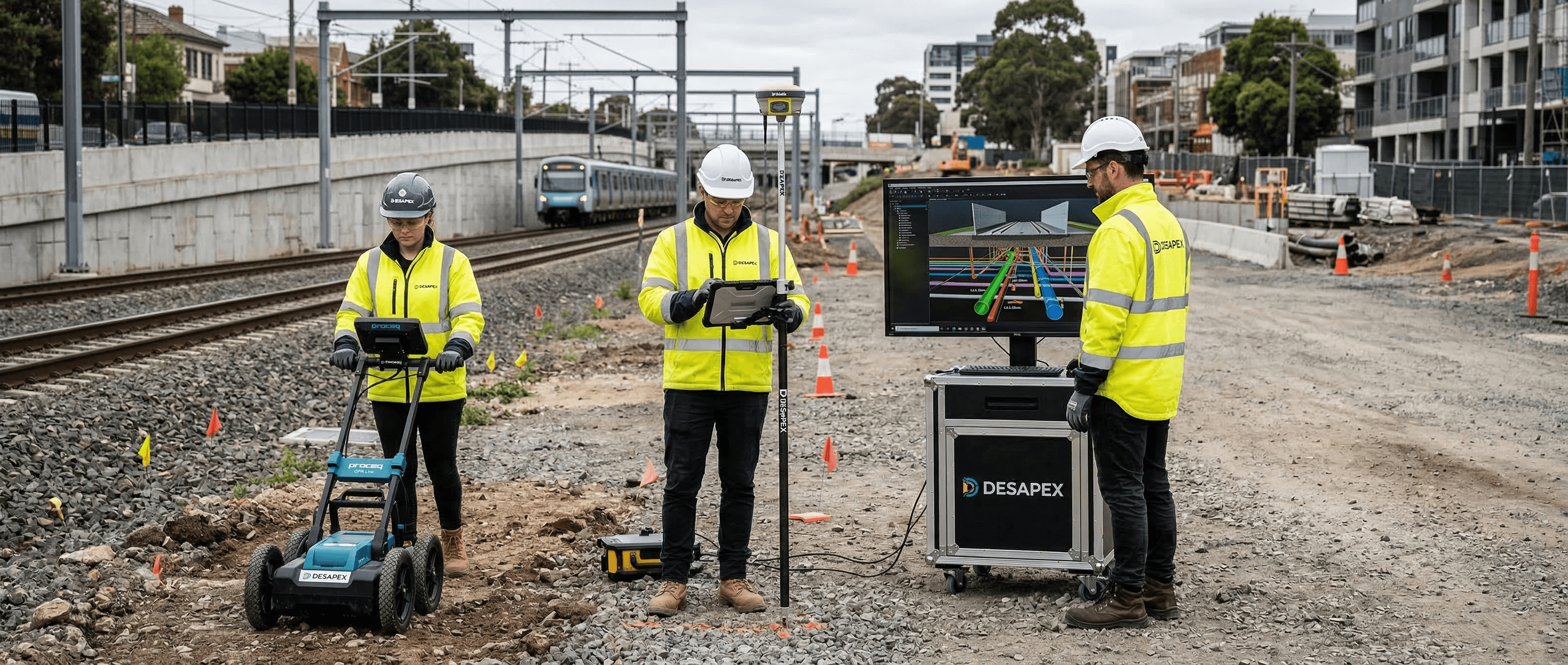
Rail and metro corridor selection is heavily constrained by existing underground infrastructure, such as water mains, sewer tunnels, telecommunications cables, gas pipelines, and electrical feeders that must be avoided or relocated. Desapex’s digital corridor assessment creates a comprehensive 3D underground constraint map that fundamentally de-risks alignment decisions.
Our Digital-First Approach
Deploy Scanning Technology
We combine terrestrial LiDAR scanning for surface features with drone photogrammetry for a broader corridor overview.
Core Deliverables
Surface feature capture, including existing buildings, roads, bridges, and vegetation along proposed corridors.
Subsurface utility mapping integration showing water, sewer, gas, telecom, and electrical networks with depth accuracy.
Station box feasibility assessment evaluating geotechnical conditions and adjacent building proximity.
Tunnel alignment constraint visualization identifying prohibited zones around existing foundations and utilities.
Land acquisition requirement mapping and environmental/heritage impact zone identification.
Why Choose Desapex
Underground utility strikes during metro construction are among the most expensive and politically damaging events in infrastructure delivery. Desapex’s comprehensive 3D utility mapping gives alignment engineers the crucial constraint intelligence they need to select routes that minimize utility diversions one of the largest controllable cost categories in urban metro projects.
Unique Selling Proposition
Our USP is that Desapex’s corridor model integrates surface and subsurface data in a single 3D environment not in separate layers on a 2D plan. This spatial integration reveals critical constraint relationships (e.g., a deep sewer crossing at a station entrance) that flat drawings routinely miss.