Join our webinar on Unlocking the Power of Autodesk Build: A Comprehensive Introduction
Register Now!

EPD Strategy for Indian Manufacturers: How to Prioritize SKUs, Prove Market Demand and Scale a Profitable EPD Portfolio

,
January 13, 2026

Why Manufacturers Need an EPD Strategy (Not One-Off EPDs)

Across Europe and globally, construction product EPDs to EN 15804 have grown into the tens of thousands, with ECO Platform estimating over 40,000 EN 15804 EPDs and well above 100,000 EPDs overall when other formats are included. Individual programs like EPD-Norway alone report thousands of published EPDs and an average of nearly nine EPDs per company, showing that leading manufacturers are already moving from single certificates to multi-EPD portfolios.

This growth is driven by regulations (EU Construction Products Regulation revisions), digital product passports, green building schemes (LEED, BREEAM, IGBC, GRIHA) and Scope 3 supplier programs, where SBTi requires companies with large Scope 3 emissions to set targets that cover at least 67% of those emissions forcing them to demand verified data from suppliers. For Indian manufacturers exporting to Europe or serving global OEMs, this translates into more ESG questionnaires, supplier engagement requests, and tender clauses asking for EN 15804-compliant EPDs or equivalent.

Desapex can help manufacturers translate this regulatory and buyer pressure into a structured EPD and LCA roadmap, including portfolio planning aligned with building LCA and embodied carbon requirements.
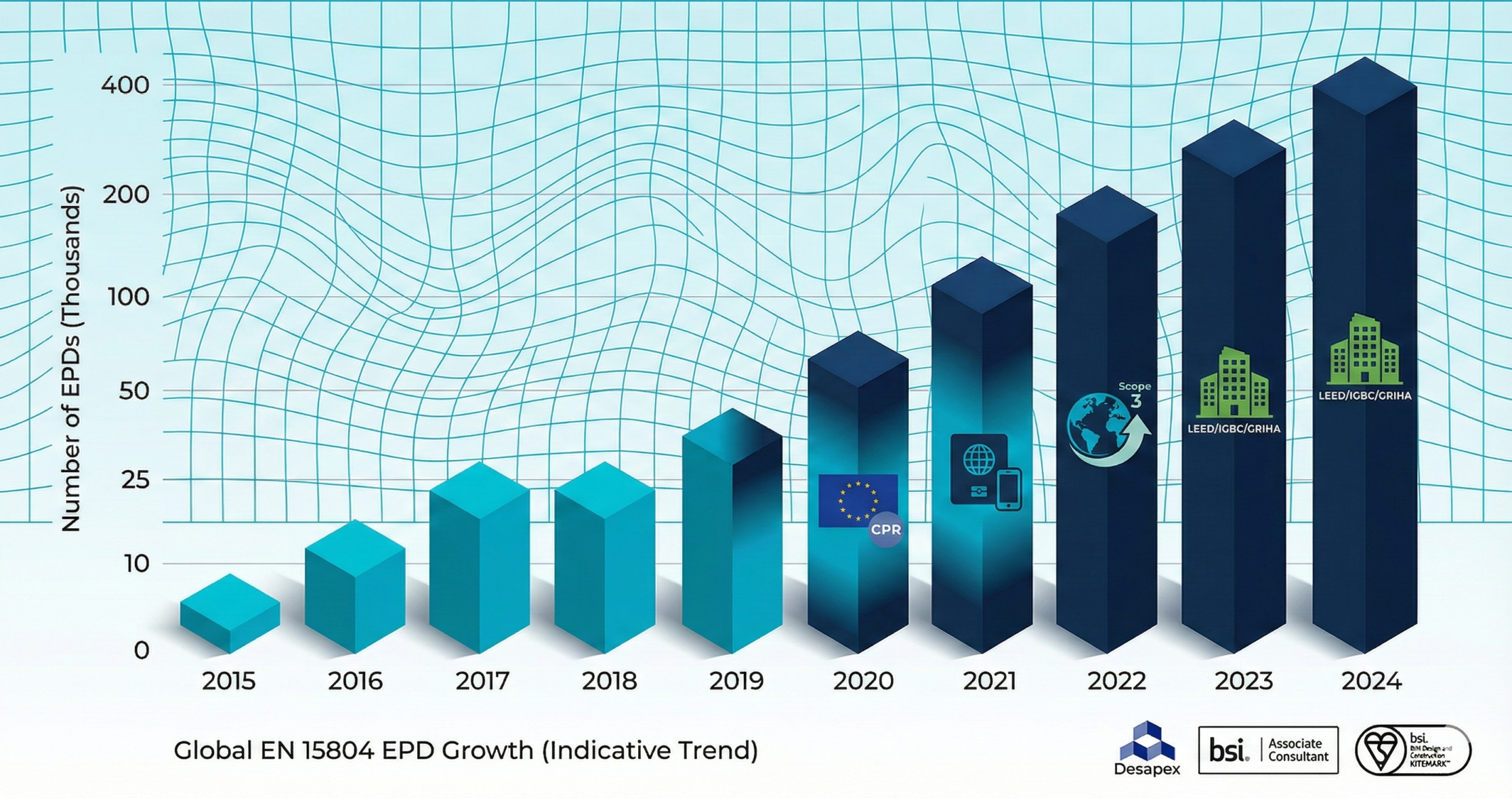
Global EN 15804 EPD growth (illustrative from sector data)

The First Step: EPD Strategy & Priority Product Identification

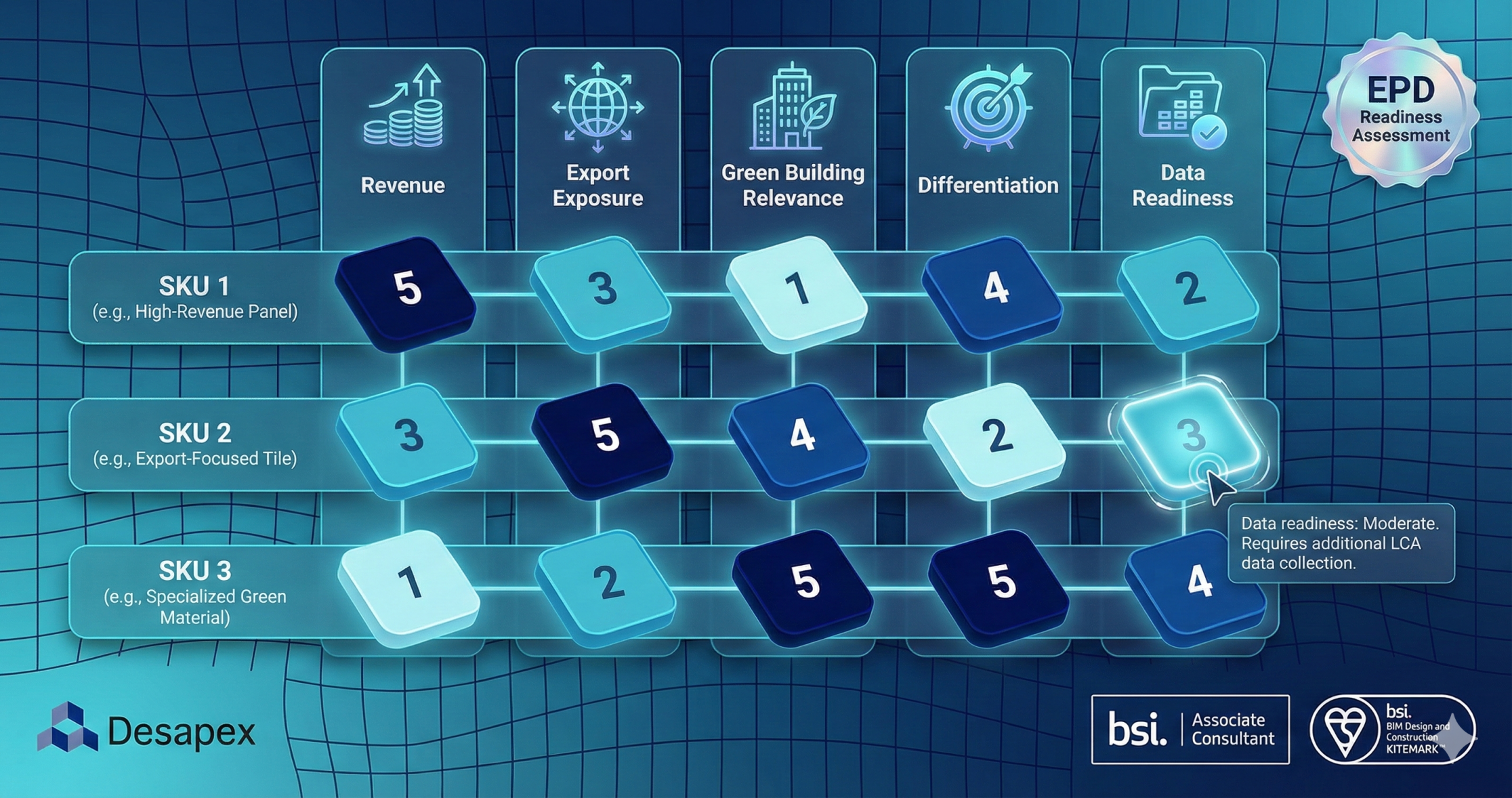
The most effective EPD journeys begin with 3-5 high-impact SKUs chosen using objective business and data criteria, not gut feel. For Indian manufacturers, a practical scoring method should combine revenue, export dependence, green building relevance, differentiation potential, and data availability.

Recommended priority criteria:

  • Revenue and margin contribution (top-line and profitability impact)
  • Export or global OEM exposure (EU, UK, US, Middle East projects)
  • Green building relevance (use in LEED, IGBC, GRIHA, BREEAM projects)
  • Competitive differentiation potential (few or weak competitor EPDs in ECO Platform / Environdec / UL databases)
  • Data readiness (availability of energy, materials, BoM, waste, and logistics data at plant level)

Desapex offers a 30‑minute “EPD readiness assessment” where your top 20–30 SKUs are rapidly screened against these criteria and scored in a joint workshop with commercial and operations teams, building on Desapex’s experience with generic and product-specific LCA data in the Indian context.

Priority scoring matrix (structure)

How to Assess Real Market Demand for EPDs in Your Sector

Before investing, manufacturers should test: “Is there real EPD demand in my segment?” through a structured scan of tenders, rating systems, and competitor activity. Construction sectors in Europe and Scandinavia have already seen public buyers making EPDs mandatory or heavily rewarded for key materials, and this pattern is spreading to other markets.

Key demand signals to scan:

  • Public tenders and model documents (CPWD, NHAI, PSUs in India; EU TED for European contracts) for embodied carbon, LCA, or EPD language.
  • Buyer ESG and supplier onboarding questionnaires checking for Scope 3 data, product carbon footprints, or EPDs.
  • EPD databases such as ECO Platform, International EPD System, and UL to count competitor or peer EPDs by product type.
  • Green building rating systems (LEED, BREEAM, IGBC, GRIHA) that grant points or preferential recognition for products with verified EPDs as part of material transparency or embodied carbon credits.

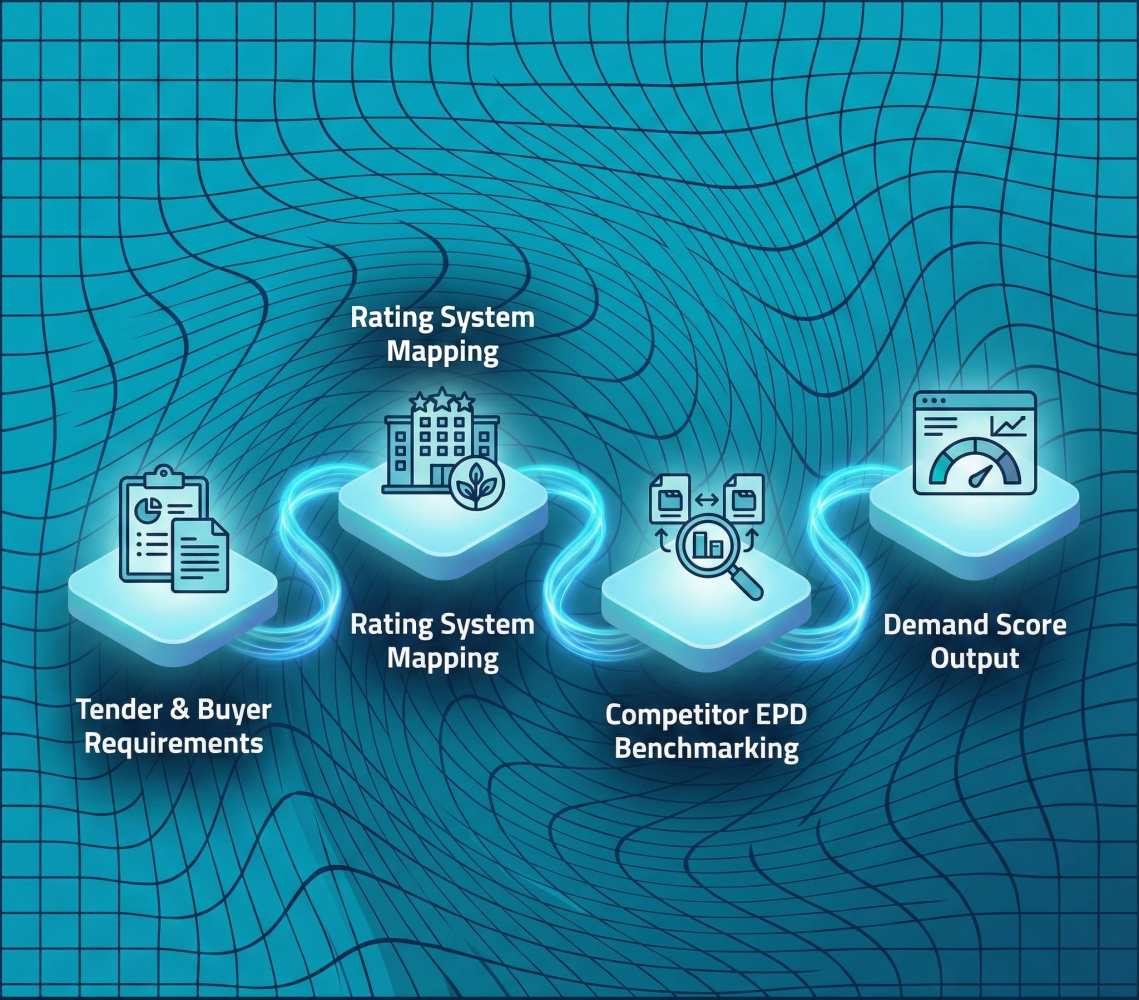
Desapex supports manufacturers with a structured “EPD Demand Scan Framework”: mapping tenders, rating systems, and competitor data to a sector-specific demand score, which can be integrated into your commercial strategy and sales playbooks.

EPD Demand Scan Framework

Designing for Reuse: From Pilot EPDs to Scalable EPD Portfolios

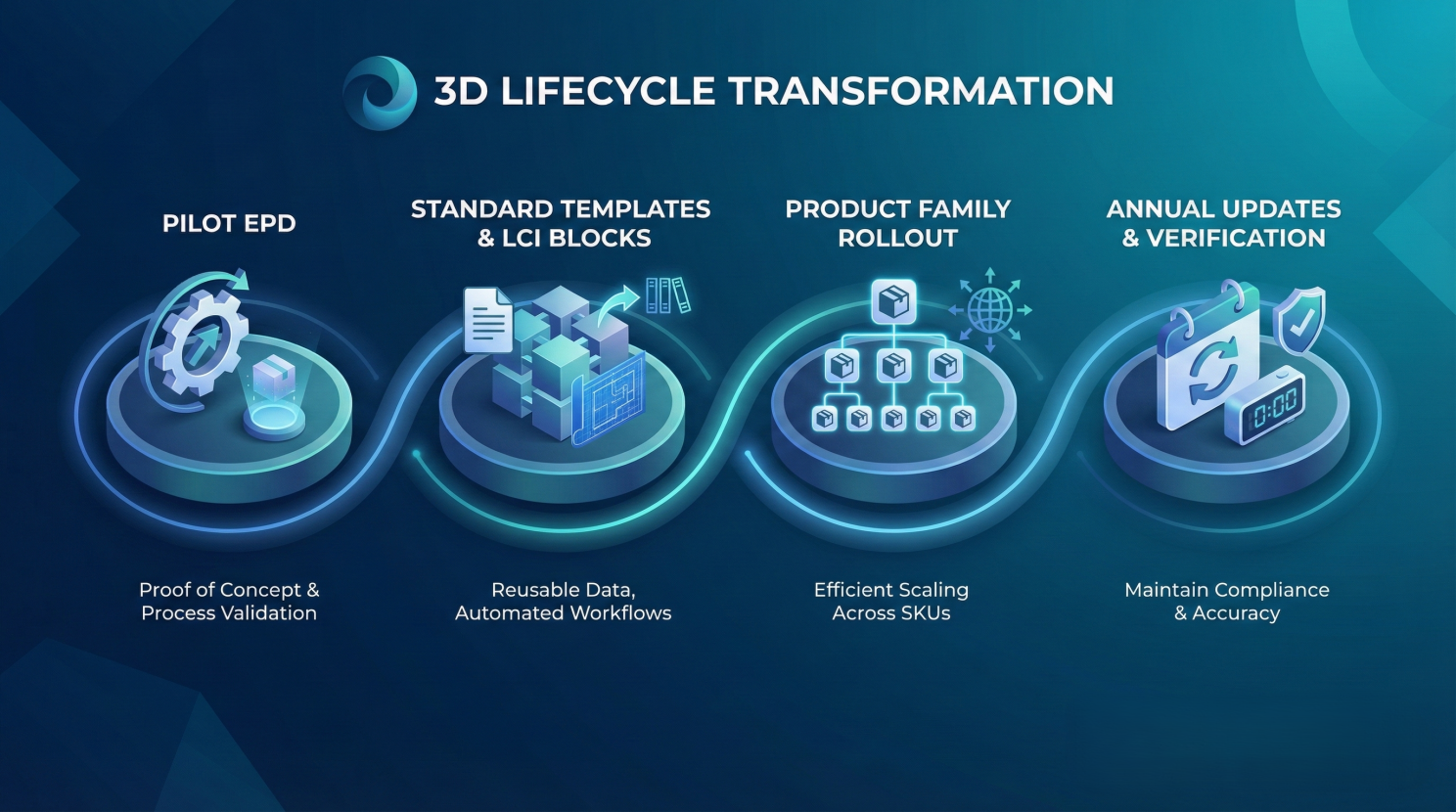
One‑off EPD projects often rely on bespoke spreadsheets, isolated data pulls, and external consultants, making them slow, expensive, and hard to repeat. A portfolio strategy instead builds templates, reusable LCI datasets, and verification-ready structures, so each new product EPD becomes an incremental effort rather than a fresh start.

Key elements of a scalable EPD architecture:

  • Standardized BoM mapping and process flow for plants, ensuring consistent allocation of energy, materials, and waste across EPDs.
  • A common modelling approach (databases aligned with EN 15804+A2, e.g., specialised open LCA datasets) that can be reused across multiple SKUs.
  • A governance model where operations, maintenance, procurement, and sustainability each own specific data field, coordinated by a central EPD/LCA lead.

Desapex helps manufacturers design this “EPD operating model”, including master templates, digital workflows integrated with BIM / digital twins where relevant, and annual update cycles aligned with verification rules.

Process diagram: Pilot to portfolio

How to Work with PCRs, Program Operators & Verification Bodies

For construction products, Product Category Rules (PCRs) and EN 15804 define how impacts are calculated, reported, and verified, ensuring comparability across manufacturers. The International EPD System’s construction products PCR (EN 15804+A2) and ECO Platform rules are widely used for EPDs that must be recognised in European projects.

Manufacturers should:

  • Choose a PCR aligned with their product type and markets (e.g., construction products EN 15804+A2 for building materials).
  • Select a programme operator with ECO Platform recognition when targeting European markets (e.g., ECO EPD programmes listed by ECO Platform).
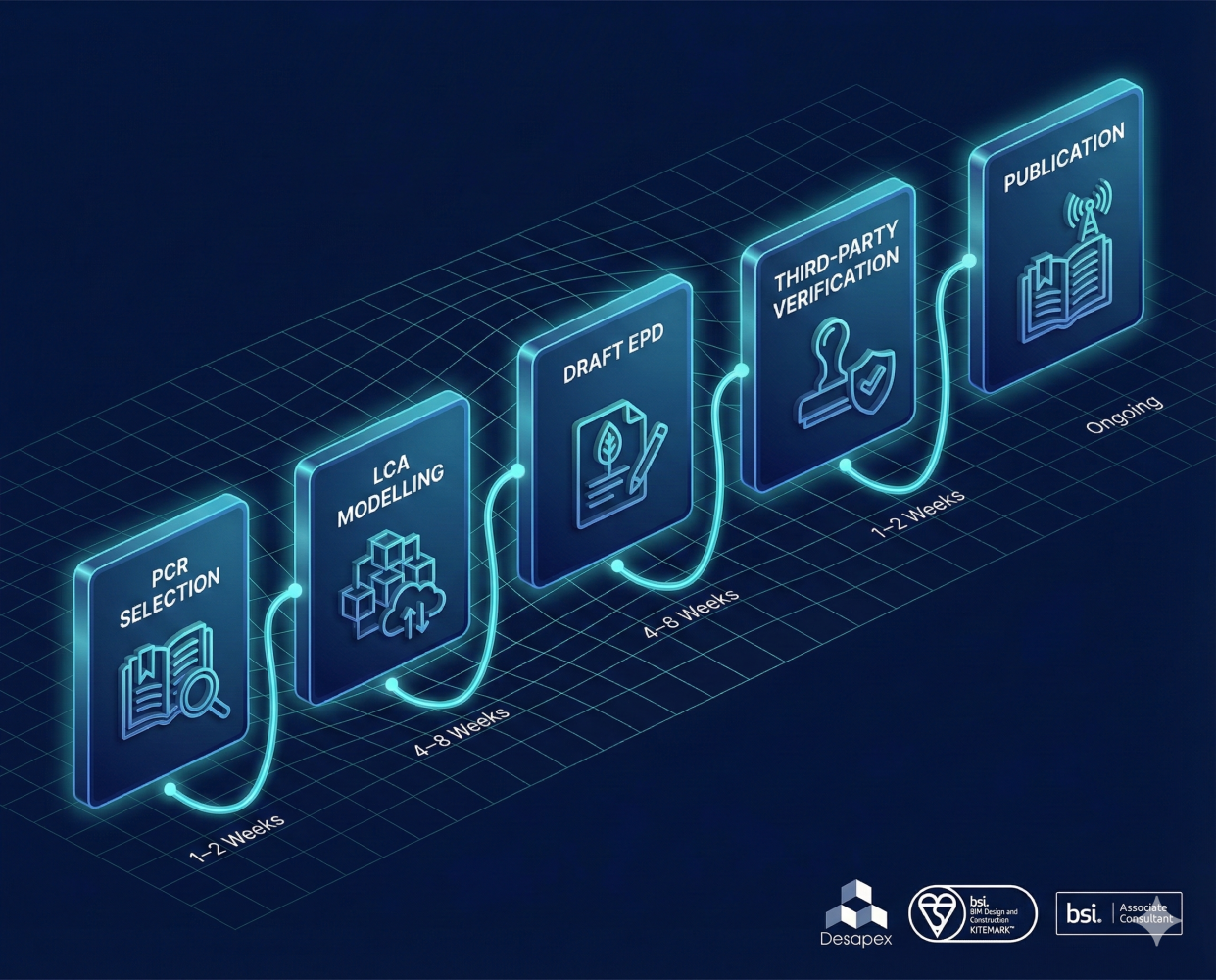
  • Work with accredited verification bodies and independent verifiers who understand both EN 15804 and Indian manufacturing realities, and plan for 6 -12 weeks of review and verification lead time depending on complexity.

Desapex can coordinate PCR selection, programme operator engagement, and verifier interactions, so internal teams focus on data and improvements rather than on navigating administrative details

Flowchart: From PCR to publication

Data Collection & Modelling: What Manufacturers Must Prepare

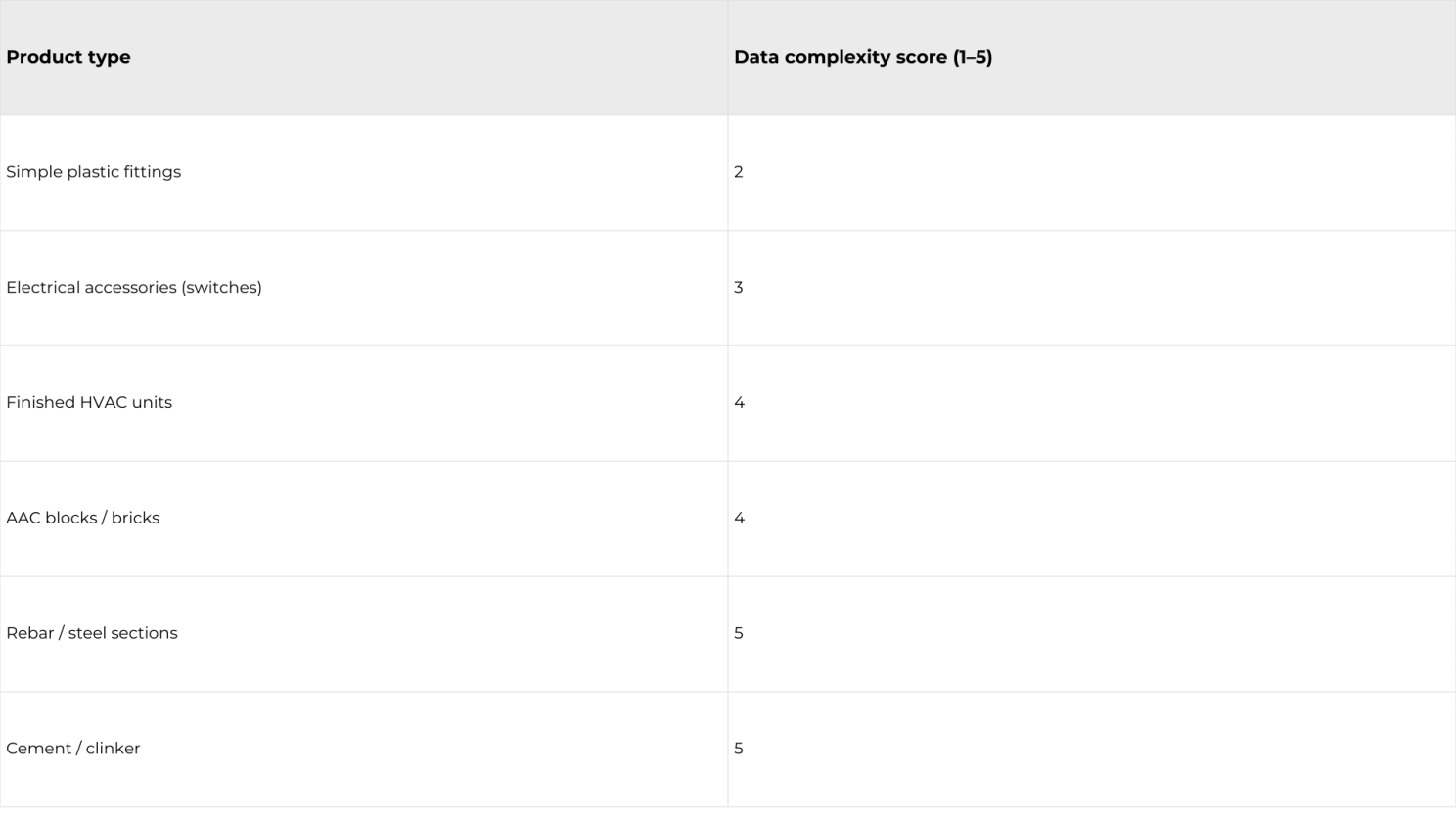
Successful EPDs are built on robust plant-level primary data: energy use by source, fuel consumption, raw materials and additives, water, packaging, waste streams, and logistics distances. For EN 15804+A2-compliant construction product EPDs, datasets must support mandatory life-cycle stages (A1–A3, C1–C4, D) and expanded impact indicators using approved LCIA methods.

Typical challenges in Indian plants include fragmented data across ERP and utility bills, limited metering of process lines, weak waste segregation data, and inconsistent BoM structures between finance and engineering. Bridging these gaps requires a data readiness checklist and structured templates.

Desapex has developed LCA data templates tailored to Indian factories and linked to BIM and digital twins where relevant, enabling smoother annual updates and product variant coverage.

Article content

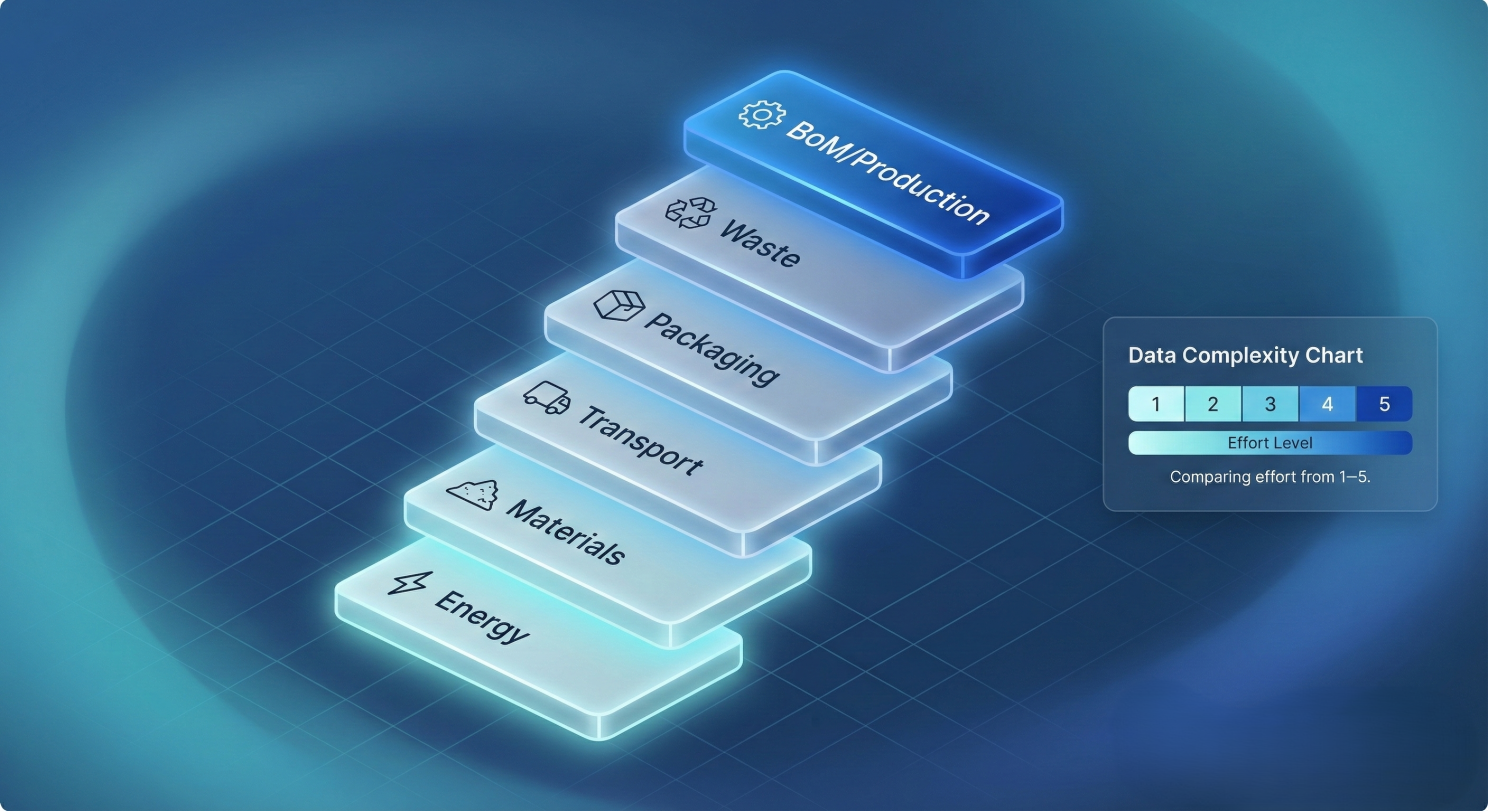
Suggested checklist items:

  • Energy: monthly electricity (kWh), fuel use by type (diesel, furnace oil, coal, gas), and on-site generation.
  • Materials: input quantities per product (cement, aggregates, resins, metals, additives), recycled content and by-products.
  • Transport: inbound raw material distances and modes, outbound product distribution profiles.
  • Packaging: types and weights per unit (pallets, films, bags).
  • Waste: process waste, scrap, reuse, recycling, and disposal routes.
  • BoM and production: standard product recipes, batch sizes, line yields.

Raw data table (relative effort score, 1–5)

Article content

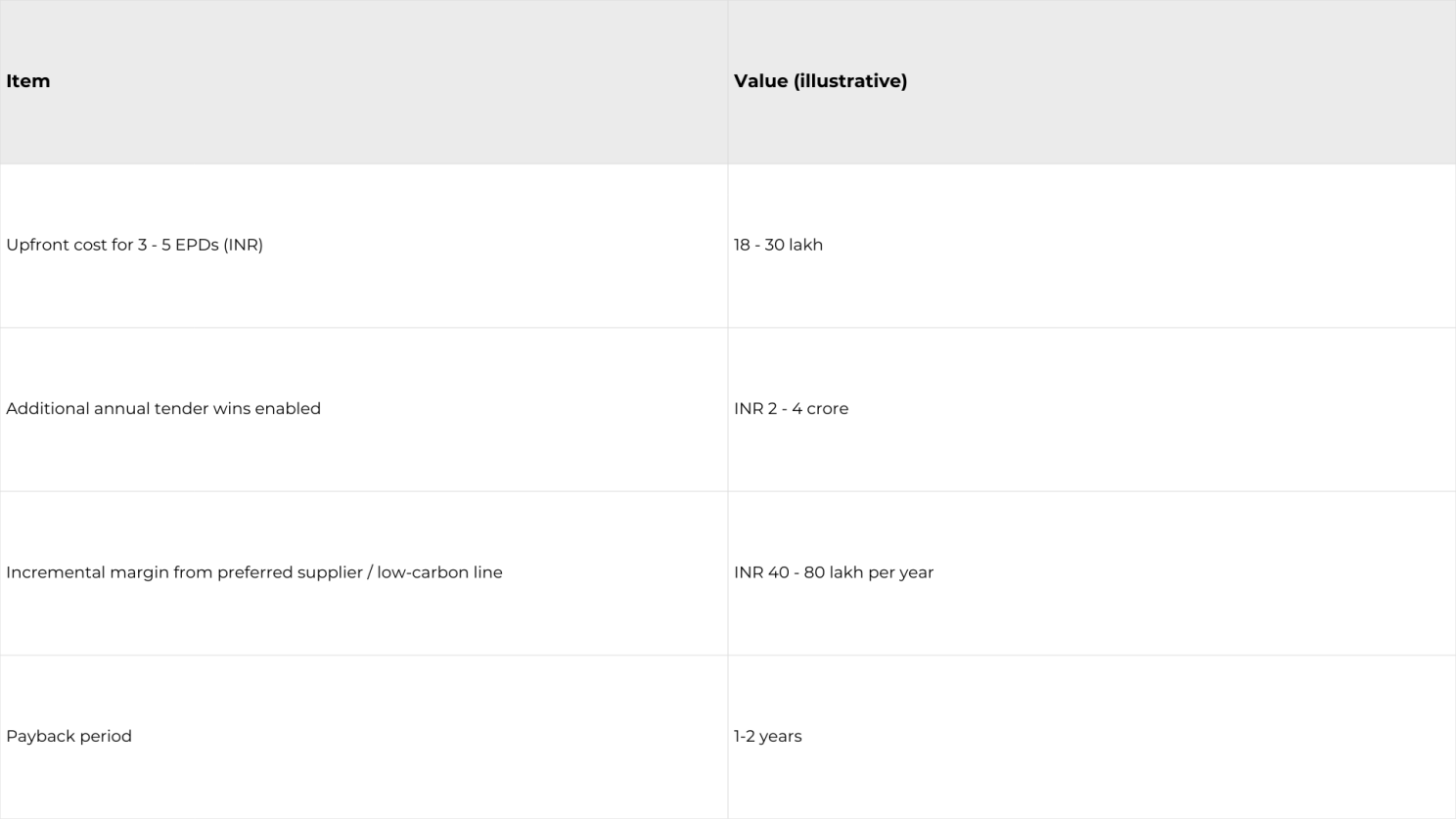
Commercial Benefits of EPDs: ROI, Tender Win Rate, Export Access

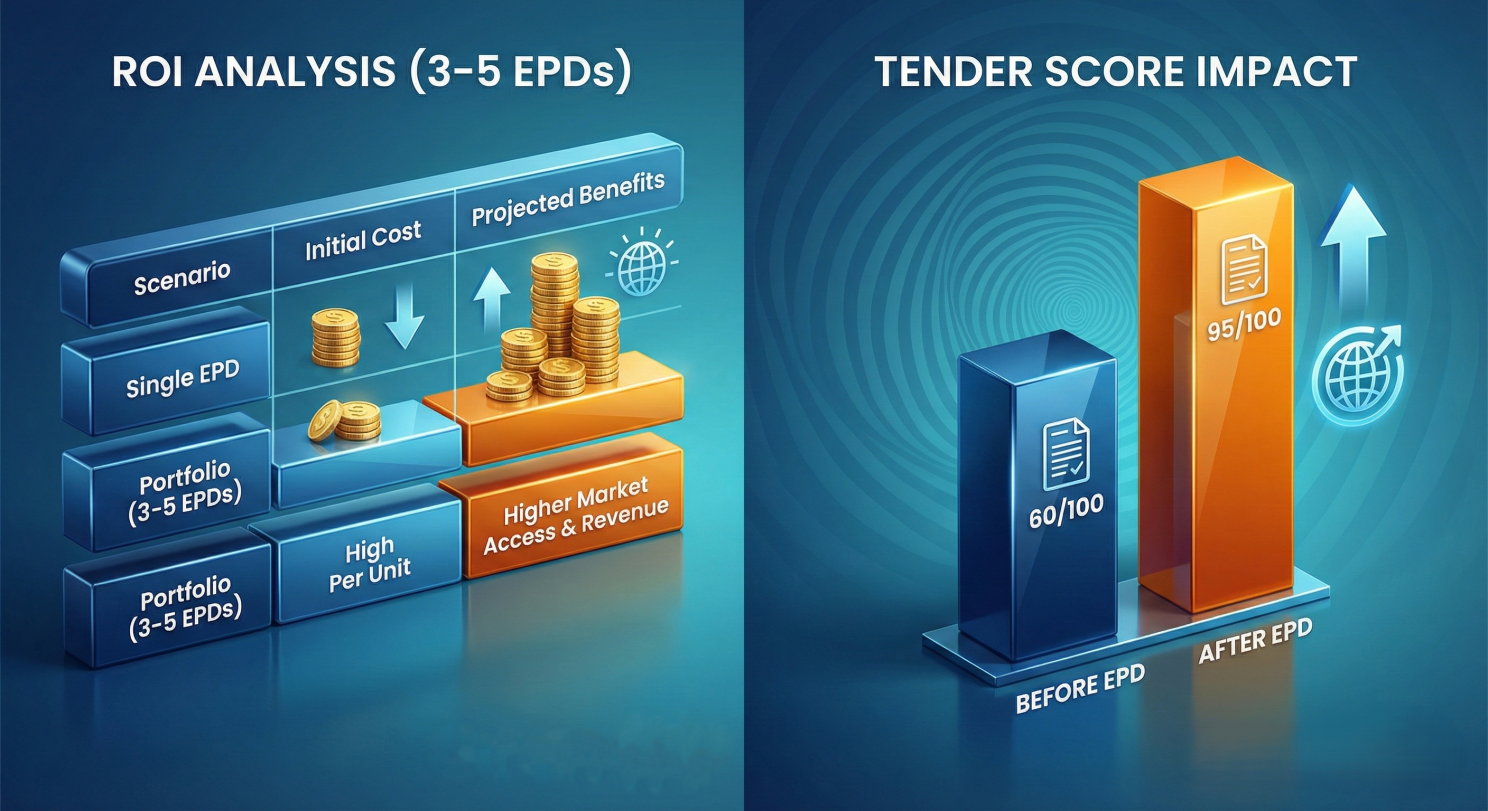
EPDs are not just compliance tools; they can improve tender scores, unlock export opportunities, and support premium pricing for low-carbon or transparent products. Green building systems such as LEED, BREEAM, and IGBC provide credits for product transparency, material optimisation, and embodied carbon reduction where EPD backed products help projects achieve higher rating levels and differentiate in the market.

European public and private buyers increasingly use EPDs as input to life cycle carbon benchmarks and procurement decision tools, especially under EU Green Public Procurement and national low-carbon building regulations. For Indian suppliers, having EN 15804 compliant EPDs can be a minimum ticket to enter certain project supply chains, particularly where clients have SBTi targets and strong Scope 3 decarbonisation commitments.

Desapex supports manufacturers in turning EPDs into sales and tender tools linking product carbon data into bid documentation, customer presentations, and building LCAs to demonstrate clear value, not just certificates.

Article content
Article content

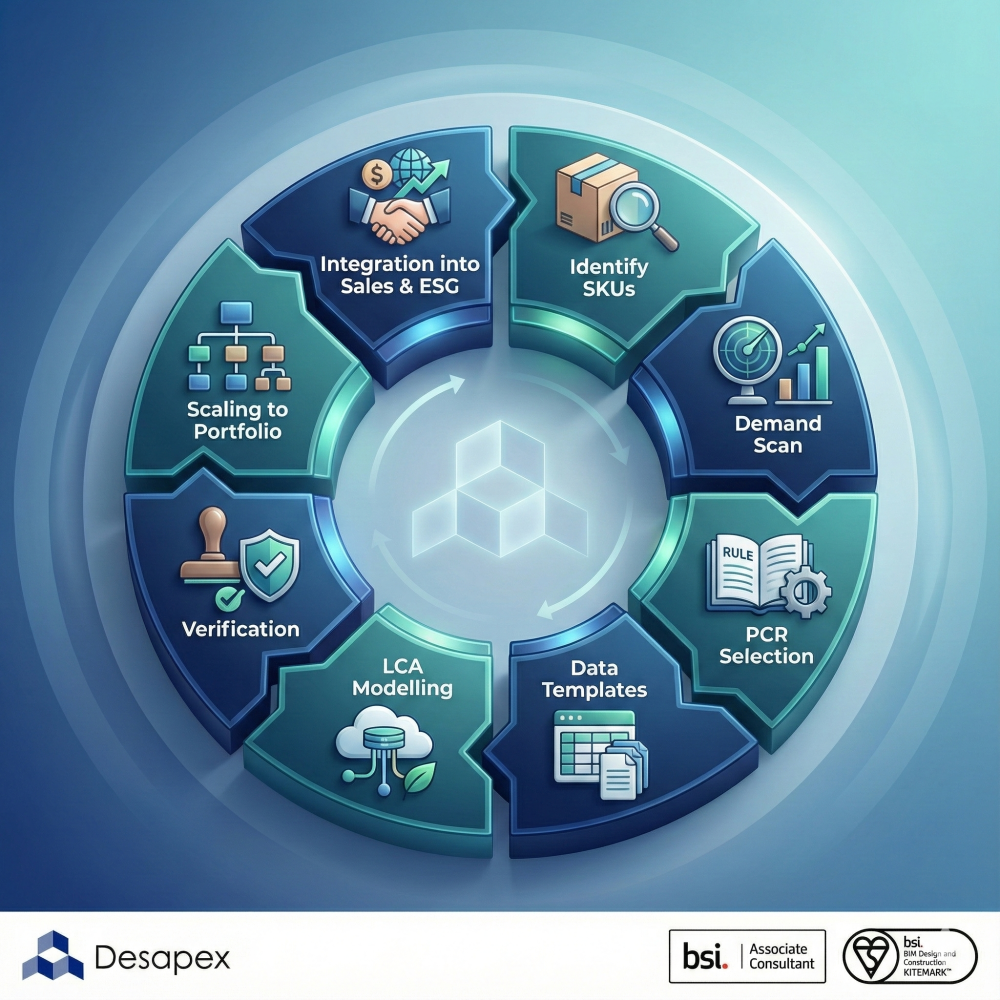
Your Next Steps: Practical 8-Step Manufacturer Action Plan

Manufacturers do not need to solve everything at once; a staged 8-step plan can move you from awareness to a functioning EPD portfolio in 6 - 18 months, depending on complexity. Each step should be owned by a small cross - functional team (commercial, plant, sustainability, finance), with clear timelines and decision points.

Eight-step action plan

  1. Identify high-value SKUs: Use the scoring matrix to shortlist 3 - 5 products with strong business and green building relevance.
  2. Conduct a market and tender demand scan: Review CPWD / PSU tenders, EU procurement portals, and green building rating systems to quantify EPD demand.
  3. Select PCRs and programme operators: Align with EN 15804+A2 where relevant and choose ECO Platform recognised programmes for EU-facing products.
  4. Build data collection templates: Implement plant level data templates and a data readiness checklist integrated with existing IT systems.
  5. Perform LCA modelling: Use EN 15804+A2-compatible databases and tools, ensuring quality checks and internal review.
  6. Undergo verification and publication: Engage independent verifiers early; plan for 6–12 weeks for reviews and corrections.
  7. Scale to a portfolio: Convert the first EPD into reusable templates; extend to product families and variants.
  8. Integrate into sales, tenders, and ESG: Embed EPD data in brochures, digital catalogues, tender submissions, and Scope 3 / ESG disclosures.
Article content

Share on social media:

Related Articles:

Browse all articles
Thank you! Your submission has been received!
Oops! Something went wrong while submitting the form.
Thank you! Your submission has been received!
Oops! Something went wrong while submitting the form.