



Introduction
Manufacturing worldwide is at a tipping point. Global factories are simultaneously facing supply chain disruptions, tariff-driven cost volatility, workforce shortages, and mounting ESG and regulatory pressures. Customers expect faster delivery, higher customization, and consistent quality, while leaders must keep costs under control and assets running with minimal downtime.
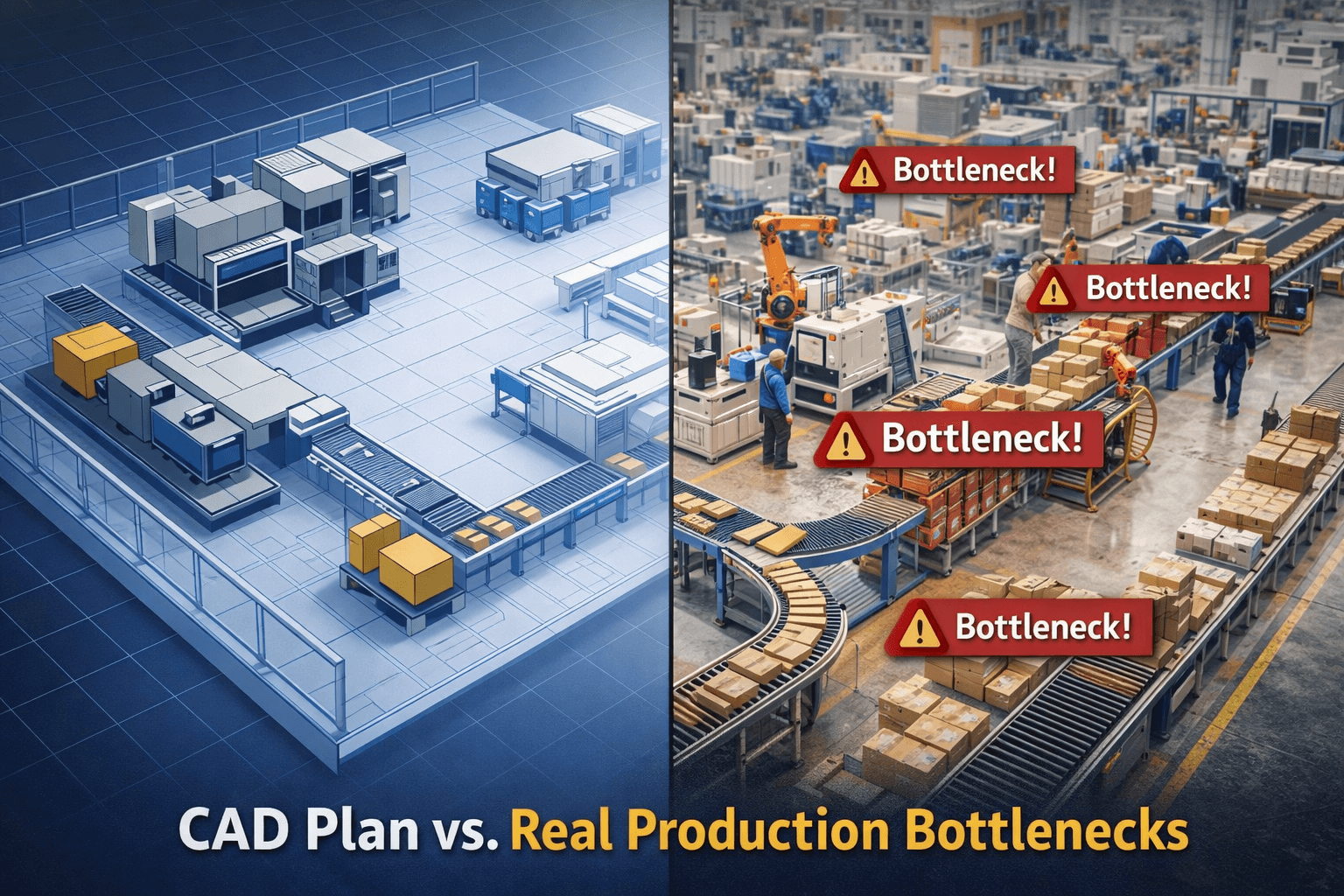
In this environment, traditional trial-and-error optimization on the shop floor is increasingly dangerous. A poorly tested change to layouts, shift patterns, or material flow can trigger missed orders, contractual penalties, and reputational damage. Manufacturers need a way to experiment safely, learn quickly, and implement only those changes that are proven to work.
This is where simulative digital twins built using discrete event simulation (DES) become essential. Across sectors such as automotive, FMCG, pharmaceuticals, electronics, and heavy industry, digital twins are being used to validate production scenarios, optimize capacity, and stabilize supply chains before a single real-world change takes place.
Why Manufacturing as a Whole Is Under Pressure
Across the global manufacturing landscape, several converging forces are increasing operational stress:
Supply chain volatility: Tariffs, geopolitical shifts, and logistics disruptions are reshaping trade flows and raising input costs.
Economic uncertainty: A majority of chief economists and manufacturing leaders expect weaker or unstable conditions, forcing firms to do more with less and be highly agile.
Workforce and skills gaps: Plants must manage talent shortages, varying labor laws, and the need to upskill workers for advanced automation and analytics.
ESG and sustainability expectations: Manufacturers are under pressure to cut emissions, reduce waste, and improve energy efficiency while maintaining competitiveness.
These pressures are not limited to any single subsector. From discrete parts factories to process plants, the common challenge is the same: optimize complex systems without risking live operations.
What a Simulative Digital Twin Brings to Manufacturing
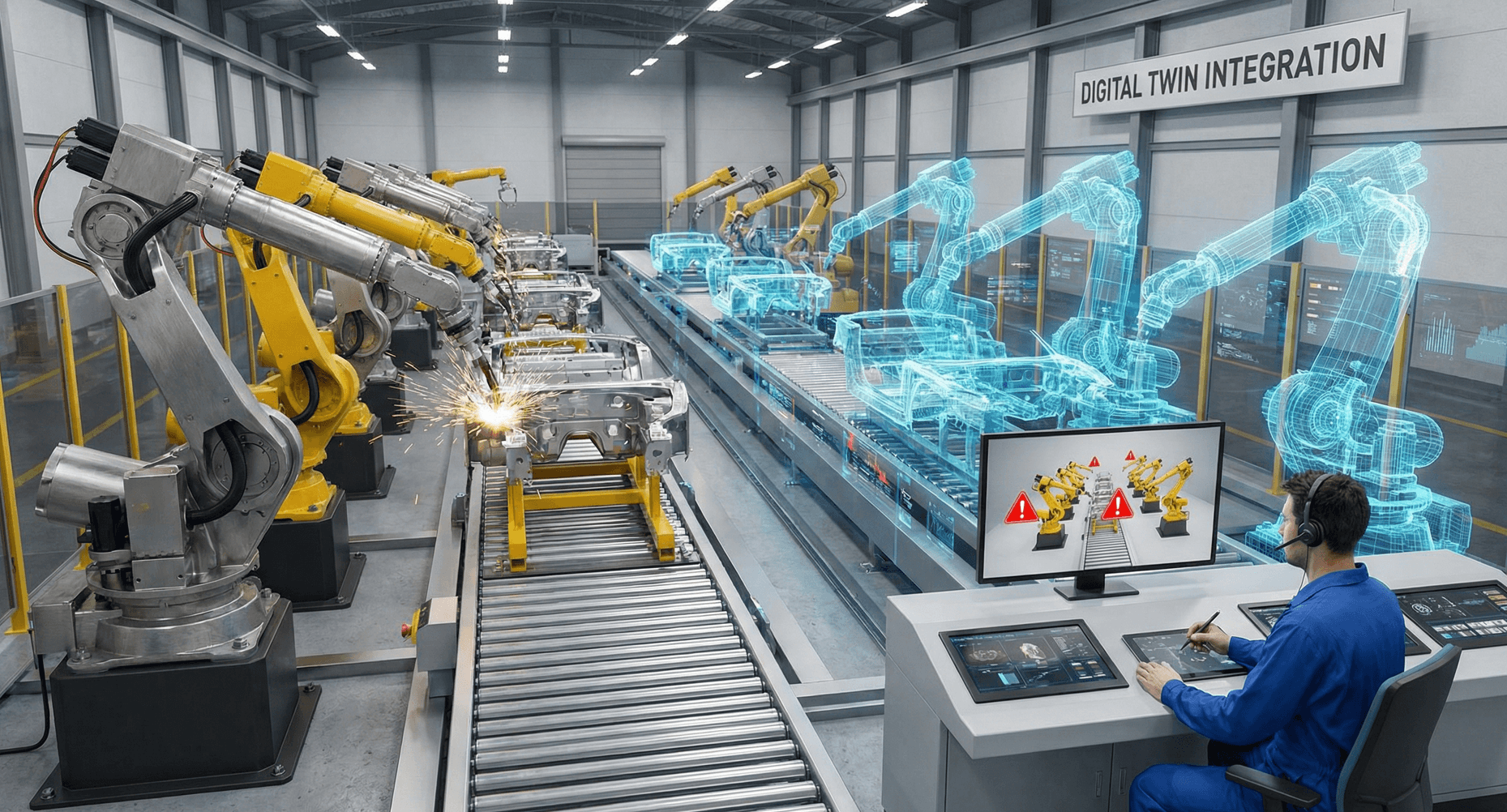
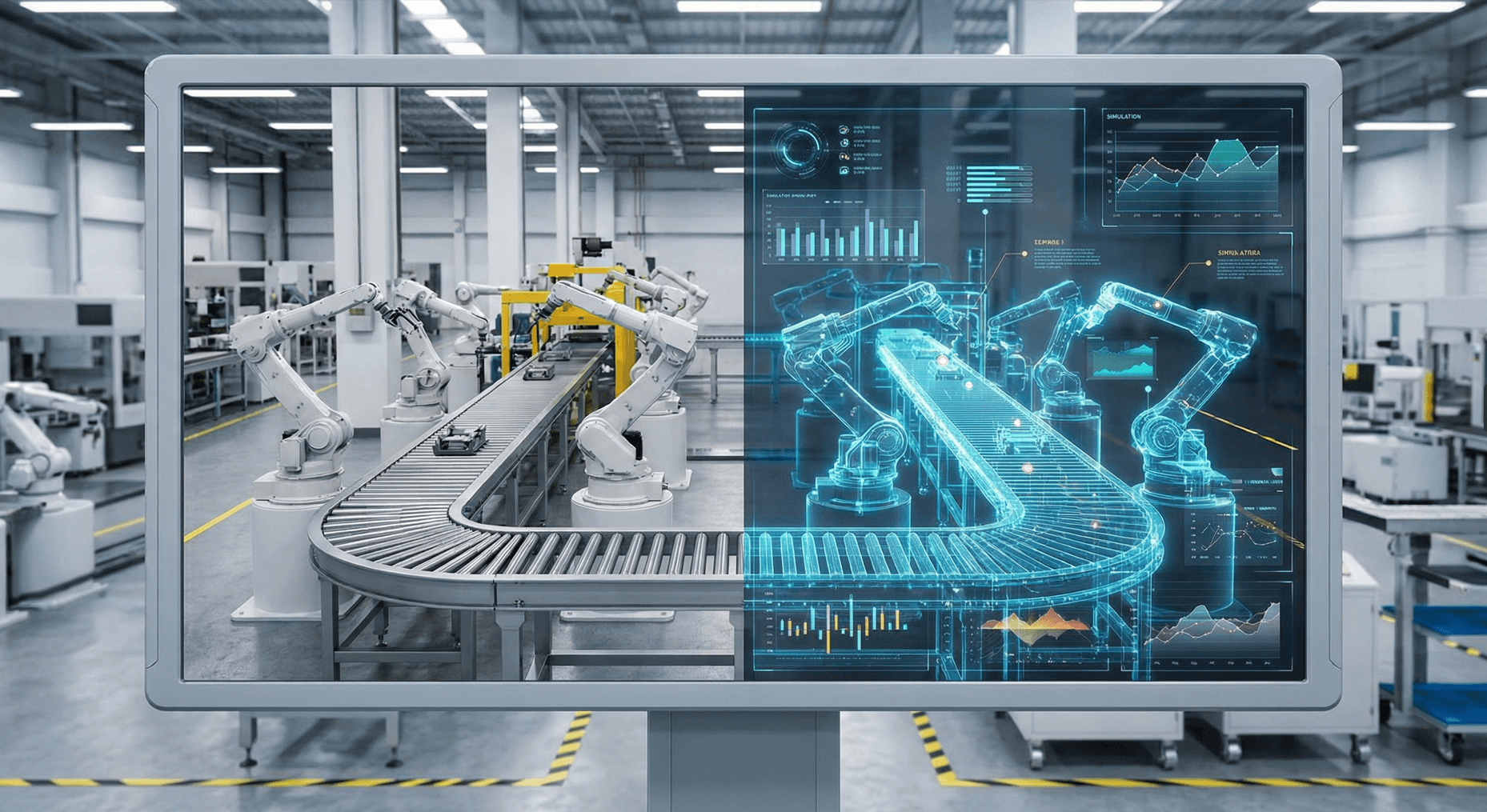
A digital twin in manufacturing is a dynamic virtual replica of a production system that uses real data, IoT streams, and simulation to mirror real-world behavior. When powered by discrete event simulation, it enables teams to conduct thousands of experiments safely and quickly, uncovering interactions and bottlenecks that are invisible in spreadsheets or static models.
Key benefits across industries include:
Risk-free experimentation: Test layout changes, buffer sizes, shift patterns, and automation options without disrupting production.
Optimized throughput and cost: Multiple case studies show DES delivering 20–40% throughput gains and significant cost reductions by targeting true constraints instead of perceived ones.
Inventory and space optimization: Digital twins help right-size WIP and storage, freeing working capital and optimizing warehouse/floor space usage.
Improved quality and reliability: Stable cycle times, better process capability, and predictive monitoring support higher sigma levels and fewer defects.
Faster time-to-market: Virtual prototyping and process design reduce the time needed to introduce new products and ramp up production lines.
Digital twins and DES are now recognized as foundational tools for digital factories, enabling better decisions throughout the lifecycle from greenfield design to brownfield optimization and continuous improvement.
How Manufacturers Build and Use Simulative Digital Twins
Whether in automotive components, pharmaceuticals, F&B, or electronics, the methodology for building a simulative digital twin is similar.
Data Foundation
Gather time-study data and performance history from existing lines.
Capture layout information (2D drawings, 3D scans, or BIM-style factory models).
Integrate resource constraints, shift patterns, and supplier lead times.
Model Creation in DES
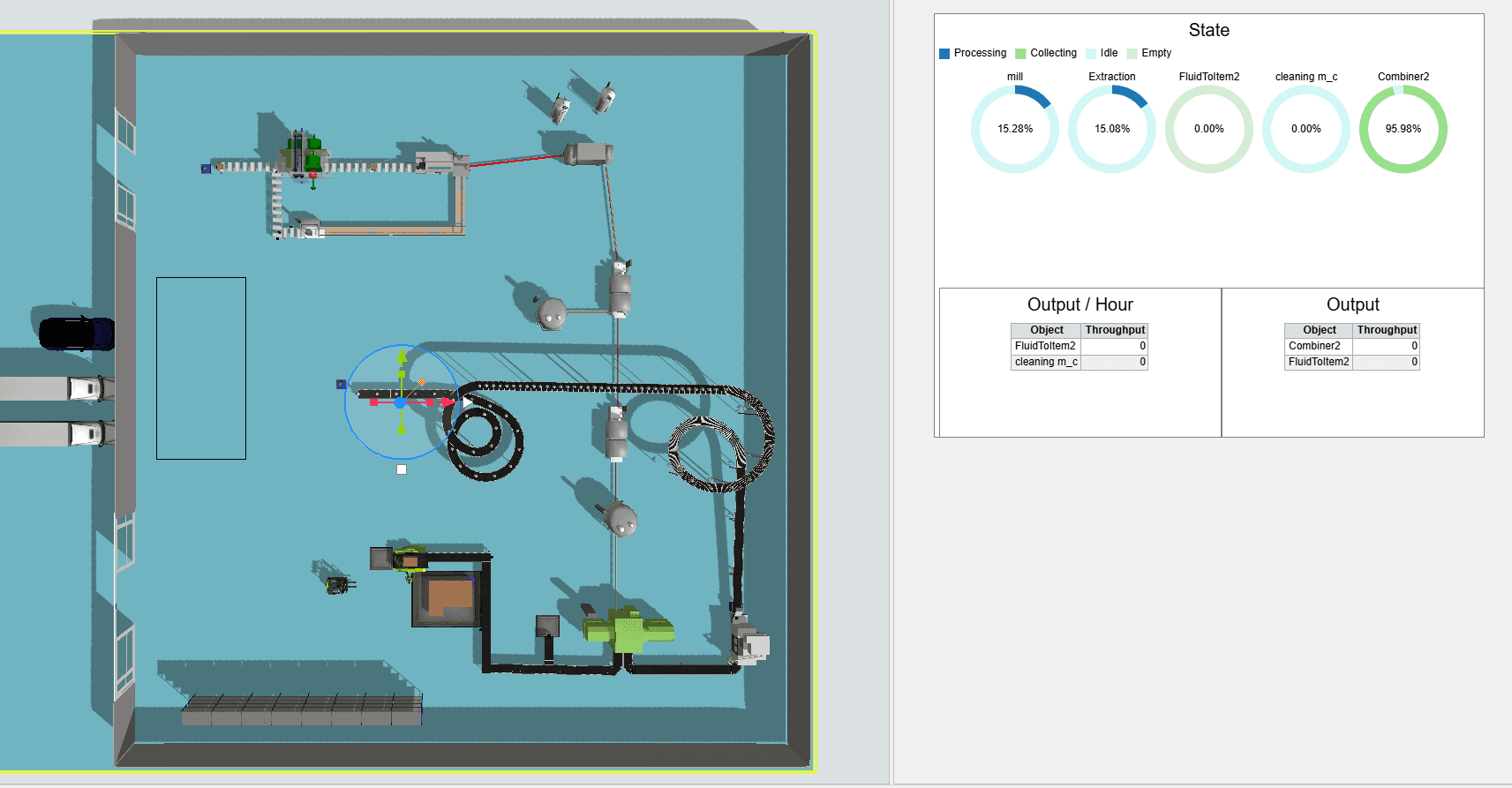
Represent each workstation, buffer, conveyor, and transport system in a DES tool (e.g., FlexSim, SIMIO, Plant Simulation).
Encode logic for arrivals, processing, failures, rework, and maintenance.
Introduce variability via probability distributions for realistic behavior.
Validation Against Reality
Compare simulated KPIs (throughput, WIP, utilization, lead time) with historical plant data.
Iterate until the model reliably reproduces current performance. At this point, it becomes a trusted digital twin of the system.
Experimentation and Optimization
Run structured experiments across hundreds of configurations using built-in experiment managers and optimization plugins.
Evaluate trade-offs between throughput, cost, WIP, staffing, and capital investment.
Turn successful configurations into implementation playbooks and rollout plans.
This structured approach is being applied in industries from beverages to pharmaceuticals, where DES has been used to:
Identify hidden bottlenecks and improve line throughput by 30% for a beverage manufacturer.
Avoid a 50 million USD unnecessary equipment investment in a pharmaceutical plant by revealing that a non-obvious stage (dispensing, not blending) was the true constraint.
Two Practical Examples from Discrete Manufacturing
The same principles apply to your two discrete manufacturing case studies, which are positioned here as illustrative examples within the broader manufacturing context.
Example 1: Precision Component Line – Solving a Curing Bottleneck
A precision component assembly line, operating across 15 stations, struggled with a 4-hour curing step that created a severe bottleneck. The first shift produced no output, upstream stations hoarded WIP, and downstream stations remained idle.
Using DES and a digital twin:
The entire line was modeled, including cycle times, layouts, and shift structures.
Baseline throughput of 6 units/day was validated in simulation.
Multiple scenarios for material release rules and shift timing were tested virtually.
The key insight was that synchronization, not equipment speed, was the root cause. Aligning material arrivals and shift boundaries with the 4-hour curing cycle enabled:
Throughput increase from 6 to about 10 units/day.
Elimination of first-shift zero-output behavior.
Sharp reduction in pre-bottleneck accumulation and post-bottleneck idle time.
This kind of problem misaligned curing, baking, mixing, or sterilization steps appears across industries like food, chemicals, and pharma, and can often be resolved through DES-driven synchronization rather than new equipment.
Example 2: Engine Assembly Line – Multi-Parameter Synchronization
An 11-station assembly line for a complex product (in this case engines, but analogous to many multi-component products) faced high cycle time variability due to unsynchronized component arrivals and unregulated inventory.
By building a simulative digital twin and testing 350–500 scenarios, the team:
Reduced cycle time from 75 minutes to about 45–50 minutes.
Cut variability from ±15 minutes to about ±2–3 minutes.
Reorganized deliveries to controlled intervals, shrinking excess inventory roughly to one-third.
Identified where targeted automation would deliver the best ROI, focusing on stability rather than raw speed.
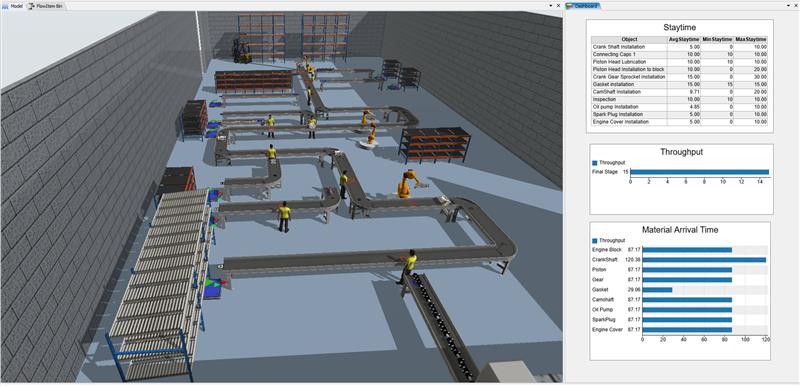
These patterns component arrival of desynchronization, over- or under-stocking, and unpredictable cycle times are common in many sectors such as consumer goods, electronics, and machinery. Digital twins and DES offer a systematic way to untangle them.
Strategic Payoff for Manufacturing Leaders
Across sectors, DES-powered digital twins support a more resilient and intelligent manufacturing strategy:
Operational resilience: Plants can simulate shocks demand surges, supplier delays, equipment failures and predefine robust responses.
Capital discipline: Investments in new equipment, automation, or layout changes are validated before money is spent.
Continuous improvement culture: The digital twin becomes a persistent asset used by engineering, operations, and planning teams to test ideas and train staff.
Analysts note that manufacturers who resume and accelerate their digital investment agendas including simulation, digital twins, and advanced analytics are better positioned to navigate tariffs, supply chain disruptions, and shifting customer expectations.
Conclusion
Manufacturing as a whole not just automotive is operating under unprecedented pressure from volatile supply chains, economic uncertainty, labor constraints, and sustainability expectations. In this context, simulative digital twins powered by discrete event simulation offer a practical and proven way to de-risk operational changes, unlock hidden capacity, and stabilize performance.
By building validated digital replicas of production systems, manufacturers can explore hundreds of configurations in hours rather than months, ensuring that only data-backed, low-risk strategies reach the factory floor. The examples of curing-bottleneck removal and assembly-line synchronization are not isolated from success stories but part of a broader movement toward predictive, resilient, and continuously optimized manufacturing.