


AI is changing data centres faster than many existing facilities were designed to handle.
The challenge isn't simply that AI needs more servers. AI workloads are changing the density, power profile, cooling requirements, network architecture and scalability expectations of the data centre itself.
A facility that was designed for conventional enterprise computing may have sufficient floor space, yet lack the electrical capacity, cooling infrastructure or network architecture required for high-density AI workloads.
So, what is actually changing in data centres in the AI era?
The answer goes well beyond GPUs.
Why AI is changing data centre infrastructure
Traditional data centres were generally designed around relatively predictable IT loads, established rack densities and predominantly air-based cooling.
AI infrastructure introduces a different set of engineering requirements.
AI training and inference rely heavily on GPUs and other high-performance accelerators. These systems can concentrate significantly more power and heat into individual racks, while also requiring high-speed communication between large numbers of processors.
That creates a chain reaction:
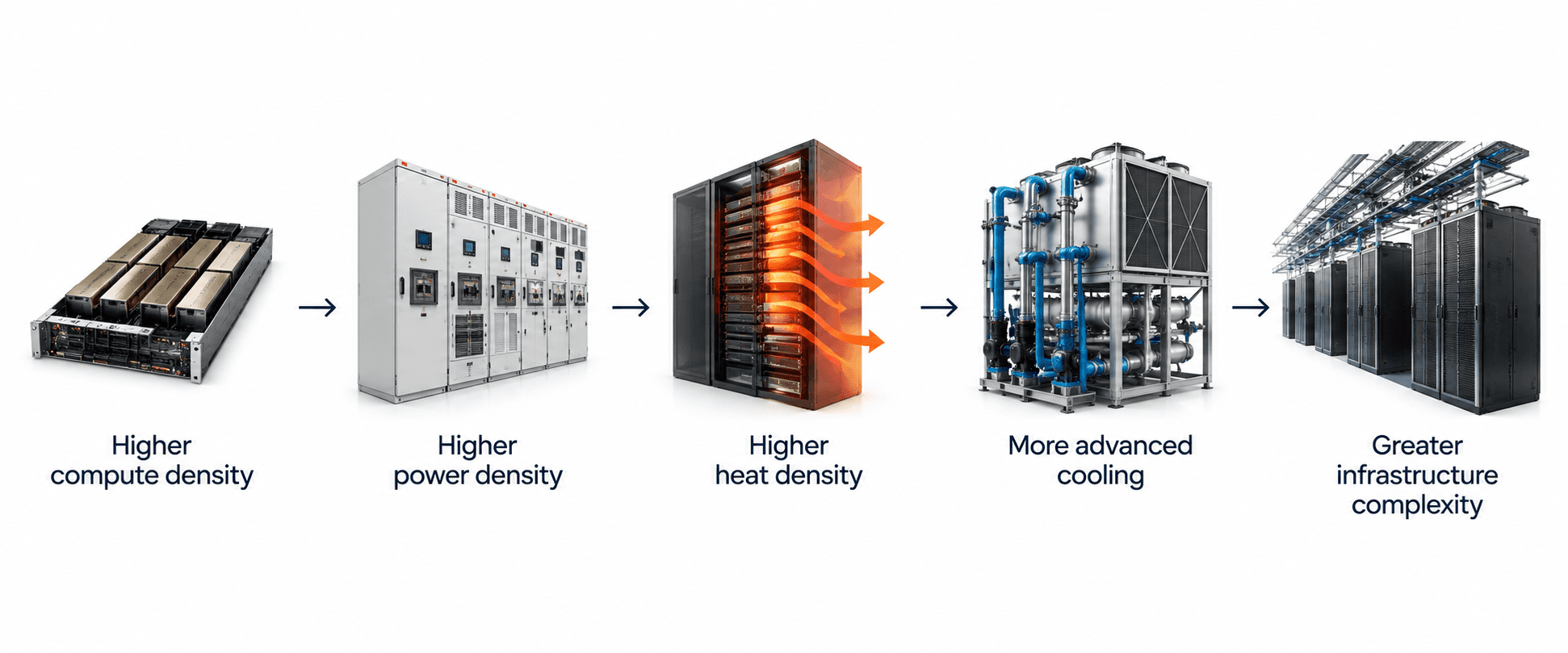
At the same time, AI workloads are evolving quickly. Today's rack configuration may not represent tomorrow's.
For data centre developers and operators, this creates a new priority: design infrastructure that can accommodate increasing density without repeatedly redesigning the facility.
1. Rack density is becoming a critical design parameter
For years, data centre planning often revolved around total IT capacity.
AI makes where that capacity is concentrated equally important.
A facility might have enough overall power to support a particular IT load, but its electrical and mechanical systems may not be able to deliver that capacity to a small number of extremely dense racks.
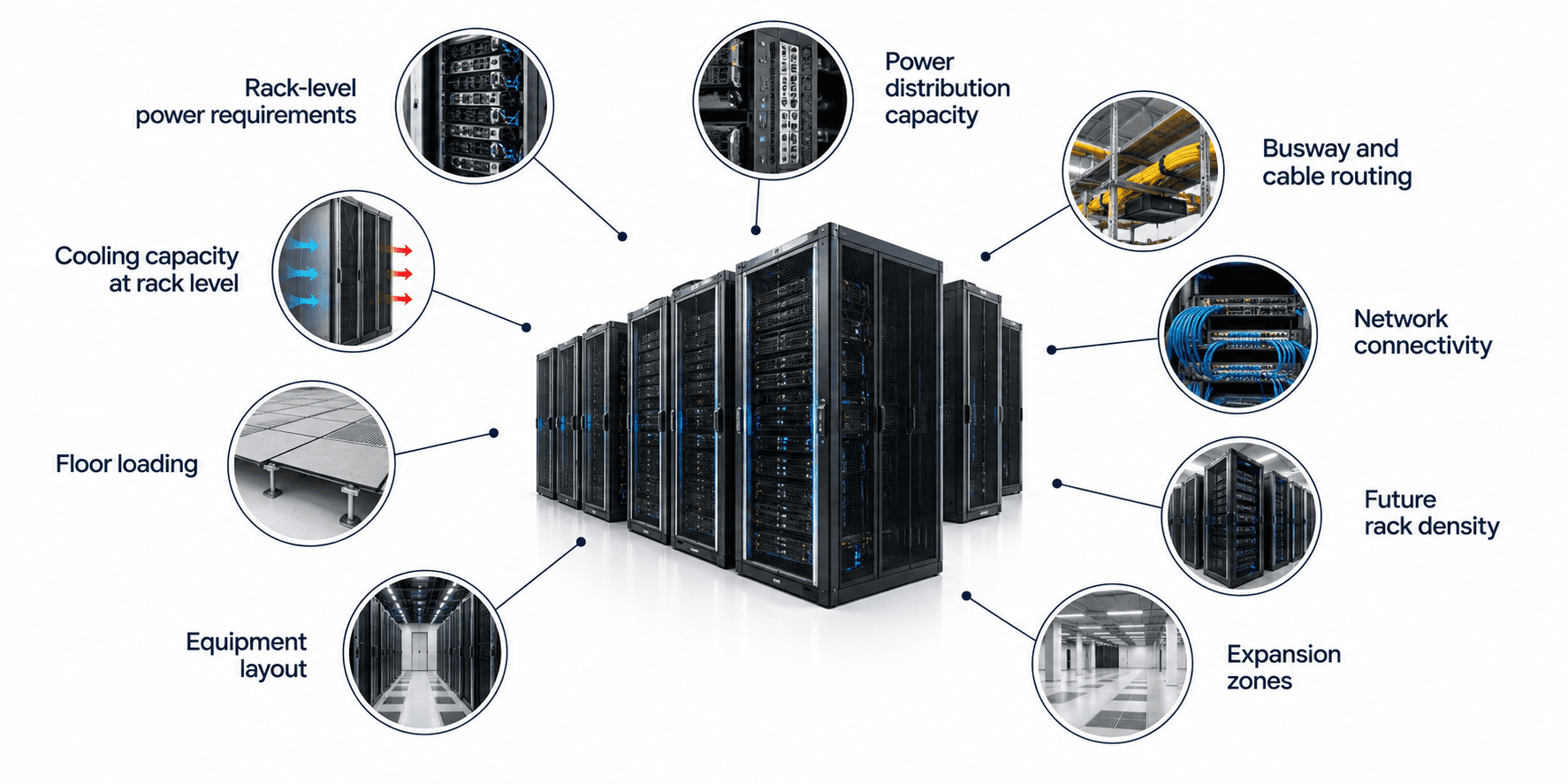
AI-ready data centre design therefore needs to consider:
Rack-level power requirements
Power distribution capacity
Cooling capacity at rack level
Floor loading
Equipment layout
Busway and cable routing
Network connectivity
Future rack density
Expansion zones
A practical example
Consider an existing data centre with several hundred square metres of available floor space.
At first glance, there appears to be plenty of room for an AI cluster.
But an engineering assessment reveals that the available electrical distribution was designed around lower rack densities. The cooling system also has limited capacity in the proposed deployment area.
The problem isn't available floor space.
The problem is the infrastructure envelope.
This is why AI data centre planning needs to evaluate power, cooling, network and physical infrastructure together not independently.
2. Cooling is moving beyond conventional air cooling
One of the biggest changes brought by AI is the increasing importance of liquid cooling.
Conventional air cooling remains effective for many workloads. However, as rack power densities increase, removing heat using air alone can become increasingly challenging.
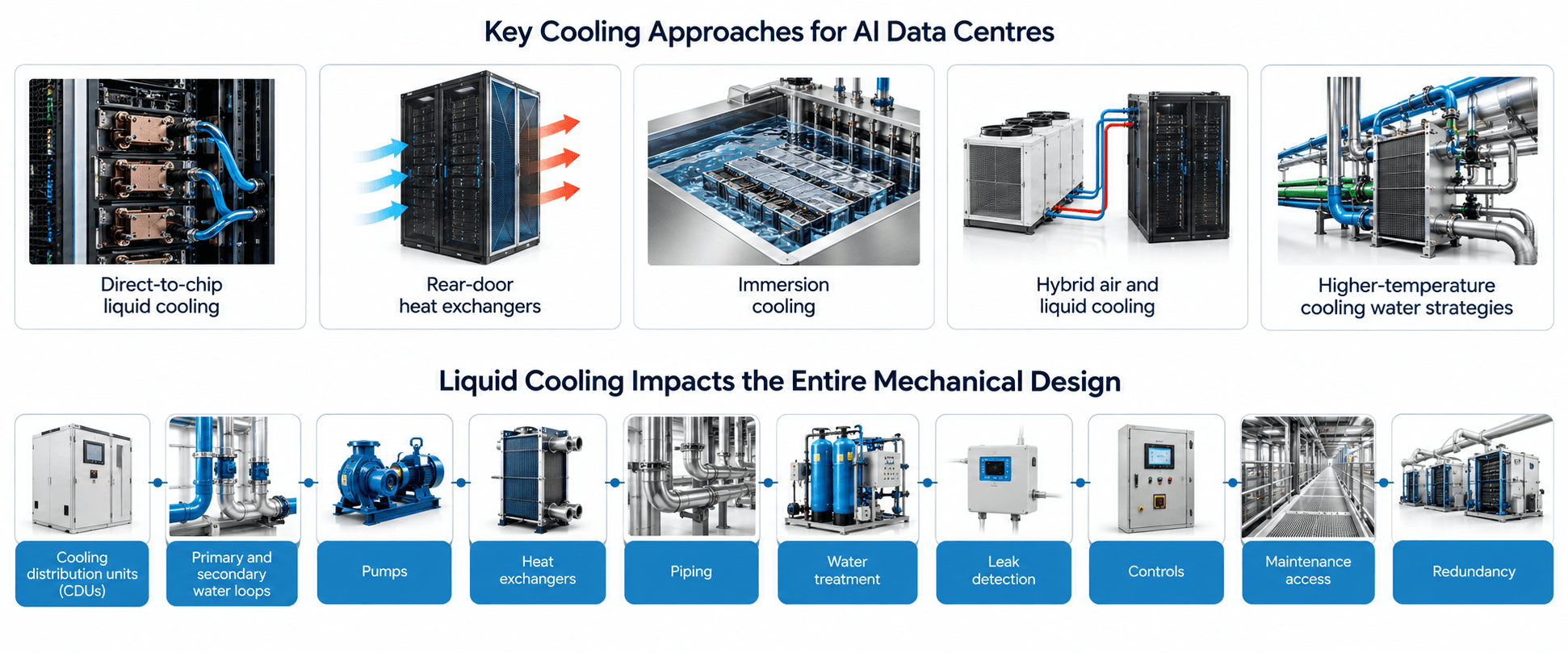
Several cooling approaches are becoming more relevant, including:
Direct-to-chip liquid cooling
Rear-door heat exchangers
Immersion cooling
Hybrid air and liquid cooling
Higher-temperature cooling water strategies
Direct-to-chip liquid cooling is particularly relevant for high-density AI environments because coolant can remove heat directly from components that generate significant thermal loads.
But liquid cooling is not simply a replacement for an existing CRAC or CRAH system.
It can affect the entire mechanical design, including:
Cooling distribution units (CDUs)
Primary and secondary water loops
Pumps
Heat exchangers
Piping
Water treatment
Leak detection
Controls
Maintenance access
Redundancy
The important shift is therefore not simply “air cooling versus liquid cooling.”
It is understanding which cooling architecture is appropriate for each workload and density zone.
3. Power becomes an even bigger constraint
AI infrastructure can significantly increase data centre power requirements.
But securing additional power is only one part of the challenge.
The electrical infrastructure must also be capable of delivering that power reliably to high-density loads.
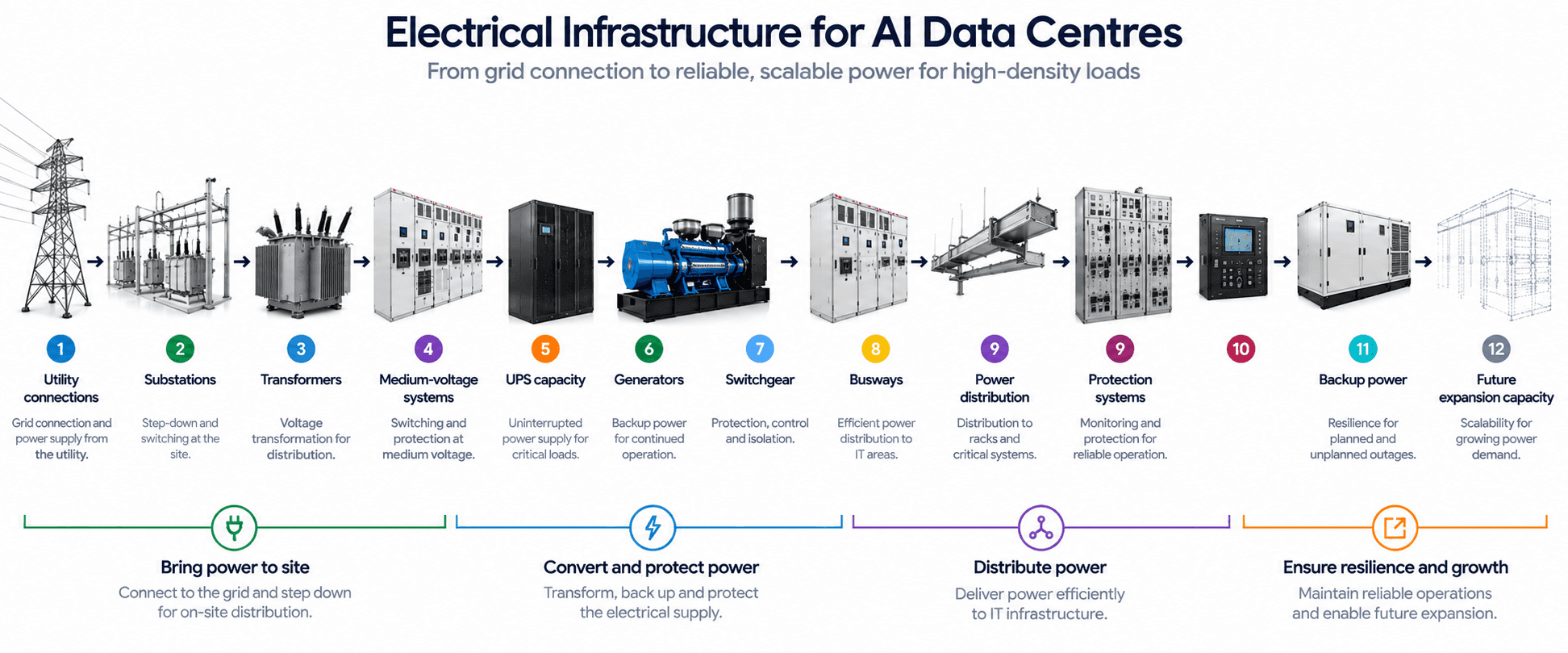
This affects:
Utility connections
Substations
Transformers
Medium-voltage systems
UPS capacity
Generators
Switchgear
Busways
Power distribution
Protection systems
Backup power
Future expansion capacity
This makes power planning an increasingly important part of data centre site selection and feasibility studies.
A site may have suitable land and fibre connectivity but still be unsuitable for an AI data centre if grid capacity or connection timelines cannot support the required load.
The earlier these constraints are identified, the more options a project team has.
4. Networking is becoming part of the infrastructure equation
AI clusters aren't simply large collections of powerful processors.
Those processors need to communicate with each other at extremely high speeds.
Training workloads can involve large volumes of data moving between accelerators, storage systems and other infrastructure.
As a result, AI data centre design needs to consider:
High-bandwidth networks
Low-latency connectivity
Network topology
Fibre infrastructure
Storage performance
Interconnect capacity
Network redundancy
Data movement
This changes how physical infrastructure is planned.
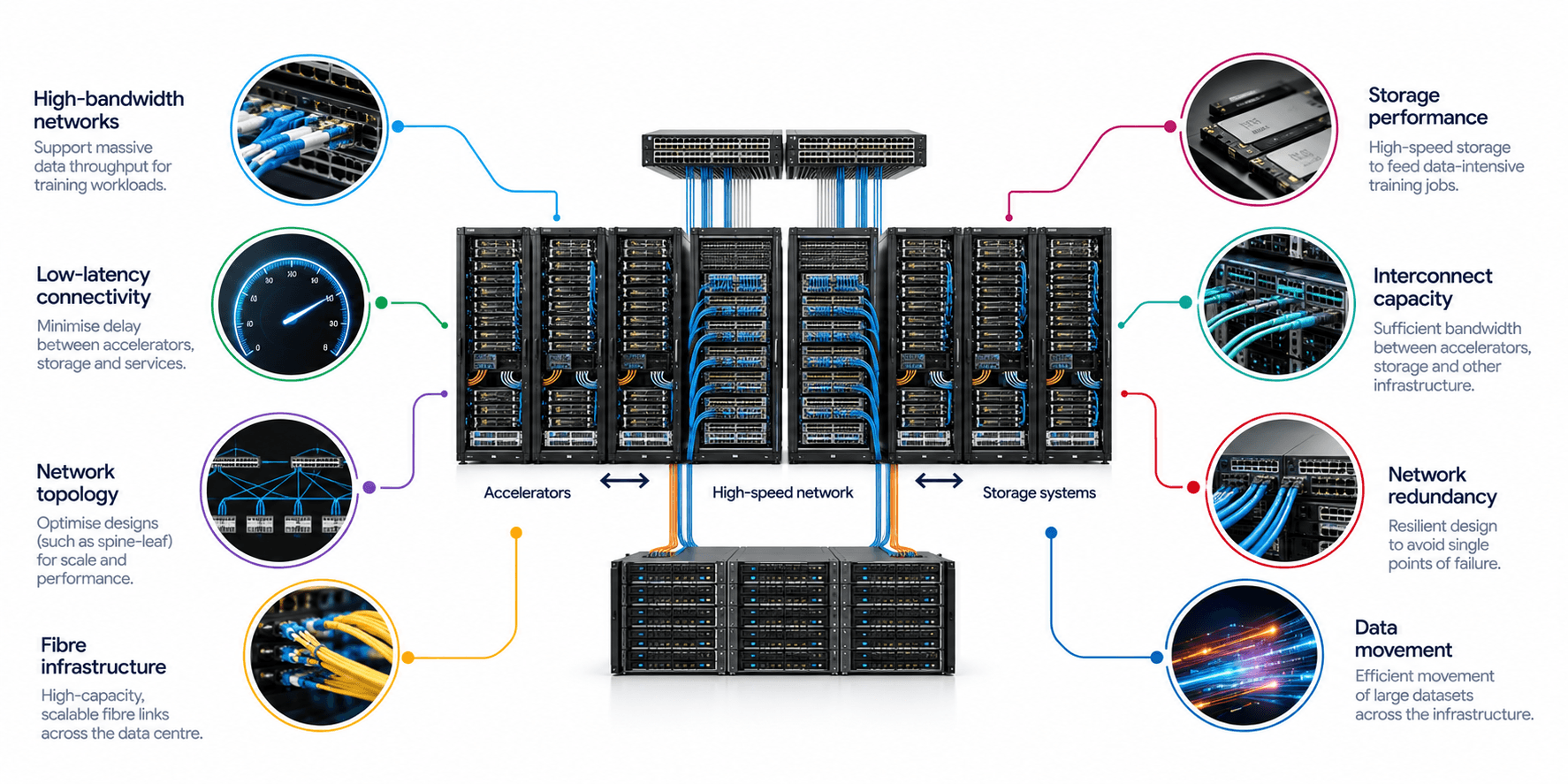
Cable pathways, equipment locations, network rooms and rack layouts need to be coordinated alongside electrical and mechanical systems.
In high-density environments, network architecture is no longer just an IT consideration it has physical implications for the building.
5. Data halls are becoming more heterogeneous
The future data centre is unlikely to consist entirely of identical racks.
A single facility may contain:
Conventional workloads
Lower-density enterprise servers using traditional air cooling.
AI training clusters
High-density accelerator infrastructure requiring significant power and potentially liquid cooling.
AI inference infrastructure
Distributed workloads with different performance and latency requirements.
High-performance storage
Infrastructure designed to support intensive data movement.
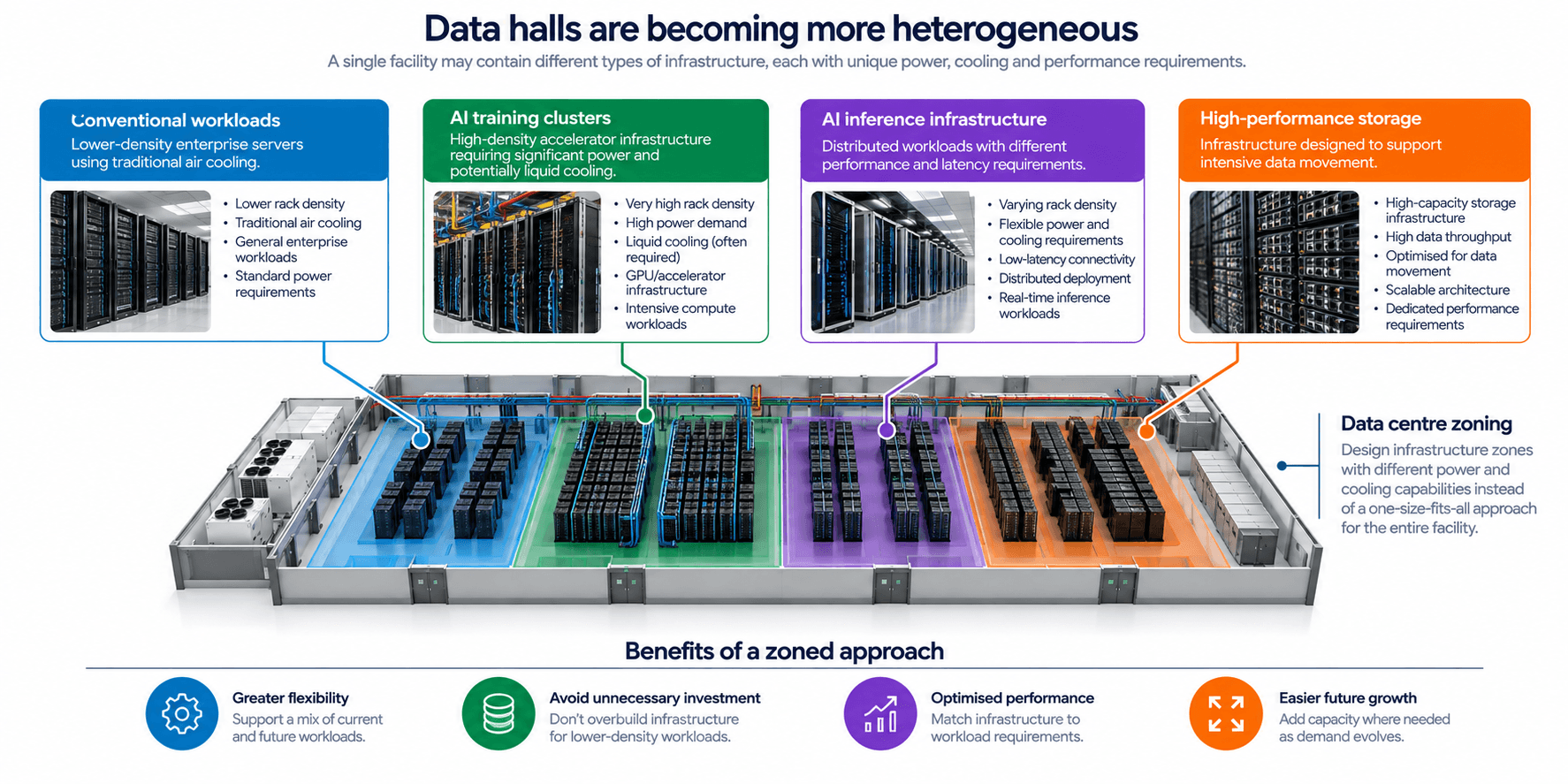
This creates the need for data centre zoning.
Instead of designing every part of a facility around one assumed rack density, developers can create infrastructure zones with different power and cooling capabilities.
That approach can improve flexibility while avoiding unnecessary investment in infrastructure that every workload doesn't require.
6. Existing data centres face a new challenge: AI retrofits
Not every AI deployment will happen in a brand-new hyperscale facility.
Many organisations will want to introduce AI workloads into existing data centres.
This creates a difficult engineering question:
Can the existing facility support the new workload?
A proper assessment should consider:
Electrical capacity
Can the existing electrical distribution support higher rack densities?
Cooling capacity
Can the mechanical system remove the additional heat?
Physical infrastructure
Can floors, pathways and equipment areas support the proposed deployment?
Network infrastructure
Can the existing connectivity support the required data movement?
Resilience
Will introducing higher-density loads affect redundancy or operational risk?
Expansion
Can the facility support further AI growth?
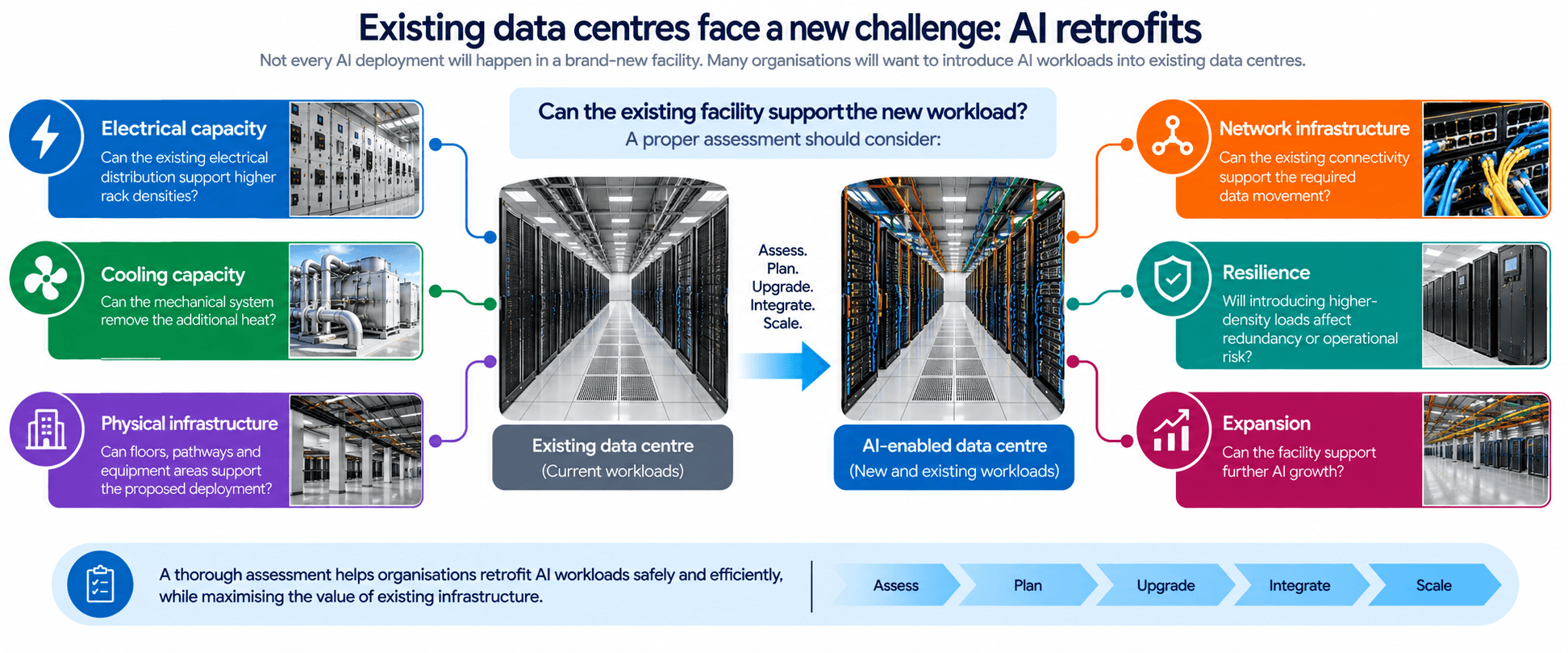
An AI retrofit should therefore begin with an engineering assessment, not equipment procurement.
7. Digital engineering becomes more important
As infrastructure becomes more complex, coordination becomes increasingly critical.
Imagine an AI deployment where:
New liquid-cooling pipes cross an electrical pathway.
A high-density rack exceeds the available cooling capacity.
Network cabling conflicts with mechanical services.
New equipment cannot be moved through the existing access route.
A proposed electrical upgrade affects maintenance clearances.
These issues are expensive to discover during construction.
They are considerably easier to identify during design.
This is where BIM and digital engineering become valuable.
A coordinated digital model can help project teams:
Detect multidisciplinary clashes
Validate equipment layouts
Coordinate MEP systems
Plan construction sequencing
Review maintenance access
Improve quantity and cost visibility
Support commissioning
Create a reliable digital record for operations
For increasingly complex AI facilities, digital coordination becomes a practical risk-management tool—not simply a modelling exercise.
8. Sustainability is becoming a harder engineering problem
More compute inevitably brings greater resource requirements.
Power consumption is the most visible concern, but cooling can also introduce significant energy and water considerations.
AI data centre sustainability therefore needs to be evaluated across the complete infrastructure system.
Key considerations include:
Energy efficiency
Cooling efficiency
Water consumption
Renewable energy availability
Heat rejection
Waste heat recovery
Equipment utilisation
Carbon intensity
Lifecycle performance
This changes the sustainability question.
Instead of asking only:
“How efficient is the building?”
data centre owners increasingly need to ask:
“How efficiently can this facility deliver the compute it was designed to provide?”
That requires optimisation across IT, electrical and mechanical systems rather than treating energy efficiency as a separate initiative.
9. Flexibility may be the most important AI-ready feature
AI hardware is evolving rapidly.
GPU generations change. Rack densities increase. Cooling technologies evolve. Workloads shift between training and inference.
A data centre can have a useful operational life measured in decades, while the technology inside it can change dramatically within a few years.
This creates a fundamental design challenge:
How do you design a building for technology that hasn't been fully defined yet?
The answer isn't trying to predict exactly what the future will look like.
It is designing an infrastructure platform that can adapt.
That may involve:
Reserved electrical capacity
Expandable cooling systems
Modular plant
Flexible rack layouts
Multiple cooling options
Scalable network infrastructure
Dedicated AI zones
Future expansion pathways
The goal is not simply to build an AI data centre.
The goal is to build a data centre that can remain useful as AI infrastructure evolves.
What should companies do before building an AI data centre?
AI infrastructure planning should start with the workload—not the hardware.
Before developing or upgrading a facility, organisations should answer eight questions:
1. What workloads will the facility support?
Training, inference, HPC, enterprise workloads or a combination?
2. What rack densities are expected?
Don't plan only around today's rack. Consider the next generation of equipment.
3. How much power is actually available?
Evaluate utility capacity, electrical distribution and future expansion.
4. What cooling architecture is appropriate?
Determine where air, liquid or hybrid cooling makes engineering and operational sense.
5. Can the site support the growth?
Assess power, water, fibre, land, environmental constraints and expansion potential.
6. How will different workload zones coexist?
Plan for different densities and cooling requirements rather than assuming uniformity.
7. How will the systems be coordinated?
Use BIM and multidisciplinary engineering to identify conflicts before construction.
8. What happens five years from now?
Test the design against higher densities, new cooling technologies and changing compute requirements.
What will the AI data centre of the future look like?
There probably won't be one universal model.
Some AI workloads will continue to run in large-scale facilities. Others will move closer to users and data through distributed or edge infrastructure. Existing enterprise facilities will also be upgraded to support AI workloads.
What these environments have in common is a greater emphasis on:
High-density compute.
High-capacity power infrastructure.
Advanced cooling.
High-speed networking.
Flexible architecture.
Digital engineering.
Operational efficiency.
The data centre is becoming less like a static building and more like an adaptable infrastructure platform for computing.
The real change isn't AI. It's infrastructure complexity.
AI may be the driver, but infrastructure is where the transformation becomes visible.
More compute changes power.
More power changes cooling.
More cooling changes mechanical systems.
More accelerators change networking.
More complexity increases the importance of digital coordination.
And faster technology cycles increase the value of flexible design.
That means the most important question for data centre owners and developers isn't simply:
“Is this facility AI-ready today?”
It is:
“Can this facility adapt when AI-ready means something different tomorrow?”
That is the real challenge and opportunity of data centre design in the AI era.
Building for the AI era
An AI-ready data centre requires multiple engineering disciplines to work together from the earliest stages of planning.
Desapex supports data centre projects across engineering, BIM, digital construction and infrastructure planning, helping clients evaluate complex power, cooling, spatial and coordination requirements across the data centre lifecycle.
Explore Desapex Data Centre Services to learn how our integrated engineering and digital delivery capabilities can support your next data centre project.
The future of AI depends on more than better processors. It depends on infrastructure designed to keep up.
FAQ
What is an AI data centre?
An AI data centre is a facility designed to support high-performance AI workloads using infrastructure capable of handling high compute, power, cooling and networking requirements.
How are AI data centres different from traditional data centres?
AI data centres typically require higher rack densities, greater power capacity, advanced cooling, high-speed networking and more flexible infrastructure than facilities designed primarily for conventional enterprise workloads.
Why does AI require liquid cooling?
High-density AI processors generate significant amounts of heat in a concentrated area. Liquid cooling can remove heat more efficiently than air in applications where conventional cooling becomes difficult or inefficient.
How does AI affect data centre power requirements?
AI workloads can substantially increase power demand because GPUs and other accelerators consume significant electrical power. This can affect utility connections, electrical distribution, UPS systems, generators and future capacity planning.
Can an existing data centre be upgraded for AI?
Yes, depending on its electrical, mechanical, structural and network capacity. An engineering assessment can determine whether the existing infrastructure can support higher-density AI workloads and what upgrades may be required.
What makes a data centre AI-ready?
An AI-ready data centre combines sufficient power and cooling capacity with high-speed networking, appropriate rack densities, flexible infrastructure, digital coordination and expansion capability for future generations of AI hardware.