Webinar
Inside the Data Center
Discover the structural engineering behind the mission-critical digital world.
Friday, 30 Oct 2026
11:30 AM CET | 4:00 PM IST


A construction project can have hundreds of drawings, thousands of components, multiple contractors, constantly changing schedules, and millions of data points.
Yet one question often remains difficult to answer:
What is actually happening on the project right now and what is likely to happen next?
A BIM model can show what a building is supposed to look like. A construction schedule can show when activities are supposed to happen. Site reports can explain what has already happened.
But these information sources are often disconnected.
A digital twin in construction brings them together.
It creates a dynamic digital representation of a physical building, infrastructure asset, or construction environment and connects it with project, operational, and real-world data. Unlike a static 3D model, a mature digital twin can evolve with the physical asset and support monitoring, simulation, prediction, and decision-making throughout its lifecycle.
Why Does Digital Twin Technology Matter in Construction?
Construction is inherently dynamic.
Designs change. Site conditions differ from assumptions. Materials arrive late. Construction sequences are modified. MEP systems compete for limited space. Progress rarely follows the original programme exactly.
Consider a large commercial building.
The BIM model shows where an HVAC duct should be installed. The programme says installation should happen next week. But on site, another trade has already occupied the space.
The problem is not necessarily that the BIM model or schedule is wrong.
The problem is that the digital information does not always reflect the physical reality quickly enough.
This is where digital twins become valuable.
By connecting BIM, schedules, site information, IoT sensors, reality capture, asset data, and analytics, a digital twin can create a more continuously updated view of the project and asset.
What Is a Digital Twin in Construction?
A digital twin in construction is a dynamic digital representation of a physical building, infrastructure asset, or construction environment that combines BIM and other project data with information from the real-world asset.
It is more than a 3D model.
A construction digital twin can bring together:
BIM models
2D drawings and specifications
Construction schedules
Cost and project information
RFIs and change information
Site progress data
Laser scans and photogrammetry
IoT and sensor data
Equipment information
MEP system data
Asset and maintenance records
Environmental information
Operational data
AI and analytics
The key difference is connection and continuous information flow.
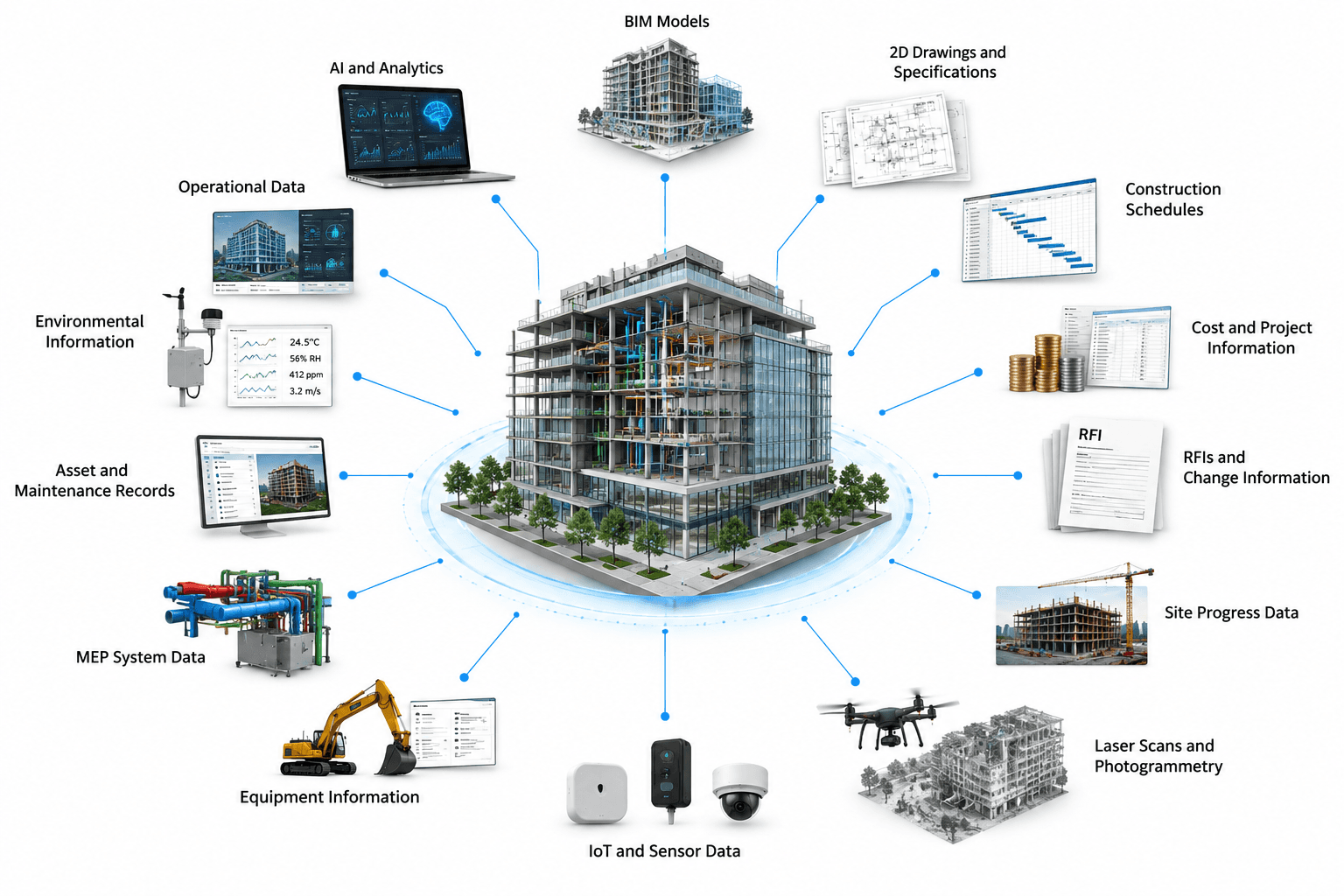
A static BIM model primarily represents the design and information associated with an asset. A digital twin extends that information into construction and operations, potentially connecting the digital representation with real-world performance data.
BIM vs. Digital Twin
The simplest way to understand the relationship is:
BIM helps define and coordinate the asset.
A digital twin helps connect, monitor, simulate, and manage the asset over time.
BIM is therefore often a foundational component of a construction digital twin, rather than an alternative to it.
How Does a Digital Twin Work in Construction?
A digital twin typically works by connecting multiple sources of information around a common digital representation.
Think of it as a continuous loop:
Physical Asset → Data Collection → Digital Model → Analysis & Simulation → Decision → Physical Action → New Data

For example, imagine a hospital project.
1. Build the digital foundation
Architectural, structural and MEP BIM models are coordinated and combined into a multidisciplinary model.
2. Connect project information
The model is linked with construction schedules, specifications, equipment information and other project data.
3. Capture physical reality
Reality-capture technologies such as laser scanning, drones, photogrammetry or mobile scanning can capture actual site conditions.
4. Compare planned vs. actual
The actual site condition can be compared against the BIM model and construction programme.
5. Analyse the difference
Teams can identify deviations, clashes, delays, incomplete work or sequencing problems.
6. Simulate alternatives
Before making a change physically, teams can test different construction sequences or scenarios digitally.
7. Continue into operations
After handover, the digital twin can incorporate asset information and operational data to support facility management, maintenance and performance optimisation.
This lifecycle approach is one of the major differences between a conventional project model and a true digital twin.
What Are the Main Uses of Digital Twins in Construction?
Digital twin technology can support different stages of the construction lifecycle.
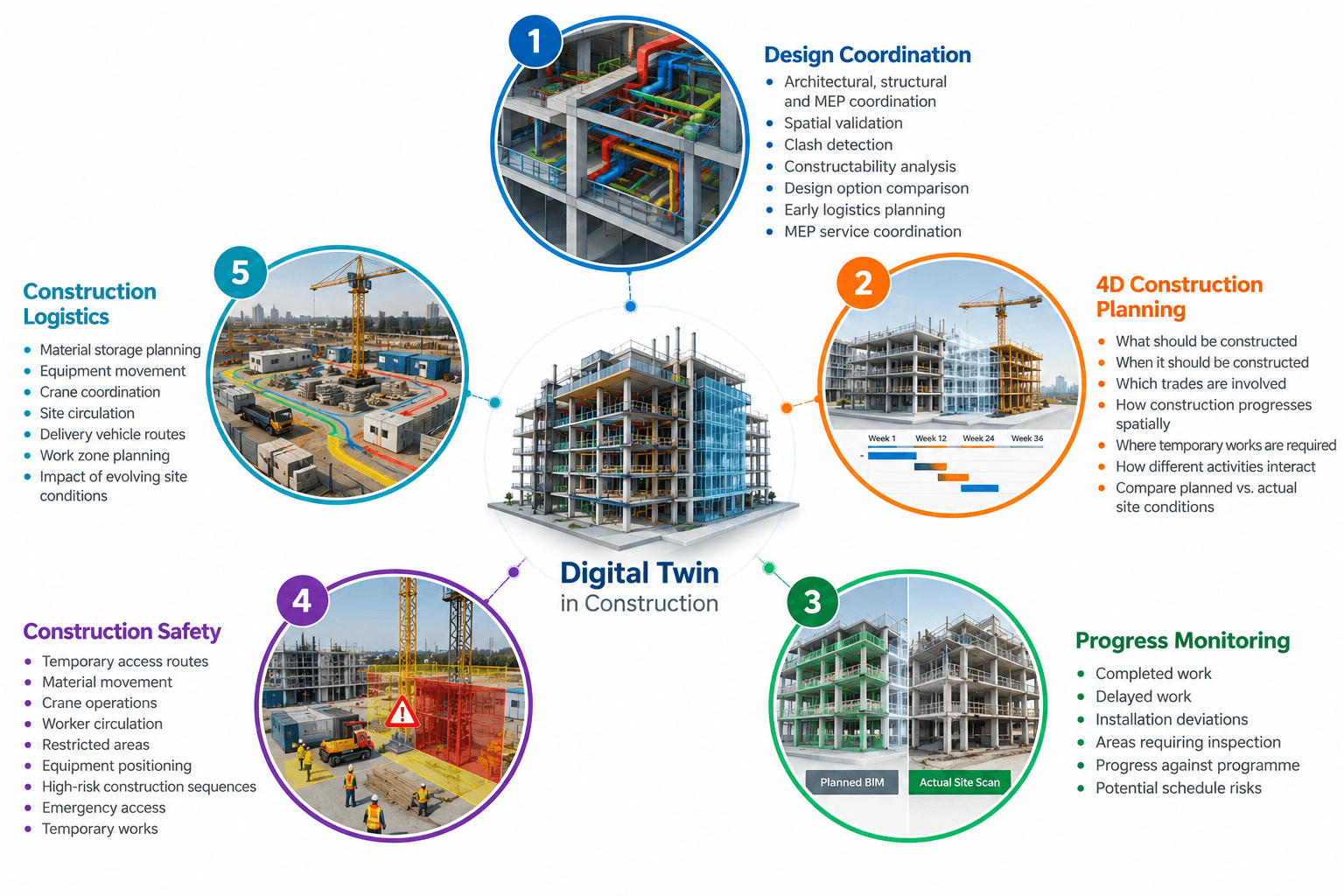
1. Design Coordination
Before construction begins, a digital twin environment can help teams understand how different building systems interact.
For example:
Architectural, structural and MEP coordination
Spatial validation
Clash detection
Constructability analysis
Design option comparison
Early logistics planning
MEP service coordination
Instead of discovering a coordination problem during installation, teams can identify and evaluate it virtually.
2. 4D Construction Planning
One of the most powerful construction applications is connecting the BIM model with the construction programme.
This creates a 4D BIM environment, where model elements are associated with time.
Teams can visualise:
What should be constructed
When it should be constructed
Which trades are involved
How construction progresses spatially
Where temporary works are required
How different activities interact
A digital twin can take this further by comparing the planned construction sequence with actual site conditions.
A real-world example comes from Heathrow Terminal 3, where a digital twin environment was connected to the construction programme to help Mace visualise work phases, test scenarios and monitor construction activities.
3. Progress Monitoring
Traditional progress reporting often relies heavily on photographs, spreadsheets and manual site reports.
Digital twins can create a more visual approach.
For example:
Planned BIM → Actual Site Scan → Automated/Visual Comparison → Progress Insight
This can help project teams identify:
Completed work
Delayed work
Installation deviations
Areas requiring inspection
Progress against programme
Potential schedule risks
Reality capture can therefore become an important input into a construction digital twin.
4. Construction Safety
Safety is another important application.
A digital twin can allow teams to simulate construction activities before workers perform them physically.
For example, teams can examine:
Temporary access routes
Material movement
Crane operations
Worker circulation
Restricted areas
Equipment positioning
High-risk construction sequences
Emergency access
Temporary works
By identifying potentially unsafe conditions virtually, teams can modify the construction approach before exposing workers to the physical risk.
Digital twins can also support ongoing monitoring when combined with site data and sensors.
5. Construction Logistics
Large construction sites are constantly moving environments.
Materials arrive. Equipment moves. Temporary facilities change. Work zones expand and contract.
A digital twin can provide a visual environment for testing logistics strategies before implementation.
For example:
Where should materials be stored this week?
Can a crane safely operate alongside another activity?
How will a delivery vehicle reach the work zone?
What happens to site circulation when a new structure is completed?
These questions can be evaluated digitally rather than discovered through trial and error.
What Technologies Are Needed to Build a Construction Digital Twin?
A digital twin is not a single software product.
It is an ecosystem of connected technologies.
BIM
Provides the geometric and information-rich foundation for representing the asset.
4D BIM
Connects model elements with time and construction activities.
IoT Sensors
Provide information from physical systems such as temperature, energy consumption, equipment condition or environmental conditions.
Laser Scanning
Captures highly detailed information about existing or constructed conditions.
Photogrammetry and Drones
Provide aerial imagery and reality-capture data for large or difficult-to-access areas.
Cloud Platforms
Enable different stakeholders to access and exchange information across project teams.
APIs and Data Integration
Connect otherwise separate systems, allowing information to move between BIM, schedules, IoT platforms, asset-management systems and other applications.
AI and Analytics
Can help identify patterns, detect anomalies, predict potential issues and support what-if analysis.

The value comes not from any individual technology but from how effectively these technologies are integrated around a common information environment.
What Is the Difference Between a BIM Model, 4D BIM and a Digital Twin?
These terms are often used interchangeably, but they are not identical.
Technology | Primary Purpose |
|---|---|
3D BIM | Represents geometry and asset information |
4D BIM | Adds construction time and sequencing |
5D BIM | Adds cost information |
Digital Twin | Connects the digital representation with real-world data and lifecycle processes |
There can be significant overlap.
A sophisticated digital twin may contain 3D, 4D and 5D information, but its defining characteristic is not simply the number of dimensions.
The important distinction is the connection between the digital representation and the physical asset or process.
A digital twin is intended to evolve as the physical asset changes.
How Digital Twins Improve Construction Project Management
For project managers, the biggest opportunity is moving from reactive management to informed decision-making.
Instead of asking:
“What went wrong?”
teams can increasingly ask:
“What is changing, why is it changing, and what could happen next?”
Digital twins can support project management by providing:
Better visibility of project status
Planned-vs-actual comparison
Improved stakeholder communication
Construction sequence optimisation
Early identification of potential conflicts
Better coordination between disciplines
More informed decision-making
Improved handover information
Better operational readiness
The technology does not eliminate the need for experienced project teams.
Instead, it gives those teams better information with which to make decisions.
Real-World Evidence: Digital Twins Are Already Being Used
Digital twin applications are no longer purely theoretical.
The Institution of Civil Engineers highlights projects including Crossrail, Heathrow Terminal 5 and The Shard as examples where digital twin-related technologies have been used in major built-environment projects. Crossrail, for example, used BIM and 3D CAD within a common data environment containing more than 250,000 models.
At Heathrow Terminal 3, a digital twin environment was linked to a construction programme so teams could rehearse construction operations, evaluate changes and visualise the effects of different work phases.
These examples demonstrate an important point:
The value of a digital twin is not the visual model itself. The value comes from using connected information to make better decisions.
What Are the Benefits of Digital Twins in Construction?
When implemented correctly, digital twins can help organisations:
Reduce Rework
Identify coordination and constructability problems before physical installation.
Improve Construction Planning
Visualise sequences and test alternative approaches.
Improve Progress Visibility
Compare planned construction against actual site conditions.
Improve Safety
Evaluate high-risk activities and site logistics before execution.
Support Better Collaboration
Give stakeholders a common visual and data-rich representation of the project.
Improve Handover
Carry structured asset information from design and construction into operations.
Support Predictive Maintenance
Once operational data is connected, analytics can help identify potential equipment or system issues before failure.
Improve Asset Performance
Owners can use the digital twin to understand how an asset performs throughout its lifecycle.
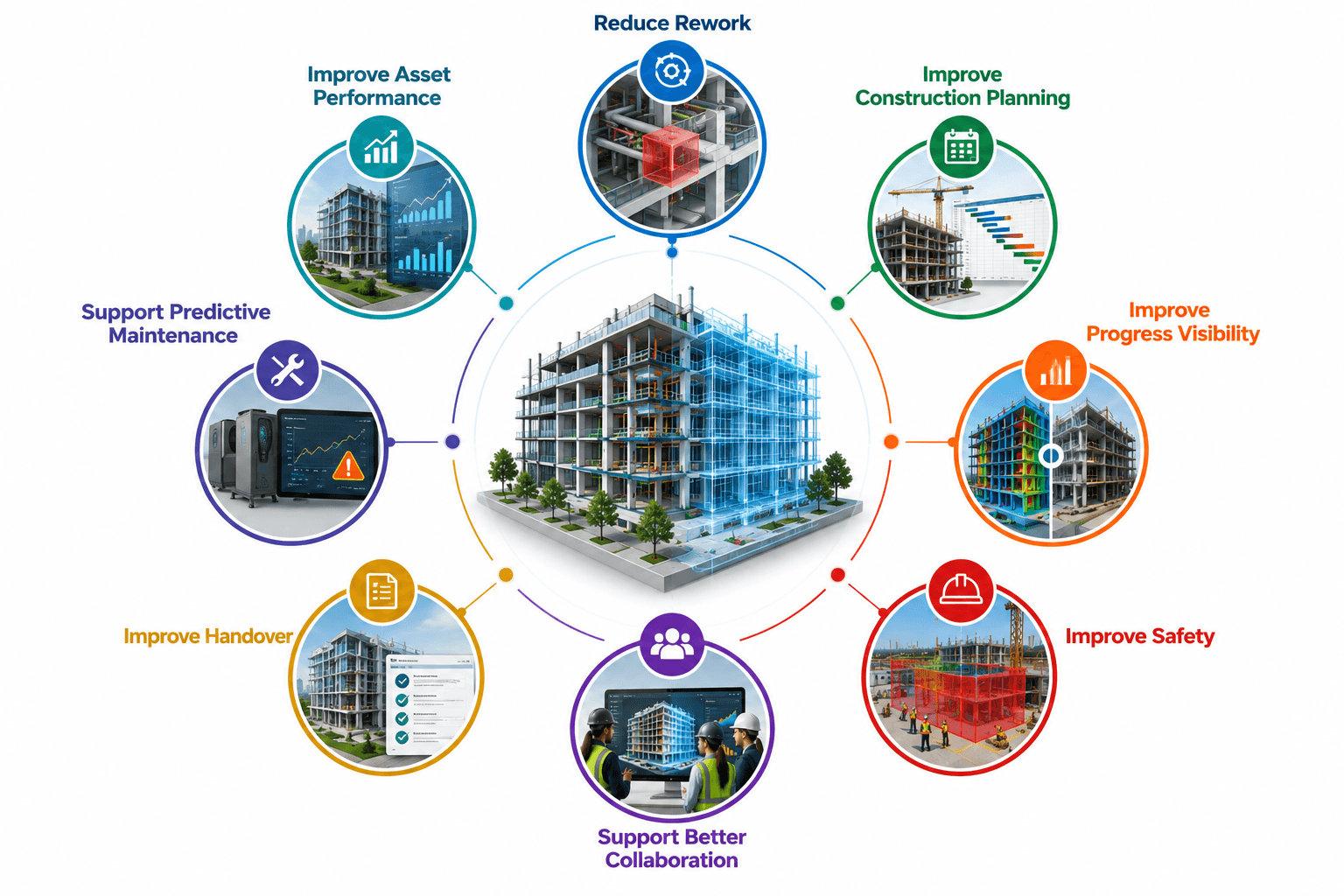
The potential extends beyond construction because much of an asset's value is realised during its operational life.
What Are the Challenges of Implementing Digital Twins?
Digital twin implementation is not simply a matter of buying software.
The biggest challenges are often organisational and informational.
Data Quality
A digital twin is only as reliable as the information feeding it.
Poor BIM data, inconsistent naming, incomplete asset information or inaccurate site data can undermine its value.
Interoperability
Projects use many platforms, file formats and systems.
Connecting them reliably can be difficult.
Data Ownership
Teams need clear rules for who creates, validates, updates and owns different types of information.
Skills
Digital twins require collaboration between BIM specialists, engineers, construction teams, IT professionals, data specialists and facility managers.
Implementation Cost
Sensors, cloud platforms, integrations and data-management processes require investment.
Change Management
Technology alone will not improve a project if teams continue using disconnected workflows.
How Can Construction Companies Get Started With Digital Twins?
A practical approach is to start with a specific business problem, rather than attempting to digitise everything at once.
Step 1: Define the objective
Decide what you want the digital twin to achieve.
For example:
Improve progress monitoring
Optimise construction sequencing
Improve MEP coordination
Support asset handover
Improve facility operations
Step 2: Establish the BIM foundation
Ensure the models are accurate, coordinated and structured according to the project's information requirements.
Step 3: Identify required data
Determine what information needs to flow into the digital twin and who is responsible for maintaining it.
Step 4: Connect schedules and project information
For construction applications, linking the BIM model with the programme is often a strong starting point.
Step 5: Add reality capture
Use scanning, drones, photogrammetry or other methods to establish the actual condition of the project.
Step 6: Add IoT and operational data where valuable
Not every asset requires hundreds of sensors.
Use connected data where it supports a clear operational or project-management objective.
Step 7: Build the feedback loop
The real value begins when information flows back into decision-making.
Model → Data → Insight → Decision → Action → Updated Data
What Is the Future of Digital Twins in Construction?
The next generation of digital twins will likely become increasingly connected with:
Artificial intelligence
Machine learning
Automated progress tracking
Computer vision
Autonomous reality capture
IoT networks
Predictive analytics
Robotics
Extended reality
Generative design
Smart building systems
Digital asset management
The biggest shift will not simply be better 3D visualisation.
It will be the ability to use a connected digital environment to simulate possible futures before making decisions in the physical world.
Imagine a project manager being able to ask:
“If this activity is delayed by five days, what other trades, spaces and milestones will be affected?”
Or a facility manager asking:
“Which HVAC assets are showing abnormal behaviour and what is the likely impact?”
That is where digital twins move from being a visualisation tool to becoming a decision-support system for the built environment.
Final Thoughts
A digital twin in construction is not simply a 3D model with a new name.
It is a connected digital representation of a physical asset or construction process that brings together geometry, information, project data and where appropriate real-world performance data.
BIM provides the foundation.
4D connects construction with time.
Reality capture connects digital information with physical progress.
IoT provides live operational data.
AI and analytics turn data into insights.
Together, these capabilities can help construction organisations move from fragmented information and reactive decision-making toward a more connected, predictive and data-driven way of delivering projects.
The real question is therefore not:
“Do we need a digital twin?”
It is:
“Which decisions could we make better if our digital project environment accurately reflected what is happening in the physical world?”
That is where the business case for digital twins begins.
How Desapex Can Help
At Desapex, digital construction workflows can bring together BIM, 4D planning, construction sequencing, coordination, progress monitoring and visualisation to help project teams make better-informed decisions.
From BIM model preparation and schedule integration to 4D construction simulation, planned-vs-actual progress monitoring and construction optimisation, the objective is to turn project information into something teams can actively use not simply deliver as documentation.
If your organisation is exploring how digital twins, BIM and 4D workflows can improve construction planning, coordination or project delivery, talk to Desapex about your project requirements.