Webinar
Inside the Data Center
Discover the structural engineering behind the mission-critical digital world.
Friday, 30 Oct 2026
11:30 AM CET | 4:00 PM IST


Public Health Engineering (PHE) is the branch of engineering concerned with planning, designing, constructing, operating and maintaining infrastructure that protects human health and the environment.
At its core, PHE deals with some of the most basic requirements of a healthy society:
Safe water → Safe sanitation → Safe wastewater management → Effective drainage → Responsible waste management → Healthy environment
Although the terminology varies between countries—the fundamental objective is similar: to prevent disease and environmental harm by designing reliable systems for water, sanitation and environmental services.
The World Health Organization places water, sanitation and hygiene within a public-health framework and emphasizes risk management across the complete water and sanitation service chain.
Why Is Public Health Engineering Important?
Imagine a city without a properly managed water and sanitation system.
People may have access to water, but the source could be contaminated.
A wastewater system may exist, but untreated sewage could enter a river.
A drainage network may have been constructed, but blocked drains could cause flooding.
A treatment plant may have modern equipment, but poor operation and maintenance could make it ineffective.
This illustrates an important principle:
Public health engineering is not simply about constructing infrastructure. It is about ensuring that infrastructure continuously delivers a safe service.
Water and sanitation systems create multiple barriers between people and health hazards. If one barrier fails, another should help prevent exposure.
This is why modern approaches increasingly emphasize risk assessment, monitoring, operation, maintenance and continuous improvement, rather than relying only on end-point testing or infrastructure coverage. WHO's Water Safety Plan approach, for example, considers risks throughout the water supply chain from catchment to consumer.
What Does a Public Health Engineer Do?
A Public Health Engineer may work on projects ranging from a small rural water-supply system to a large metropolitan wastewater network.
Typical responsibilities include:
Assessing water sources
Estimating water demand
Designing water-treatment plants
Designing water-distribution networks
Designing sewerage systems
Designing sewage-treatment plants
Designing stormwater drainage
Planning solid-waste-management systems
Conducting hydraulic analysis
Selecting pumps and mechanical equipment
Monitoring water quality
Assessing environmental and health risks
Developing infrastructure-management systems
Using digital technologies
Planning water reuse and resource recovery
Supporting climate-resilient infrastructure
The role is therefore highly multidisciplinary.
The Major Areas of Public Health Engineering
Public Health Engineering can be visualized as a connected system rather than a group of separate subjects.
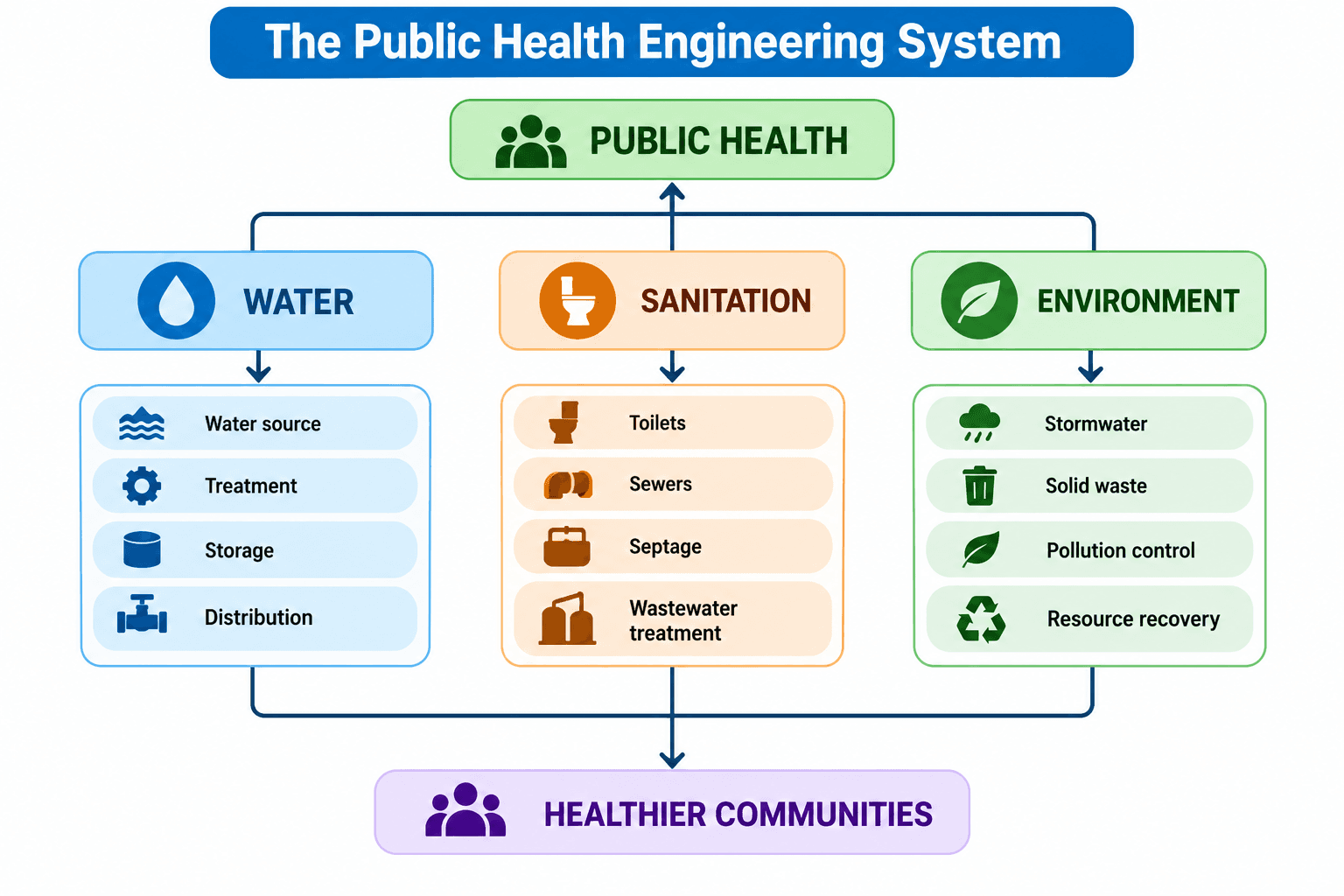
The principal areas are:
Water Supply Engineering
Water-supply engineering deals with providing adequate quantities of safe water to people and institutions.
It includes:
Source → Intake → Conveyance → Treatment → Storage → Distribution → Consumer
Sources may include:
Rivers
Lakes
Reservoirs
Groundwater
Springs
Rainwater
Desalinated water
Reclaimed water for appropriate non-potable applications
Engineering decisions depend on source quality, availability, population, demand, topography, climate, economics and regulatory requirements.

Drinking-Water Treatment
Raw water cannot always be supplied directly to consumers.
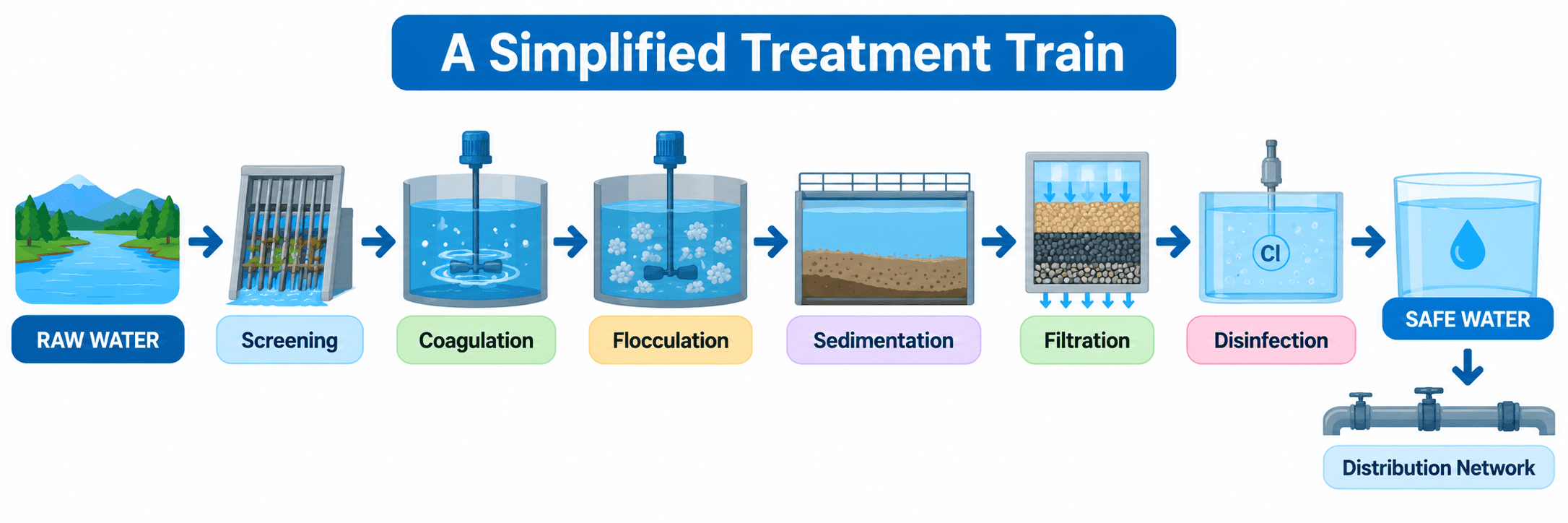
Depending on its quality, treatment may include:
Preliminary treatment: Removal of large debris and materials.
Coagulation and flocculation: Small particles are encouraged to combine into larger particles.
Sedimentation: The heavier particles settle.
Filtration: Remaining suspended particles are removed.
Disinfection: Microorganisms are controlled using an appropriate disinfectant or treatment process.
Storage and distribution: Treated water is stored and conveyed to consumers while maintaining quality.
However, the treatment plant is only one part of drinking-water safety.
Water quality can be affected by the source, treatment process, storage, distribution network, cross-connections, pressure conditions and consumer-side handling.
That is why WHO recommends a Water Safety Plan approach that systematically assesses and manages risks from the catchment through to the consumer.
Water Distribution Engineering
Once water has been treated, it must reach users reliably.
This requires a network of:
Transmission mains
Distribution mains
Branch pipelines
Service connections
Valves
Pumps
Reservoirs
Pressure-management systems
Meters
Monitoring equipment
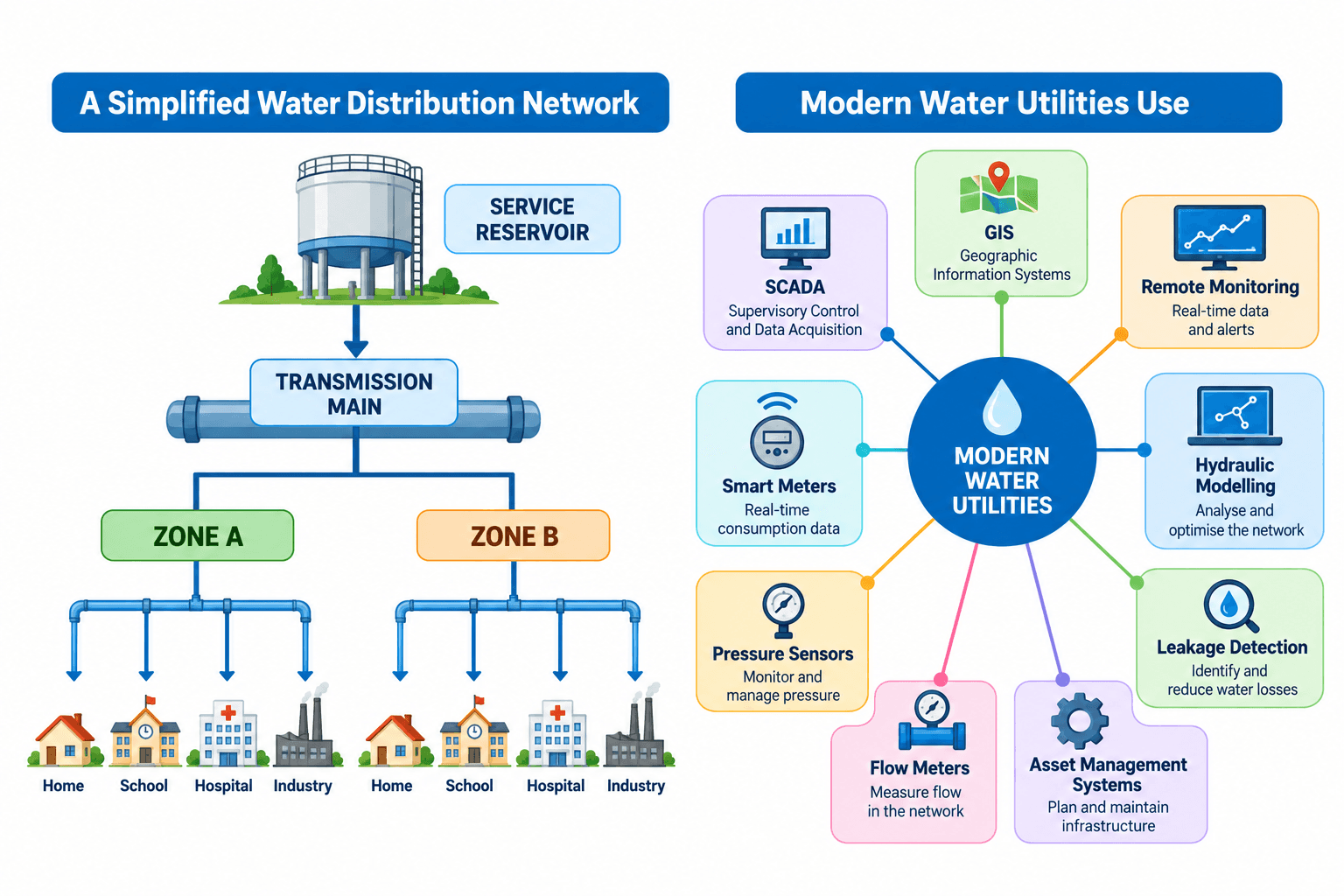
In India, CPHEEO publishes technical manuals and advisories covering water supply, operation and maintenance, water meters, GIS mapping, SCADA and 24×7 water-supply systems.
Sanitation Engineering
Sanitation is much more than providing toilets.
A complete sanitation system must safely manage human excreta throughout its entire journey.
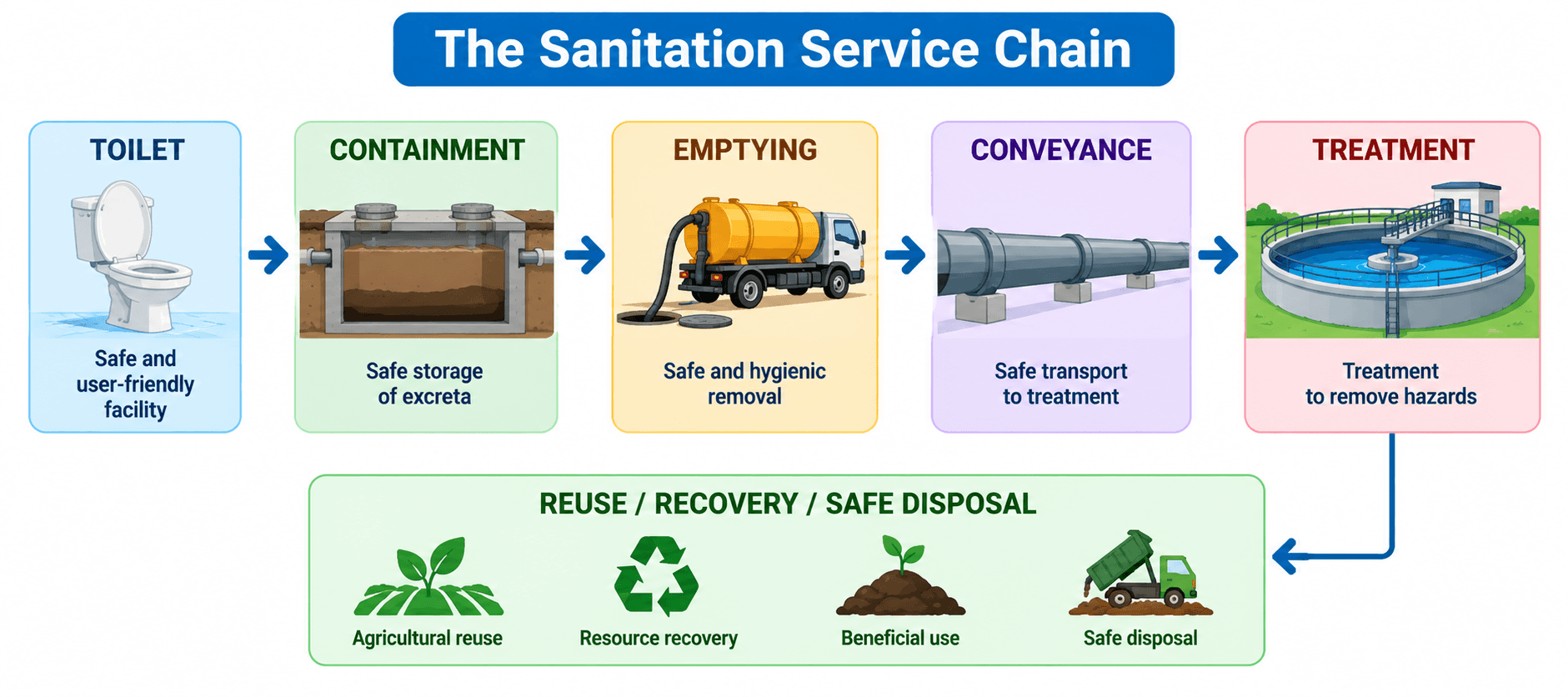
Failure at any stage can create health and environmental risks.
For example:
A properly designed toilet with unsafe containment can still create contamination.
A septic tank without safe emptying can expose workers and communities.
A sewer system without adequate treatment can transfer pollution from one location to another.
A treatment plant without proper sludge management can create secondary risks.
WHO's Sanitation Safety Planning framework therefore takes a risk-based approach across the sanitation chain from containment through conveyance and treatment to end use or disposal.
Sewerage and Sewage Treatment
Sewerage systems collect wastewater from homes, commercial buildings, institutions and other sources.
The wastewater is then conveyed to a treatment facility.
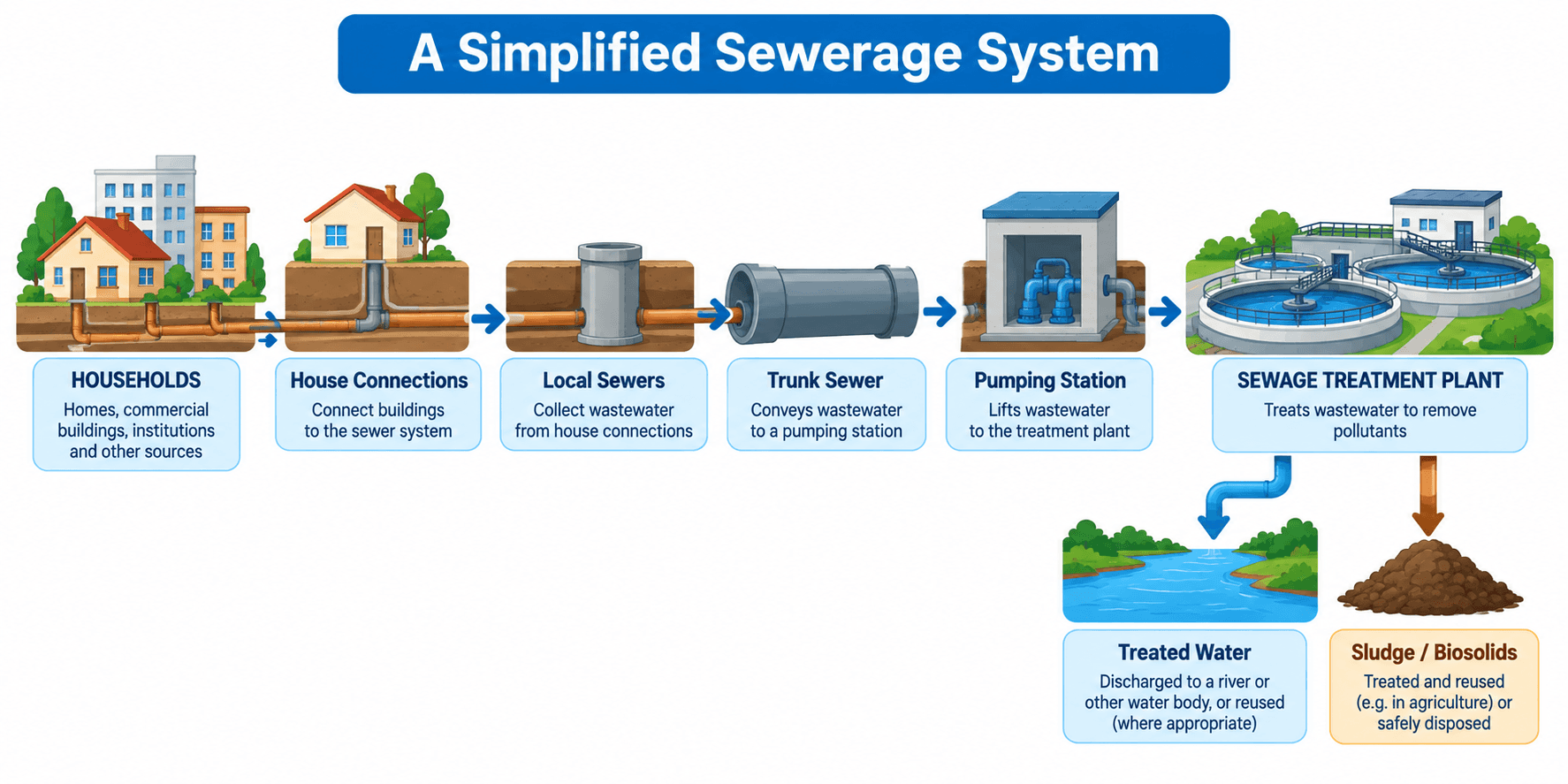
Treatment processes can include:
Screening
Grit removal
Primary treatment
Biological treatment
Secondary clarification
Tertiary treatment
Disinfection
Sludge treatment
Different technologies are selected according to factors such as:
Flow
Organic load
Land availability
Effluent requirements
Energy availability
Capital cost
Operating cost
Desired reuse
Septage and Faecal-Sludge Management
Not every community has a conventional sewer network.
In many places, sanitation relies on:
Septic tanks
Pit latrines
Other on-site sanitation systems
These systems generate septage or faecal sludge that must be safely emptied, transported, treated and managed.
Therefore:
No sewer does not mean no sanitation engineering.
In fact, decentralized sanitation and faecal-sludge management are critical components of public health engineering in many parts of the world.
This is particularly important in rapidly growing cities where sewer networks cannot immediately cover every settlement.
Stormwater and Urban Drainage
Rainwater is another major engineering challenge.
When rainfall occurs over a natural landscape, some water infiltrates into the ground, some is stored, and some flows naturally toward water bodies.
Urbanization changes this.
Roads, roofs and paved surfaces increase impervious area.
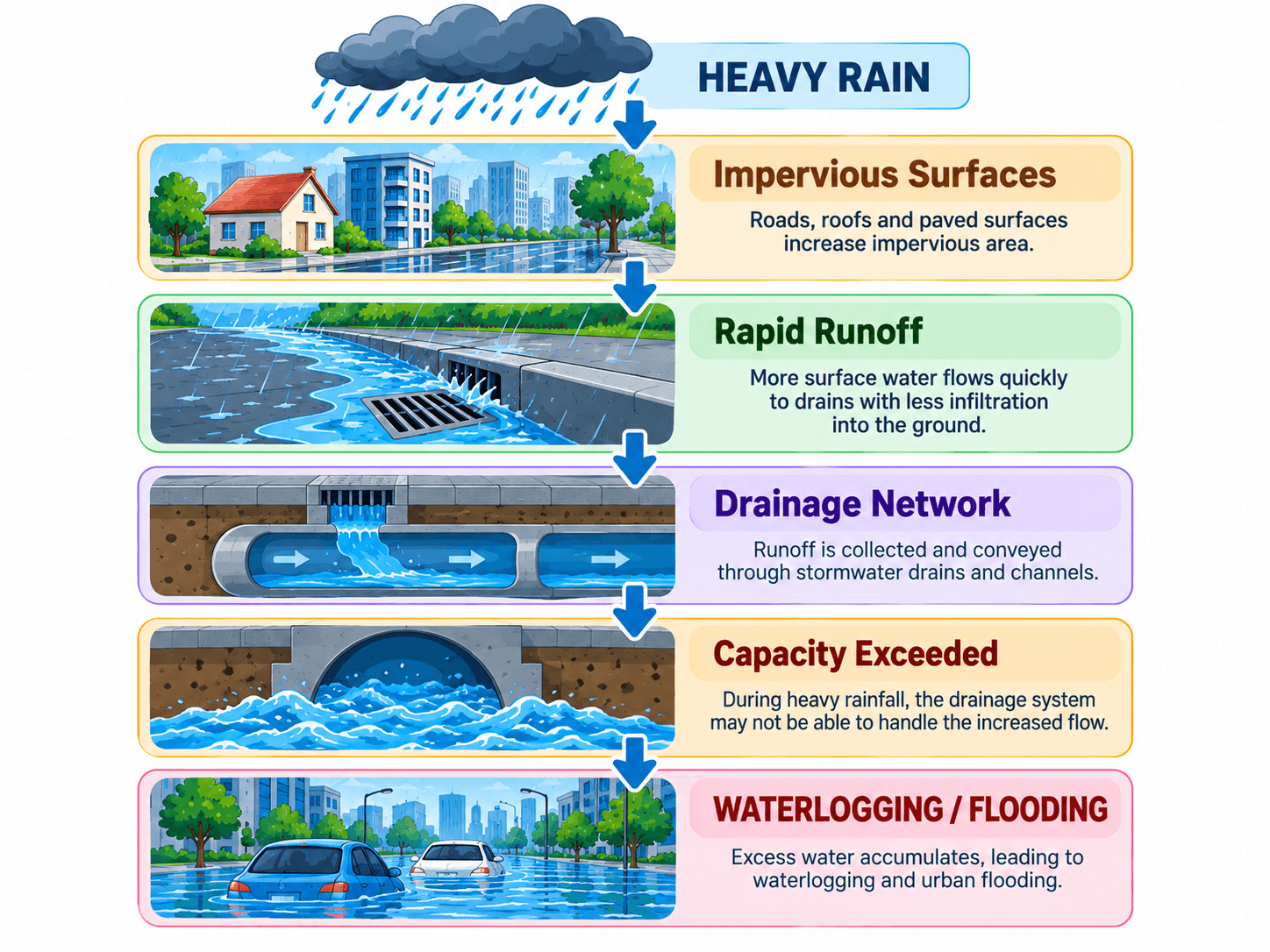
Public health engineering therefore intersects with:
Hydrology
Hydraulic engineering
Urban planning
Flood-risk management
Climate adaptation
Environmental planning
Modern drainage design increasingly needs to consider not only conventional drains but also nature-based and sustainable drainage approaches, detention, retention, infiltration and flood-resilient urban planning.
Solid Waste Management
Solid waste is another important environmental-health issue.
A modern waste-management system can be represented as:
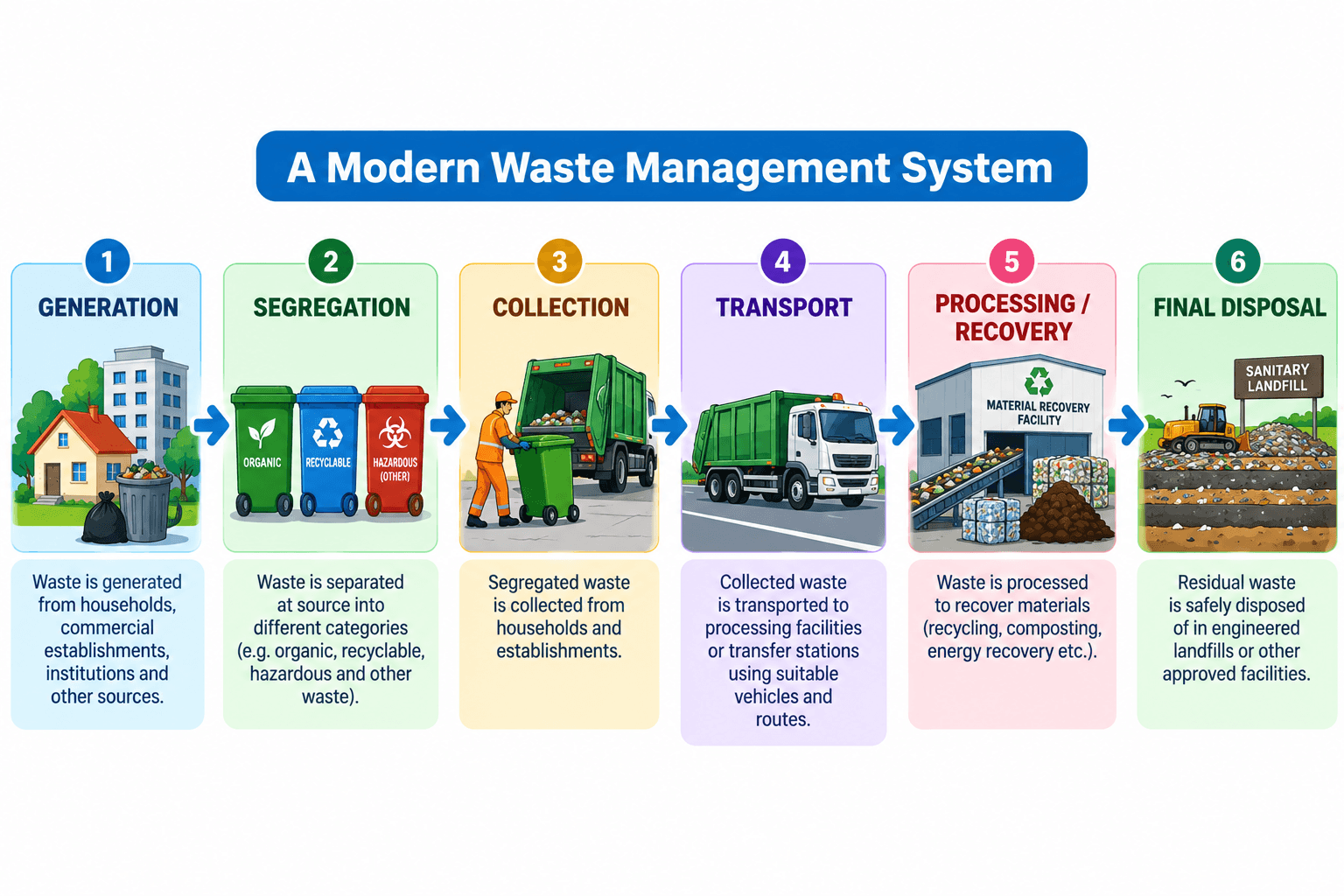
Engineering considerations include:
Waste quantity
Waste composition
Collection efficiency
Vehicle routing
Transfer stations
Material recovery
Organic-waste treatment
Composting
Landfill design
The objective is increasingly shifting from “collect and dispose” toward “reduce, recover, reuse and safely manage residual waste.”
CPHEEO's current technical reference list includes manuals on municipal solid waste management alongside water supply, sewerage and stormwater drainage.
The Connection Between Engineering and Public Health
This is the most important idea in the entire article.
Consider a contaminated water source.
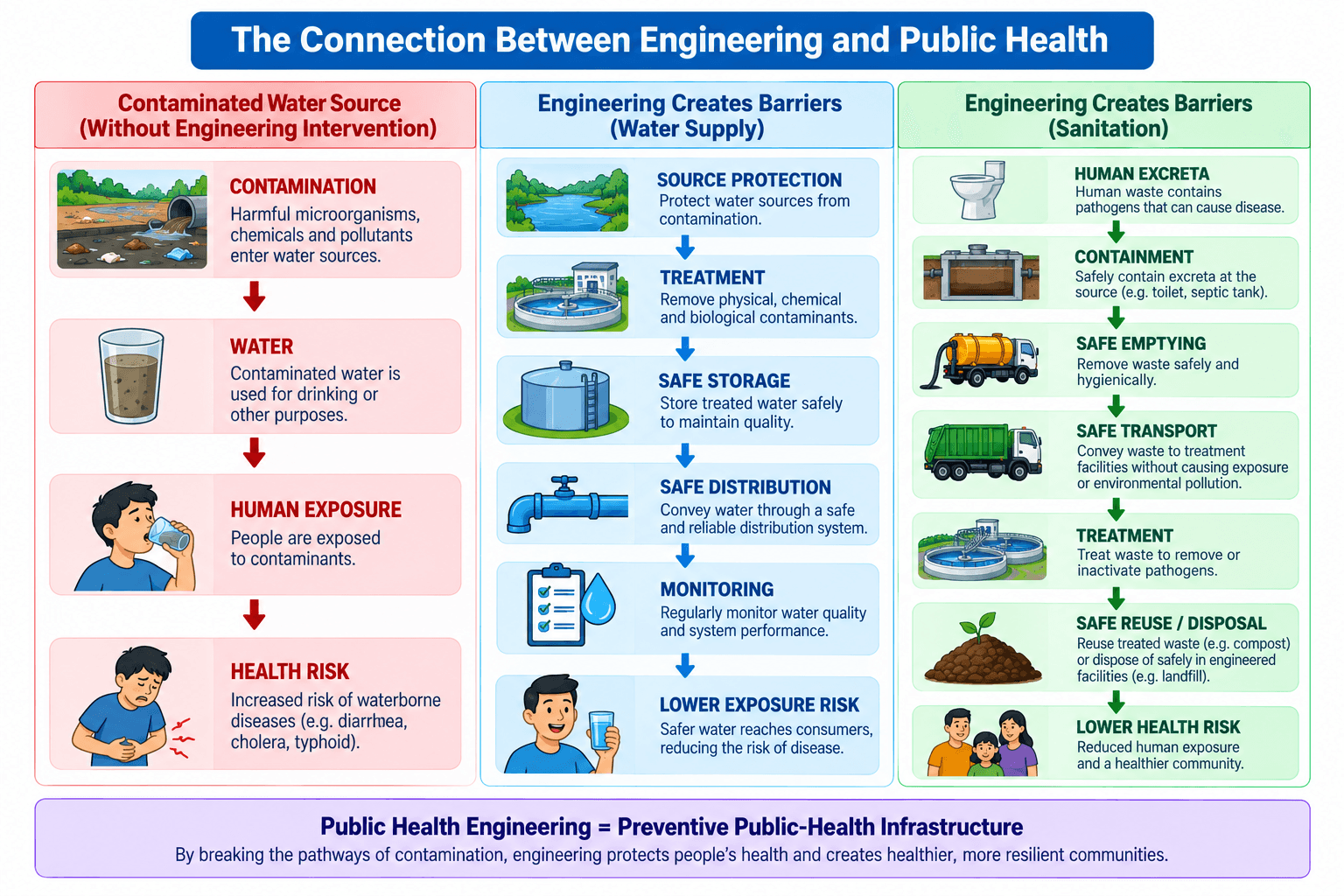
This is why PHE should be understood as preventive public-health infrastructure.
Public Health Engineering in India
India provides a particularly important context for Public Health Engineering because of its enormous diversity.
The country includes:
Megacities
Small towns
Rural settlements
Coastal communities
Arid regions
Mountainous areas
Rapidly developing peri-urban areas
Water availability, rainfall, groundwater conditions, population density, infrastructure age and local institutional capacity can vary enormously.
India's Central Public Health and Environmental Engineering Organisation (CPHEEO), under the Ministry of Housing and Urban Affairs, provides important technical references for urban water supply, sanitation and municipal solid waste management. Its published manuals include water supply and treatment, water-supply operation and maintenance, sewerage and sewage treatment, stormwater drainage and municipal solid waste management.
CPHEEO also publishes advisories covering areas such as 24×7 water supply, water meters, GIS mapping, SCADA, sewer and septic-tank cleaning, septage management and water-supply and sanitation services.
This provides an important technical foundation for engineers working in India's urban water and sanitation sector.
Public Health Engineering Beyond India
The same engineering principles apply internationally, but the solutions must be adapted to local conditions.
For example:
A high-income city | A rapidly growing city | A rural community | A water-stressed region |
|---|---|---|---|
May have:
| May need
| May benefit more from:
| May prioritize:
|
Therefore, there is no single universal PHE solution.
The engineering principles are global; the design must be local.
From Infrastructure to Service
One of the biggest changes in modern PHE thinking is the shift from asking:
“How much infrastructure have we constructed?”
to asking:
“What service is the infrastructure actually delivering?”
A water pipeline is not the final objective.
The objective is:
Reliable + Safe + Affordable + Sustainable water service
A sewage-treatment plant is not the final objective.
The objective is:
Safe wastewater management + environmental protection + resource recovery where appropriate
A drainage channel is not the final objective.
The objective is:
Reduced flood and water logging risk
This distinction is critical when planning, financing and operating infrastructure.
Digital Public Health Engineering
The PHE engineer of the future will increasingly work with digital systems.
GIS | SCADA | Sensors | Hydraulic modelling |
|---|---|---|---|
Used to map:
| Can provide
| Can monitor:
| Can help engineers understand
|
The result is a transition from reactive infrastructure management toward more predictive and data-driven management.
Climate Change and Public Health Engineering
Climate change makes PHE even more important.
Engineers increasingly have to consider:
Floods: Can overwhelm drainage and wastewater systems.
Drought: Can reduce water availability and increase competition for resources.
Heat: Can affect water demand, infrastructure and treatment processes.
Changing rainfall: Can alter runoff patterns and drainage requirements.
Water quality changes: Can affect treatment requirements.
The solution is not simply to build larger infrastructure.
Modern PHE needs to ask:
Can this system continue to protect public health under future conditions?
WHO's current water-safety approach explicitly incorporates climate resilience and equity into risk management.
The Future: From Waste Management to Resource Management

Wastewater is increasingly being viewed not simply as something to dispose of, but potentially as a source of:
Reusable water
Nutrients
Energy
Organic resources
This creates a bridge between Public Health Engineering, Environmental Engineering and the Circular Economy.
What Makes a Good Public Health Engineer?
A strong PHE engineer needs more than technical design skills.
They need to understand:
Engineering: Hydraulics, treatment processes, structures, pumps, networks and infrastructure.
Science: Chemistry, microbiology, environmental science and water quality.
Public health: Exposure pathways, disease prevention and risk management.
Management: Operations, maintenance, finance, procurement and institutions.
Technology: GIS, SCADA, sensors, modelling and data analytics.
Society: User behaviour, affordability, accessibility and community needs.
Resilience: Climate risks, emergencies and changing future conditions.
The Big Picture
Public Health Engineering sits at the intersection of engineering and human wellbeing.
Its systems are often invisible when they work well.
We open a tap.
Water arrives.
We flush a toilet.
Waste disappears.
Rain falls.
A drainage system carries the runoff away.
Waste is collected.
A treatment plant protects a river.
These everyday services depend on thousands of engineering decisions.
The real achievement of Public Health Engineering is therefore not the pipeline, pump, sewer, treatment plant or drain itself.
It is the safe and reliable service that protects people and the environment.
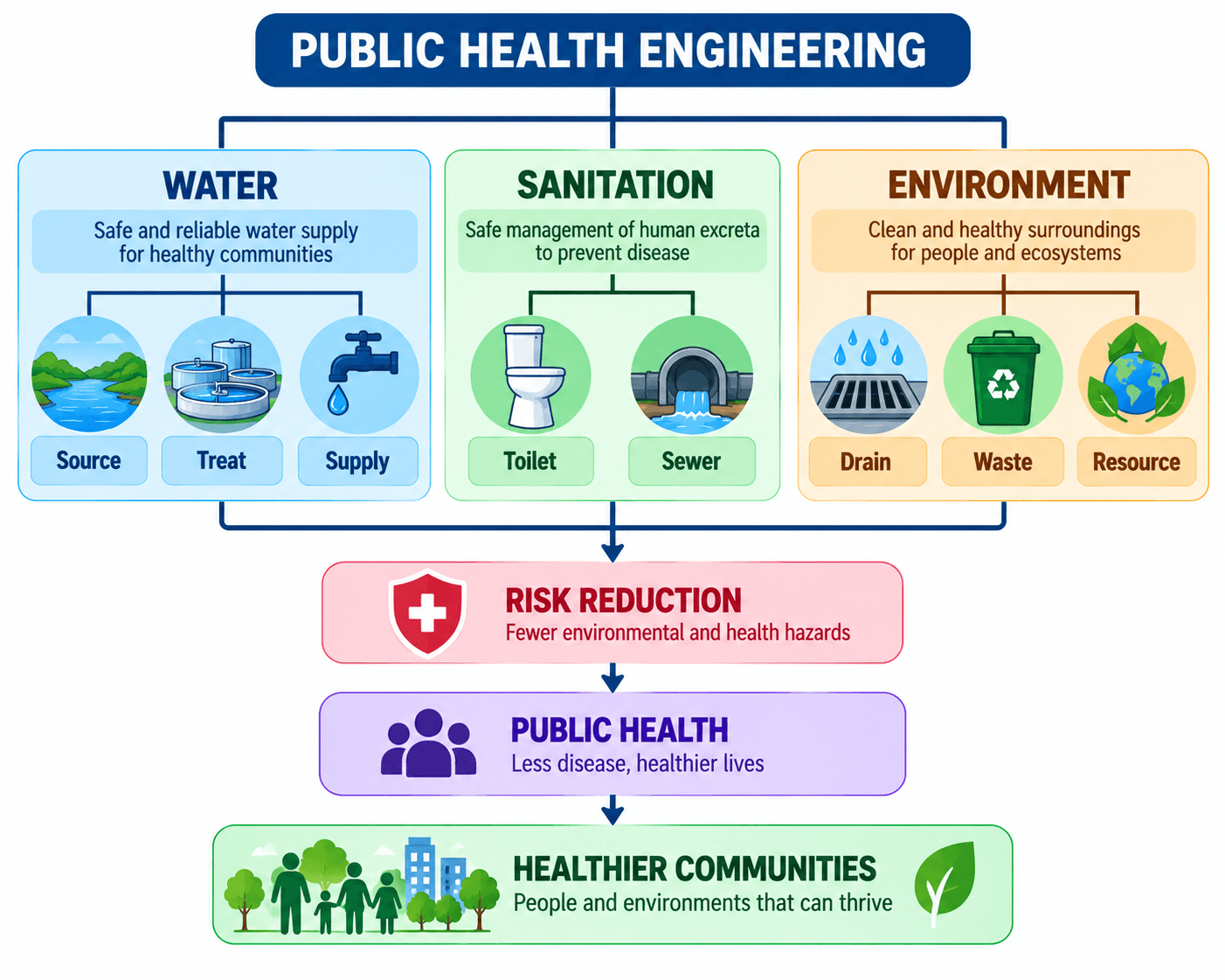
Public Health Engineering is ultimately about designing systems that prevent hazards from becoming health problems.
And that principle is equally relevant in India, Asia, Africa, Europe, the Americas, Australia and every other region of the world.