


Digital transformation in manufacturing isn’t a one-time technology upgrade it’s a strategic, step-by-step evolution. Many manufacturers struggle not because they lack tools, but because they lack a clear roadmap that connects design, engineering, operations, and automation into one cohesive digital ecosystem.
This is where the Digital Factory Maturity Model becomes essential.
At Desapex, our Digital Engineering & Manufacturing (DEM) services help manufacturers understand where they are today, where they need to go, and how to get there with minimal risk and maximum ROI.
Why a Digital Factory Maturity Model Matters
Manufacturing leaders today face a common set of challenges:
Disconnected design, planning, and production systems
Late-stage design changes impacting cost and schedules
Limited visibility into factory performance
Underutilized data from machines and facilities
Pressure to improve productivity, sustainability, and scalability
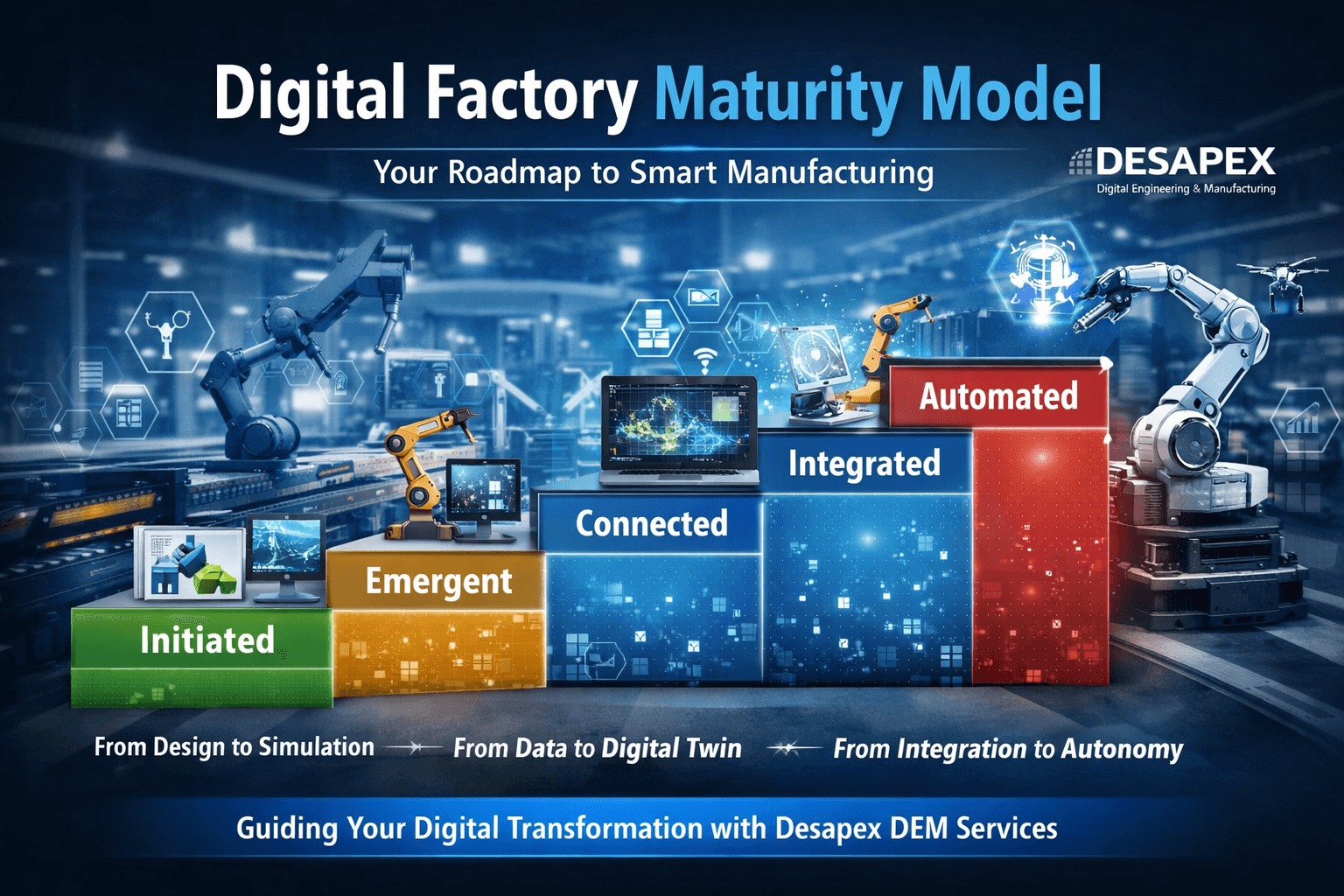
The Digital Factory Maturity Model provides a structured framework to address these challenges by aligning people, processes, and technology across five progressive stages moving from basic digitization to intelligent, autonomous operations.
Instead of random tool adoption, manufacturers gain a clear transformation path backed by measurable business outcomes.
Stage 1: Initiated – Digital Design and Documentation
At the Initiated stage, organizations take their first step by replacing manual drawings and paper-based workflows with digital design tools.
Key Characteristics
Standalone 2D and 3D design tools
File-based data storage
Minimal cross-team collaboration
Digital adoption driven mainly by engineering teams
Representative Software
AutoCAD – 2D layouts and factory drawings
Autodesk Inventor – 3D mechanical design
Revit – Factory buildings and facility design
CATIA – Product design and modeling
Creo – Mechanical design
NX – Integrated CAD/CAM
Business Impact
Improved design accuracy
Reduced manual errors
Faster documentation cycles
How Desapex Helps
Desapex helps organizations standardize digital design practices, define modeling standards, and establish a strong foundation for future digital factory initiatives.
Focus Area: Establish digital design standards and basic data discipline.
Stage 2: Emergent – Process Planning and Simulation
In the Emergent stage, manufacturers expand beyond design to virtual factory planning and process validation.
Key Characteristics
Digital factory layouts and line planning
Material flow and logistics simulation
Virtual validation of manufacturing processes
Structured data management at department level
Representative Software
Factory Design Utilities (FDU) – Factory layouts and material flow
FlexSim – Discrete event simulation
Process Simulate – Manufacturing process simulation
Autodesk Vault – Data management and version control
Navisworks – Model coordination and clash detection
Solid Edge – Mechanical and production design
Business Impact
Reduced physical prototyping
Early detection of layout and workflow issues
Faster and more confident production planning
How Desapex Helps
Through digital factory simulations and layout optimization, Desapex enables clients to validate decisions virtually before committing capital on the shop floor.
Focus Area: Standardize digital process planning and data management.
Stage 3: Connected – Digital Thread and Collaboration
The Connected stage marks a major shift: systems stop working in isolation and begin forming a digital thread.
Key Characteristics
Centralized product and process data
Integration between CAD, PLM, and factory planning tools
Improved traceability and collaboration
Early adoption of digital twins for products and facilities
Representative Software
Autodesk Fusion Manage / Vault Professional – Product data management
Autodesk Construction Cloud – Model coordination and collaboration
Windchill – Product lifecycle management
Teamcenter – Enterprise PLM
3DEXPERIENCE Platform – Collaborative digital platform
NX – Design-to-manufacturing integration
Business Impact
Single source of truth for factory and product data
Faster engineering change management
Improved cross-functional visibility
How Desapex Helps
Desapex designs and implements connected digital ecosystems, ensuring seamless data flow between design, engineering, construction, and manufacturing teams.
Focus Area: Build a connected digital backbone across systems and teams.
Stage 4: Integrated – End-to-End Digital Factory
At the Integrated stage, manufacturers achieve a closed-loop digital factory, where data flows continuously from design to production and back.
Key Characteristics
Shop-floor feedback integrated with engineering systems
Advanced simulation and scenario planning
Enterprise-wide analytics and optimization
IT and OT convergence
Representative Software
Autodesk Tandem – Facility and operational digital twins
Autodesk Forge / Platform Services – Data integration and visualization
Tecnomatix – Digital manufacturing and optimization
DELMIA Apriso – Manufacturing operations management
Ansys – Advanced engineering simulation
Power BI / Tableau – Manufacturing analytics
Business Impact
Improved productivity and throughput
Predictive quality and maintenance
Reduced operational and project risk
How Desapex Helps
Using digital twins, analytics, and system integration, Desapex enables manufacturers to move from reactive operations to data-driven continuous improvement.
Focus Area: Leverage integration and analytics for operational excellence.
Stage 5: Automated – Intelligent and Autonomous Factory
The Automated stage represents the pinnacle of digital maturity—where factories operate with intelligence, adaptability, and autonomy.
Key Characteristics
AI-driven decision-making
Robotics and smart automation
Real-time digital twins
Autonomous inspection and predictive maintenance
Representative Software
Autodesk Tandem with IoT integrations – Real-time facility twins
NVIDIA Omniverse – Industrial digital twin and AI simulation
Siemens Industrial Edge & AI – Intelligent automation
FactoryTalk – Smart manufacturing platform
UiPath / Automation Anywhere – Robotic Process Automation (RPA)
Azure IoT / AWS IoT – Cloud-based industrial intelligence
Business Impact
Near-zero downtime
Highly adaptable production systems
Sustainable, scalable manufacturing operations
How Desapex Helps
Desapex supports the transition to intelligent automation by integrating digital twins, IoT, AI, and advanced analytics into a unified operational framework.
Focus Area: Adopt intelligent automation and AI-driven optimization.
Conclusion: Building the Digital Factory with Desapex DEM Services
A successful digital factory is not defined by automation alone. It is built on connectivity, integration, intelligence, and continuous improvement.
The Digital Factory Maturity Model helps manufacturers:
Prioritize the right digital investments
Reduce transformation risks
Align strategy, technology, and operations
Achieve long-term operational excellence
With Desapex DEM services, manufacturers don’t just adopt tools they build a future-ready digital factory ecosystem that evolves with business needs.
Your digital factory journey doesn’t start with automation.
It starts with clarity and Desapex helps you every step of the way.