



The Monday Morning Problem Nobody Talks About
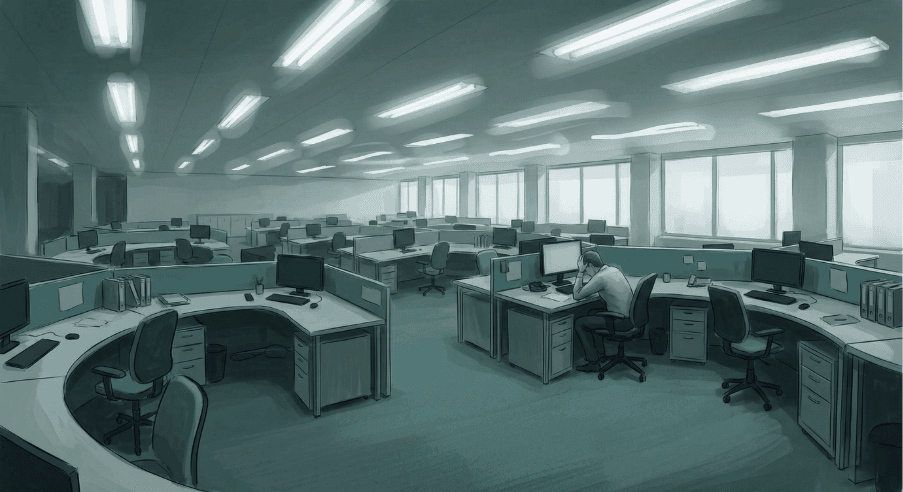
Picture this: It's Monday morning. Across your organization, 12% of your workforce hasn't shown up. The ones who did are sitting under flickering fluorescent lights, breathing recycled air that's quietly suppressing their cognitive performance by up to 50%. By noon, half of them will be fighting a headache they'll attribute to stress, but the real culprit is the building around them.
This isn't a hypothetical. It's the daily reality of most commercial workspaces and it carries a price tag that dwarfs your energy bill, your maintenance costs, and your sustainability certification fees combined.
Here's the number that should change how you think about real estate: in a typical office building, 90% of total operating costs are people salaries, benefits, and productivity. Energy is roughly 1%. Yet most building investment conversations obsess over that 1% and ignore the 90%.
What if your building could be your most powerful people strategy?
What Is Health ROI, and Why Is It Different?
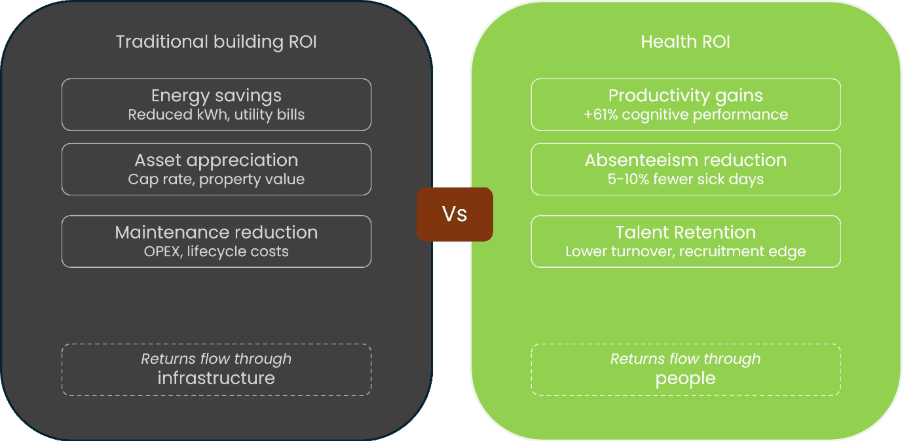
Return on investment is a concept everyone understands. You spend X, you get back Y, the ratio tells you whether it was worth it. Traditional building ROI is measured in energy savings, asset appreciation, or reduced maintenance. Clean, predictable, financially legible.
Health ROI is different in one crucial way: the returns flow through people, not infrastructure.
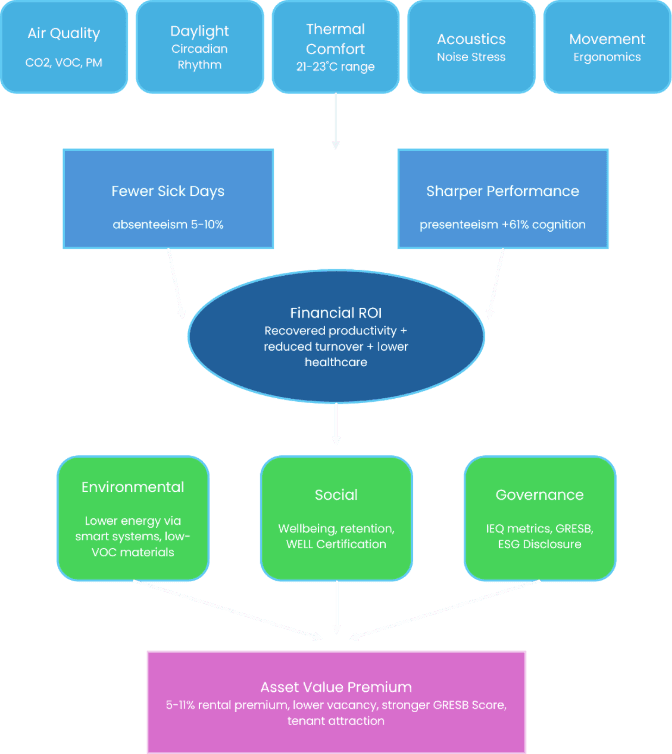
When you invest in better indoor air quality, optimized daylight, or acoustic comfort, the payoff isn't in your utility bill it's in fewer sick days, sharper thinking, better retention, and a workforce that actually shows up ready to work. The financial mechanism is indirect, but the scale is not. Research from the World Green Building Council consistently shows that a 1% improvement in employee productivity can offset an entire year's energy costs. Health ROI is where the real money lives.
How Your Building Is Silently Shaping Human Performance
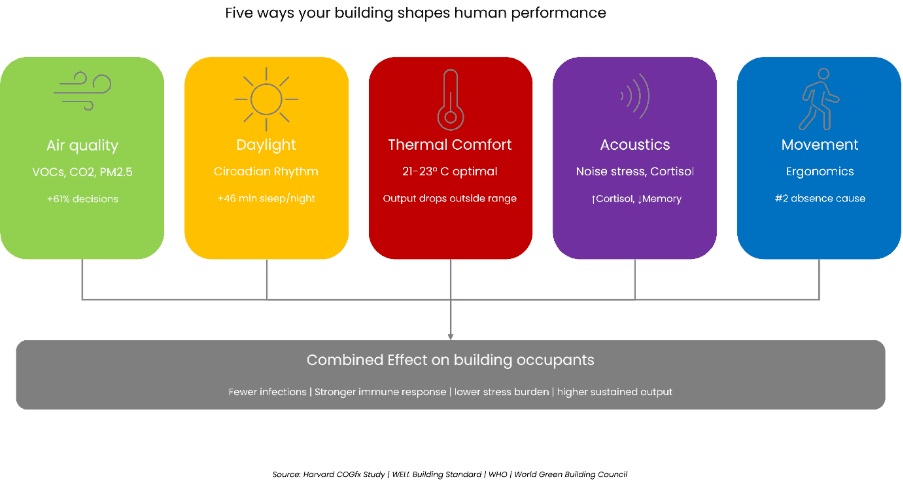
Buildings don't feel neutral. Every design and operational choice consciously or not is either supporting or degrading the people inside them.
Air quality is the most consequential and least visible factor. A landmark study from Harvard T.H. Chan School of Public Health (the COGfx Study) tested cognitive function across different indoor environments and found that decision-making performance was 61% higher in well-ventilated, low-chemical environments compared to conventional office conditions. Ventilation isn't just a comfort issue it's a cognitive infrastructure issue.
Daylight and circadian alignment matter because human biology hasn't caught up with the electric light bulb. Natural light regulates cortisol, melatonin, and alertness cycles. Workers in daylight-optimized spaces sleep an average of 46 minutes more per night, which cascades into better mood, faster recovery from illness, and stronger immune resilience.
Thermal comfort is deceptively contentious. Studies show that performance on complex tasks drops measurably at temperatures outside the 21–23°C range and in most offices, that range is either absent or inconsistently maintained. The cost isn't perceived discomfort; it's measurable output loss.
Acoustic quality or the lack of it is the silent productivity killer in open-plan offices. Unwanted noise increases cortisol levels, disrupts deep work, and has been linked to reduced memory consolidation. People are spending real cognitive resources managing noise rather than doing the work they were hired for.
Movement and ergonomics complete the picture. Sedentary work combined with poor ergonomics contributes to musculoskeletal conditions the second most common reason for workplace absenteeism in high-income countries, according to WHO data.
Put all of this together and you're not describing a luxury wellness program. You're describing the baseline operating conditions that determine whether your human capital actually performs at its potential.
The Absenteeism Link: Where Buildings Meet the Payroll
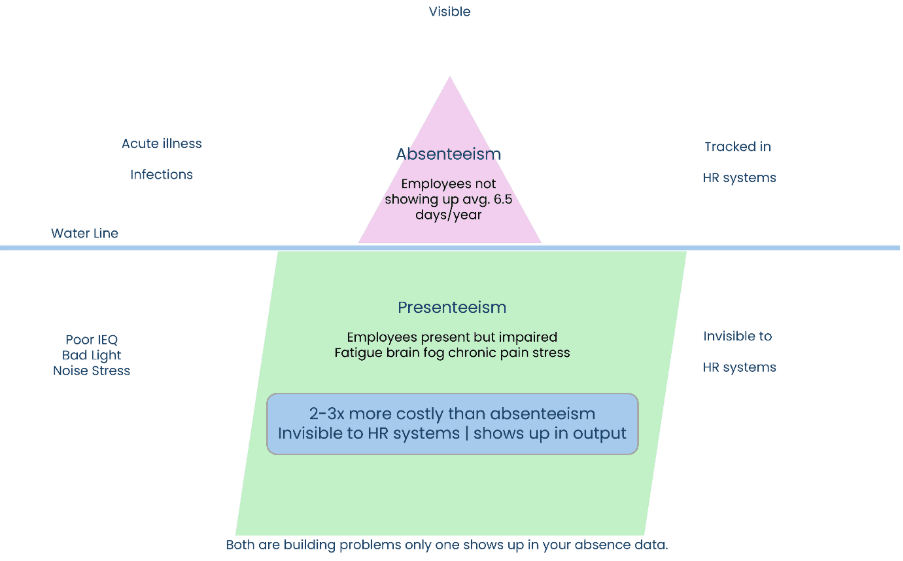
Absenteeism employees not showing up to work is a visible, measurable cost. The International Labour Organization estimates that productivity losses from poor health cost economies roughly 4–6% of GDP annually. At the company level, the average employee loses around 6.5 working days per year to illness.
But absenteeism is only half the story and arguably the smaller half.
Presenteeism is what happens when employees show up but aren't fully functional. They're in the building but they're fatigued, fighting a mild illness, struggling to concentrate, or managing chronic pain. Studies consistently show that presenteeism costs 2–3 times more than absenteeism because it's invisible it doesn't show up in your absence tracking system, but it absolutely shows up in your output.
The WELL Building Standard's evidence base drawing from hundreds of peer-reviewed studies documents a consistent pattern: buildings designed with occupant health as a design priority show 30–50% reductions in symptoms like headaches, respiratory issues, and fatigue. The World Green Building Council's landmark report found that workspace quality improvements can reduce absenteeism by 5–10%.
The mechanism is not mystical. Better air quality means fewer respiratory infections circulating through a shared space. Better daylight means better sleep, which means stronger immune systems. Better acoustics mean lower chronic stress, which reduces the inflammatory burden that makes people susceptible to illness in the first place. The building becomes either a health amplifier or a health drain there is no neutral position.
Translating Health into Financial Language
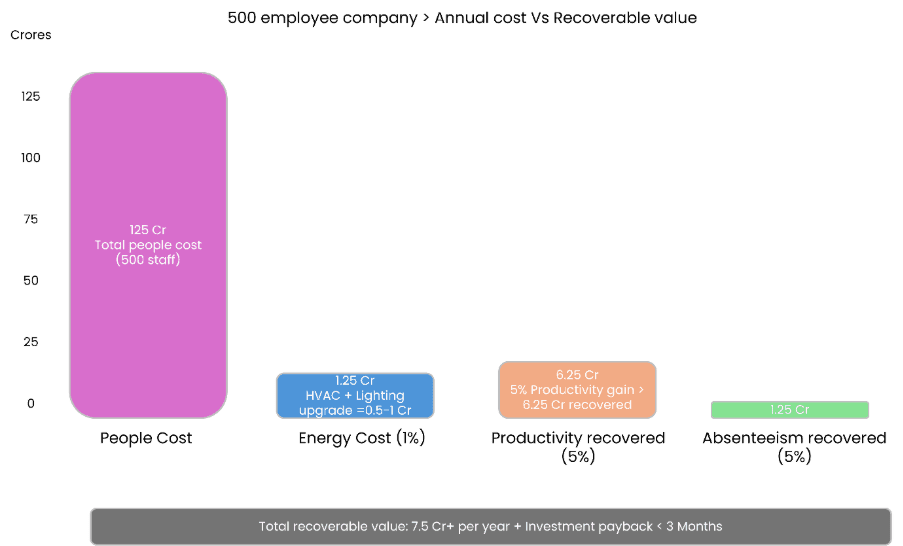
Let's make this concrete. Take a company with 500 employees at an average fully loaded cost (salary + benefits) of ₹25 lakhs per person per year. That's a ₹125 crore annual people cost.
A conservative 5% improvement in effective productivity achievable through evidence-based workplace health strategies represents ₹6.25 crore in recovered value. A 5% reduction in absenteeism at the same company is roughly 1,250 person-days recovered per year. At ₹10,000 per person per day loaded cost, that's another ₹1.25 crore.
These numbers dwarf the cost of upgrading HVAC filtration, improving lighting systems, or pursuing WELL certification and that's before accounting for reduced healthcare claims, lower turnover costs (replacing an employee typically costs 50–200% of their annual salary), and the recruitment advantage of being able to genuinely say "our workplace is designed for your health."
This is the business case that many real estate developers and corporate occupiers are leaving on the table not because the data is unclear, but because it lives in HR and facilities budgets that never talk to each other
The ESG Dimension: Health ROI as Value Creation Across All Three Pillars

Here's where the story gets significantly more interesting for investors, developers, and corporate leadership.
ESG Environmental, Social, and Governance has evolved from a reporting exercise into a genuine capital allocation lens. Institutional investors managing trillions in assets are actively screening for ESG risk, and the definition of "social" is rapidly expanding beyond supply chain ethics to include occupant and employee wellbeing.
On the Social side, healthy buildings represent the most direct and measurable expression of an organization's commitment to human capital. Employee wellbeing is now explicitly included in major ESG frameworks including GRI, SASB, and TCFD-aligned reporting. When a company can demonstrate that its workspace reduces illness rates, improves cognitive performance, and supports mental health and can back that with building performance data it transforms "employee wellbeing" from a vague pledge in an annual report into a quantified, auditable asset.
On the Environmental side, the relationship is subtler but real. Buildings optimized for occupant health through systems like demand-controlled ventilation, dynamic lighting, and low-emission materials often operate more efficiently than conventional buildings. Certification frameworks like WELL and LEED increasingly overlap in their requirements, meaning a health-optimized building often carries a smaller carbon footprint almost as a byproduct. There's also a usage angle: when a building genuinely supports wellbeing, occupants use it more intentionally and waste less energy, materials, and space.
On the Governance side, the integration of health metrics into building management represents a new frontier of responsible stewardship. Leading organizations are beginning to track indoor air quality scores, thermal comfort compliance rates, and occupant health outcomes with the same rigor they apply to financial KPIs. This shift from buildings as passive infrastructure to buildings as active contributors to organizational performance is what serious governance looks like in the built environment.
The investment community is paying attention. GRESB (the Global Real Estate Sustainability Benchmark) has expanded its health and wellbeing scoring criteria. Institutional investors increasingly require health performance data as part of due diligence. Buildings with credible health credentials are beginning to command rental premiums of 5–11% in major markets globally, while also demonstrating lower vacancy rates and longer lease terms.
From Theory to Strategy: What This Actually Looks Like in Practice
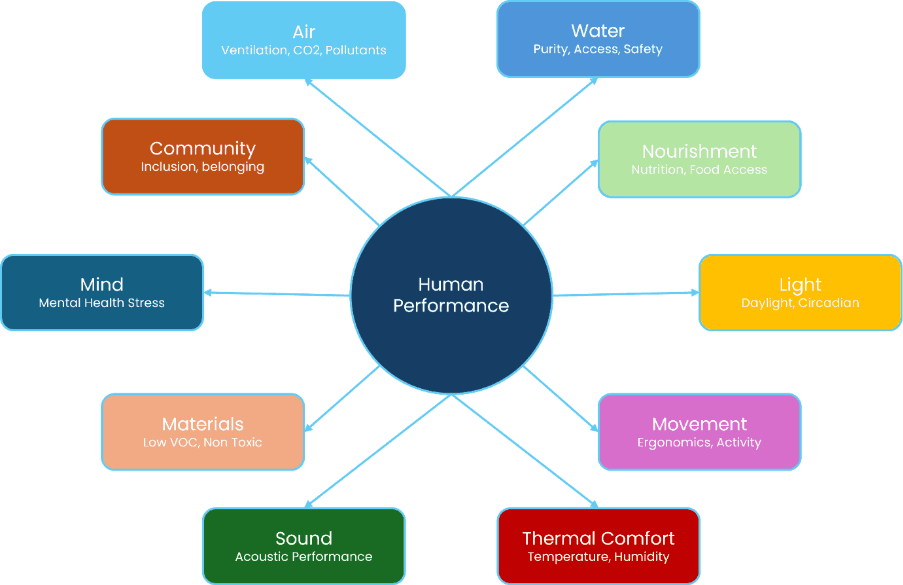
This is where a sustainability consultancy perspective becomes critical, because the gap between "health ROI is real" and "our building actually delivers it" is bridged by specific, integrated strategies not generic wellness programs.
WELL Certification provides the most rigorous third-party verified framework for building health performance, covering ten core concepts from Air and Water to Light, Sound, Movement, and Mind. It's not a checklist; it's a performance standard that requires ongoing measurement and verification. Buildings that pursue WELL don't just get a plaque; they get a continuous feedback loop between building systems and human outcomes.
Smart building systems are the engine room. Real-time air quality monitoring, CO₂-triggered ventilation adjustment, circadian-tuned lighting systems, and occupancy-based thermal zoning are no longer aspirational technology they are available, cost-effective, and increasingly expected. The key is integration: individual sensors or standalone systems add cost without adding coherence. A properly integrated building management system turns health data into actionable operations.
Energy and design modelling often seen as purely environmental tools are equally powerful for optimizing human outcomes. Daylight modelling ensures that workspaces receive appropriate natural light without glare or thermal discomfort. Airflow modelling identifies stagnation zones where pollutants concentrate. These are planning investments that pay forward through the entire lifecycle of a building.
The shift in framing is perhaps the most important strategy of all. The most forward-thinking developers and corporate real estate leaders have stopped asking "how green is this building?" and started asking "how does this building perform for the people in it?" Those reframing changes procurement criteria, design briefs, operational priorities, and reporting frameworks. It is the shift from green buildings to high-performance, human-centric buildings and it is where the next decade of built environment value creation will be found
The Road Ahead: Health as a Measurable KPI
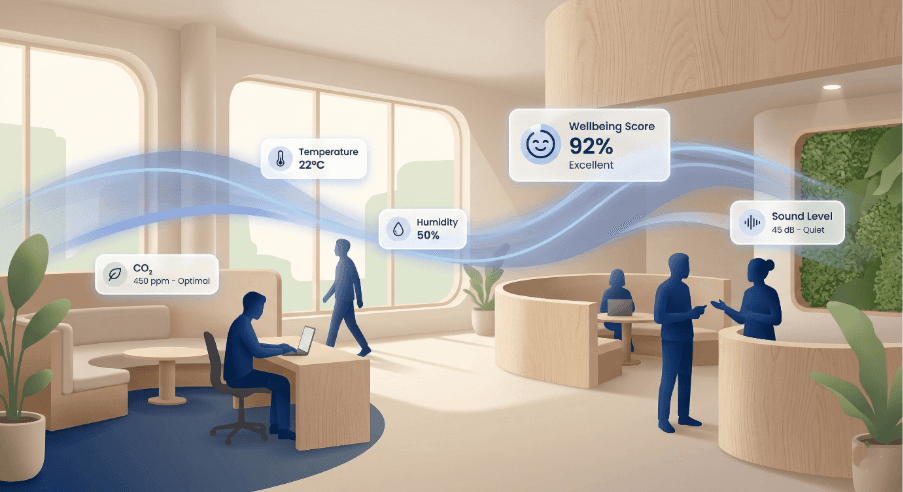
The future of healthy buildings is data-driven in a way that makes today's approaches look like rough approximations.
Continuous environmental monitoring air quality, temperature, humidity, acoustic levels will become standard infrastructure, not an add-on. Wearable integration will allow organizations to correlate building conditions with health outcomes at a scale that produces statistically robust insights. Occupant wellbeing surveys will be replaced by real-time feedback mechanisms that allow building operators to respond to comfort issues within hours rather than lease cycles.
Health will become a KPI alongside energy intensity and occupancy rate. It will appear in investor packs, annual reports, and lease negotiations. Buildings that cannot demonstrate health performance will face the same trajectory as buildings that cannot demonstrate energy efficiency first a reputational discount, then a financial one.
The Closing Argument

There is a silent cost being paid right now in almost every commercial building in the world. It's paid in sick days and foggy thinking, in talent that leaves for workplaces that care, in ESG scores that flag "employee wellbeing" as a risk rather than an asset.
The organizations and developers who act on the health-ROI connection now will not just be doing the right thing; they will be building a durable competitive advantage that compounds over time.
Your building is either working for your people or working against them. The investment to change that is smaller than you think. The return is larger than you're accounting for.
And in an era where capital, talent, and regulation are all converging on the same question what kind of organization are you? a building that genuinely supports human health is one of the most powerful answers available.
Desapex works with developers, corporate occupiers, and institutional investors to translate the science of healthy buildings into measurable building strategies from energy modelling and IEQ diagnostics to WELL certification and smart systems integration. Because the best sustainability investment you can make is one that pays you back through your people.