


As the world races toward net-zero, the energy landscape is undergoing a transformation that blends ambition with realism. While renewables such as wind and solar are growing rapidly, fossil-fuel power plants continue to shoulder much of the global electricity demand. The challenge, then, is not only how to replace them, but how to reduce their emissions in a clear and measurable way.
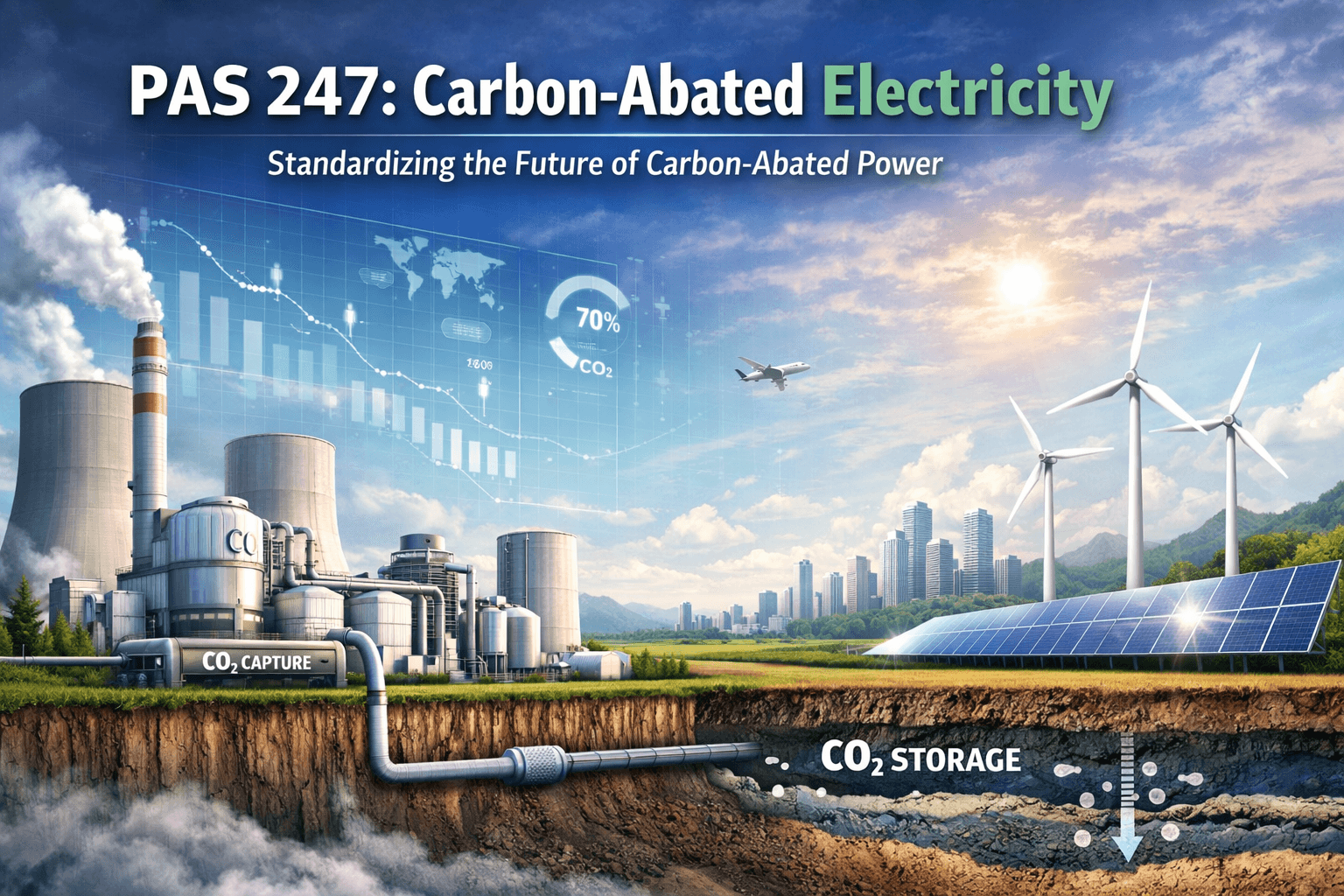
The British Standards Institution (BSI) took a decisive step toward that goal with the launch of PAS 247 – Carbon-Abated Electricity. PAS 247 is a Publicly Available Specification number 247 issued by BSI, defining how to monitor and calculate “carbon-abated electricity” from fossil-fuel power plants using Carbon Capture and Storage (CCS). It is the first framework that provides a unified, scientific method to measure and verify the decarbonization achieved by CCS-enabled power generation
A Global Effort from Taipei to London
Developed through coordination between BSI’s teams in London and Taipei, PAS 247 demonstrates how international collaboration can accelerate industrial decarbonization. The standard was officially launched in Taiwan, signaling the region’s growing leadership in advancing clean-energy transitions while maintaining industrial competitiveness.
BSI described PAS 247 as the first standardized methodology in the world that defines how to quantify “carbon-abated electricity” electricity that, while still produced from fossil fuels, has its carbon emissions captured and permanently stored or reused in verified ways.
This is more than just a technical achievement. It is a framework of trust enabling governments, utilities, and industries to credibly measure how much of their power is genuinely decarbonized, and to report it consistently across borders.
Why PAS 247 Matters
Until now, there has been no unified global standard to measure or certify how much carbon a CCS-enabled plant actually prevents from entering the atmosphere.
Countries and corporations could claim progress toward “clean coal” or “low-carbon gas,” but without transparent accounting, such claims risked inconsistency or even greenwashing.
PAS 247 changes that. It introduces a standardized methodology that allows for:
Consistent carbon accounting: ensuring every megawatt-hour of electricity has a traceable carbon-abatement value.
Comparable reporting: enabling governments and investors to compare performance across technologies and regions.
Credible certification: creating pathways for verified carbon credits or low-carbon electricity labels.
Policy alignment: providing a reference for integration with international frameworks like ISO 14064 (Greenhouse Gas Accounting) and the UNFCCC mechanisms.
In effect, PAS 247 bridges the technical rigor of engineering with the accountability demanded by policy and markets.
The Bigger Picture: Industrial Decarbonization
The introduction of PAS 247 also represents a strategic milestone in global industrial upgrading. Fossil-fuel assets remain embedded in many economies; completely retiring them overnight is impractical.
However, with CCS technology capturing CO₂ directly from flue gases and storing it underground or repurposing it for industrial use these plants can serve as transitional allies in the journey to net zero.
What PAS 247 provides is the measurement backbone for that transition.
Just as ISO 50001 gave organizations a structure to manage energy performance, PAS 247 gives utilities and regulators the confidence to quantify decarbonization scientifically, without ambiguity.
Data, Digitalization, and Verification
For standards like PAS 247 to work effectively, data accuracy and digital traceability are crucial.
Here lies a natural synergy with the world of Digital Engineering and BIM-enabled monitoring areas where Desapex continues to specialize.
Imagine a Digital Twin of a power plant continuously tracking CO₂ capture efficiency, energy flow, and storage integrity.
Sensors feed real-time data into a model aligned with PAS 247 parameters, automatically generating verified reports for regulators and investors.
Such integrations make the standard not just a document but a living, operational framework.
Furthermore, data interoperability across systems whether through IoT gateways, SCADA integrations, or LCA (Life-Cycle Assessment) tools ensures that carbon-abatement figures remain transparent, auditable, and ready for third-party verification.
This digital backbone will be vital as nations move toward carbon markets and blockchain-based carbon registries, where trust in the data equals financial and environmental value.
Implications for Asia and India
That PAS 247’s global debut took place in Taiwan is symbolic. Asia’s industrial economies from Taiwan and Japan to India and South Korea are simultaneously balancing energy security, affordability, and decarbonization.
By adopting PAS 247, these nations can demonstrate measurable progress toward carbon neutrality while continuing to leverage existing infrastructure.
For India, where over 50 % of electricity still comes from coal, carbon capture and standardization could be transformative.
Imagine applying PAS 247 within India’s ultra-supercritical thermal plants verifying captured CO₂ through digital platforms and linking the results with national carbon credit systems.
This could position India as a leader in measured decarbonization, complementing its ambitious renewable-energy goals and emerging hydrogen roadmap.
Challenges Ahead
No transition is without obstacles. Implementing PAS 247 at scale will require:
Investment in reliable CCS infrastructure.
Training of verification professionals to interpret and audit PAS 247 data correctly.
Alignment with national policies and integration into energy-market frameworks.
Continuous digital monitoring to prevent data gaps or misreporting.
However, these challenges are precisely where innovation both technical and digital will flourish.
The combination of standards like PAS 247 and digital assurance ecosystems can unlock the next level of carbon transparency.
Conclusion: Standards Powering Progress
The launch of PAS 247 – Carbon-Abated Electricity marks a milestone not just for BSI, but for the global energy transition itself.
It affirms that every watt can be measured, every emission can be verified, and every claim must be trusted.
Through the collaboration of science, industry, and standardization, the world edges closer to a sustainable energy future one where data, technology, and purpose align.
Standardization is not bureaucracy; it is the language of progress.
With PAS 247, that language now speaks the truth of decarbonization.