



What is an EPD? Quick Primer
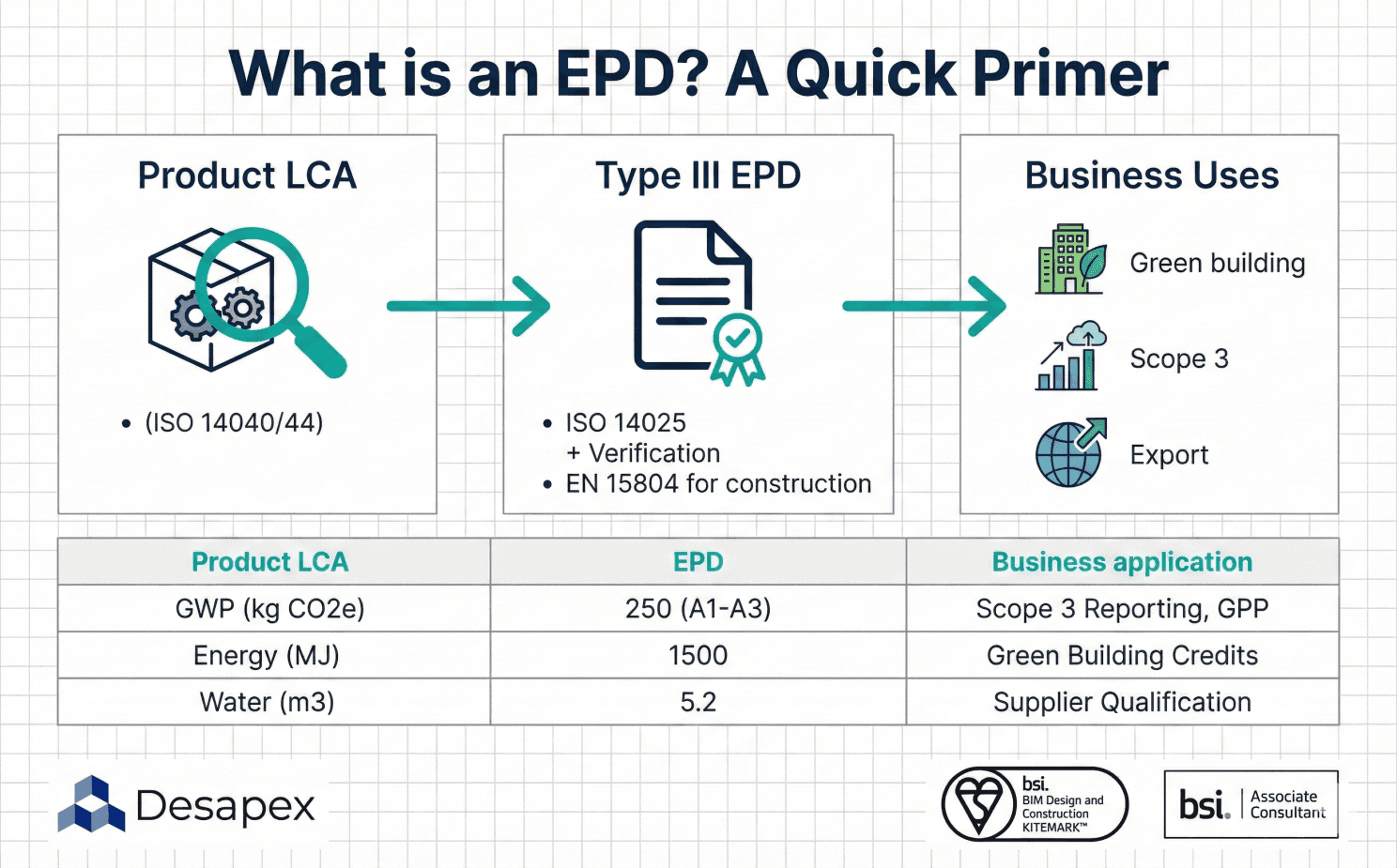
An Environmental Product Declaration (EPD) is a standardized document that reports quantified environmental impacts of a product across defined life-cycle stages, based on a Life Cycle Assessment (LCA) conducted under harmonized rules. For construction products in particular, EN 15804 specifies how to structure that LCA and how to report indicators such as global warming potential, resource use, and waste categories.
Unlike a marketing label or "green" logo, an EPD is not a pass–fail claim; it is a transparent data sheet developed and verified under ISO 14025 (Type III environmental declarations) using LCA principles from ISO 14040 and ISO 14044. It does not say whether a product is "good" or "bad", but provides robust numbers that building LCA tools, carbon accounting platforms, and procurement teams can compare across suppliers.
Why EPDs matter for Indian industry
For Indian industry, EPDs are increasingly the default data source for:
Whole-building LCA in LEED, BREEAM, and IGBC projects
Embodied carbon reporting for infrastructure owners
Scope 3 emissions quantification and SBTi-aligned supplier engagement programs
Types of EPDs: A Clear Taxonomy
EPDs sit within the broader family of environmental labels and declarations defined by the ISO 14020 series:
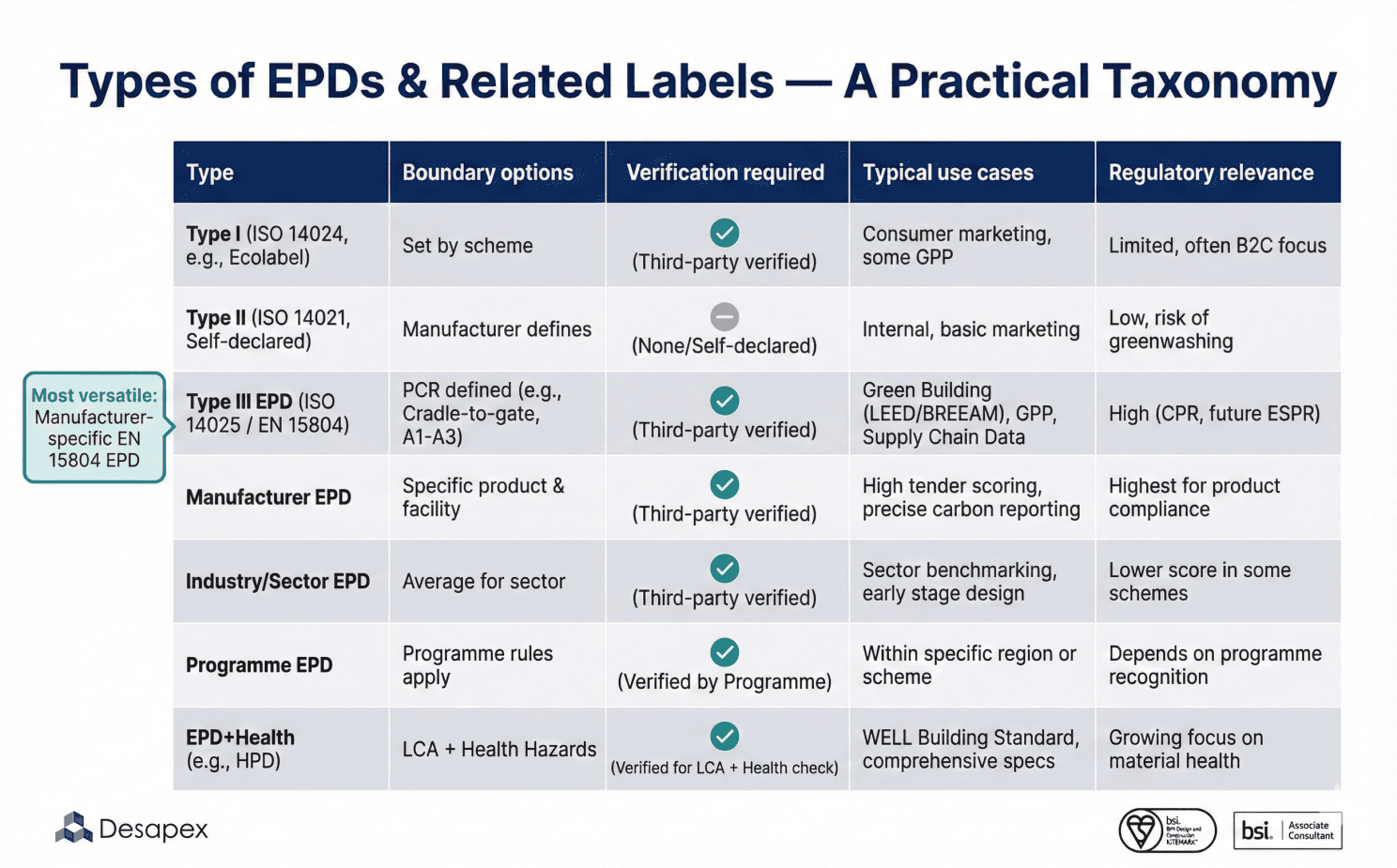
Type I eco-labels (ISO 14024): Third-party certified labels that set performance thresholds (e.g., eco-labels that certify only top-performing products).
Type II (ISO 14021): Self-declared environmental claims by manufacturers (e.g., "recyclable", "low VOC") without mandatory third-party verification.
Type III (ISO 14025): Quantified LCA-based declarations (EPDs) with standard indicators and independent verification.
Key sub-types within Type III EPDs
Within Type III EPDs, practical sub-distinctions matter for Indian manufacturers:
PCR-specific vs. generic: Product Category Rules (PCRs) define how to model and report a given product type; construction-related PCRs typically follow or complement EN 15804.
Programme EPDs: EPDs issued under recognized programme operators (e.g., ECO Platform-recognized programs in Europe, International EPD System) benefit from harmonized rules and wider acceptance.
Manufacturer vs. industry EPDs:
Manufacturer EPDs are based on primary data for a specific plant or product line and can support differentiation and Scope 3 reporting.
Industry or sector EPDs are averages across multiple manufacturers and useful for benchmarks, but cannot be claimed as representative of a specific company.
System boundaries:
Cradle-to-gate: From raw material extraction up to factory gate; sufficient for many procurement and LCA use cases.
Cradle-to-grave: Includes use and end-of-life stages; often preferred in building LCA and some regulations.
Cradle-to-cradle: Includes closed-loop recycling scenarios, relevant for circularity narratives.
EPD + health information:
Some markets request combined environmental and health disclosures (e.g., EPD plus Health Product Declaration/HPD) for indoor air quality and toxicity concerns.
How EPD Types Map to Regulatory and Procurement Needs
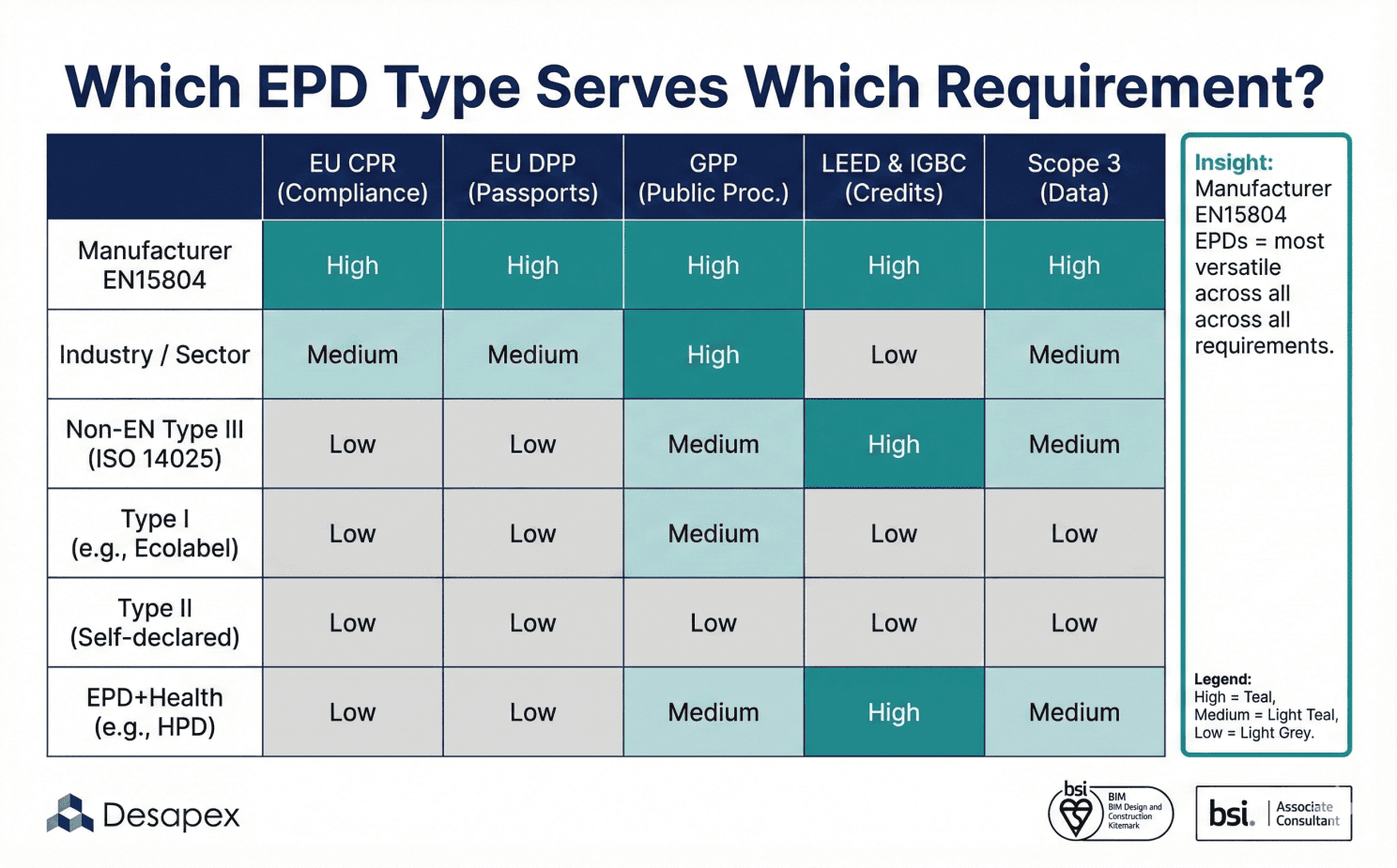
Different EPD formats unlock different doors. For Indian exporters and suppliers, aligning EPD design with target regulations and buyers is critical.
Key regulatory and procurement applications:
EU Construction Products Regulation (CPR) and ECO Platform: For construction products sold into the EU, EN 15804-compliant EPDs issued under an ECO-recognized programme are increasingly expected, especially when products are used in green building projects or in countries with embodied-carbon rules.
Digital Product Passport (DPP): EPDs provide structured environmental data that can feed upcoming EU-level Digital Product Passport requirements for selected product groups, especially where life-cycle climate impacts and material content are relevant.
Green Public Procurement (GPP): European and some national GPP schemes use EPD indicators (e.g., GWP per unit) as either minimum performance thresholds or weighted tender criteria, making verified, product-specific EPDs a route to higher scores.
Green building rating systems: LEED and BREEAM award credits for projects that use products with third-party verified EPDs; IGBC and GRIHA increasingly reference life-cycle-based product data or third-party environmental certifications.
Scope 3 and SBTi supplier engagement: Corporate buyers using SBTi guidance are requested to set supplier engagement targets where Scope 3 is material, and product-level LCA/EPDs are a key data source for accurate purchased-goods emissions.
Market Data & Opportunity for Indian Manufacturers
EPDs ride on two macro trends: rising demand for low-carbon materials and stricter disclosure on supply-chain emissions.
Globally, construction and manufacturing account for a large share of greenhouse gas emissions; manufacturing and construction together represent close to a quarter of global emissions. In India, energy-intensive sectors such as steel and cement are among the fastest-growing industrial emitters, prompting interest in standards and data that can enable decarbonization and clean technology investment.
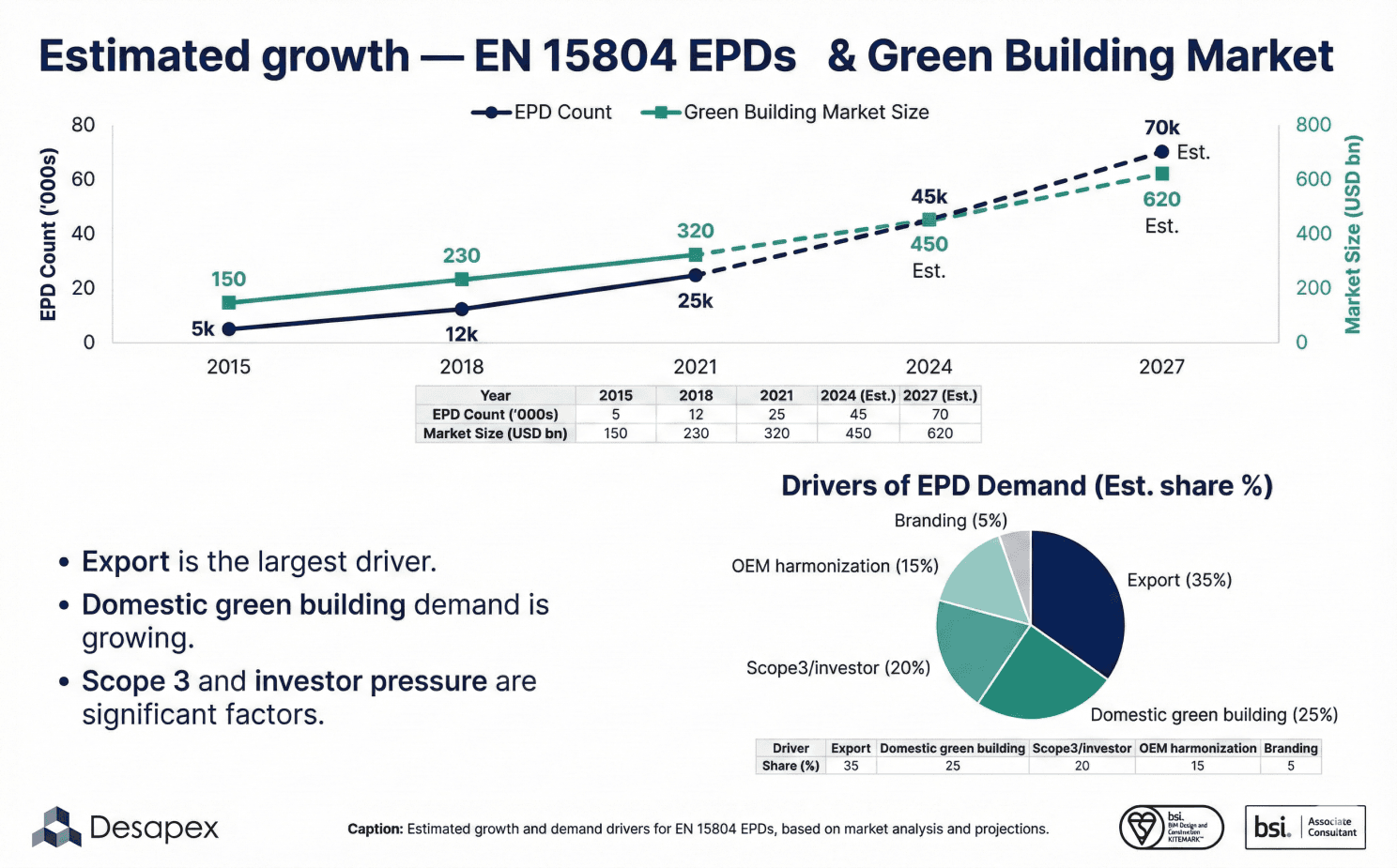
Across Europe, the number of EN 15804-compliant EPDs published through ECO Platform-recognized programmes has grown rapidly, reflecting strong demand from designers, contractors, and public buyers for product-level LCA data.
In parallel, Indian manufacturing contributes around 12–13% of GDP, and export-oriented manufacturers increasingly face ESG-linked procurement questionnaires and carbon-intensity disclosure requirements. This convergence creates a strategic opportunity: Indian suppliers that move early on EPDs can secure preferred supplier status and capture share in low-carbon product niches.
Business Case: Commercial Benefits of Choosing the Right EPD Type
The commercial value of EPDs shows up in tenders, pricing power, and risk management not just in ESG reports.
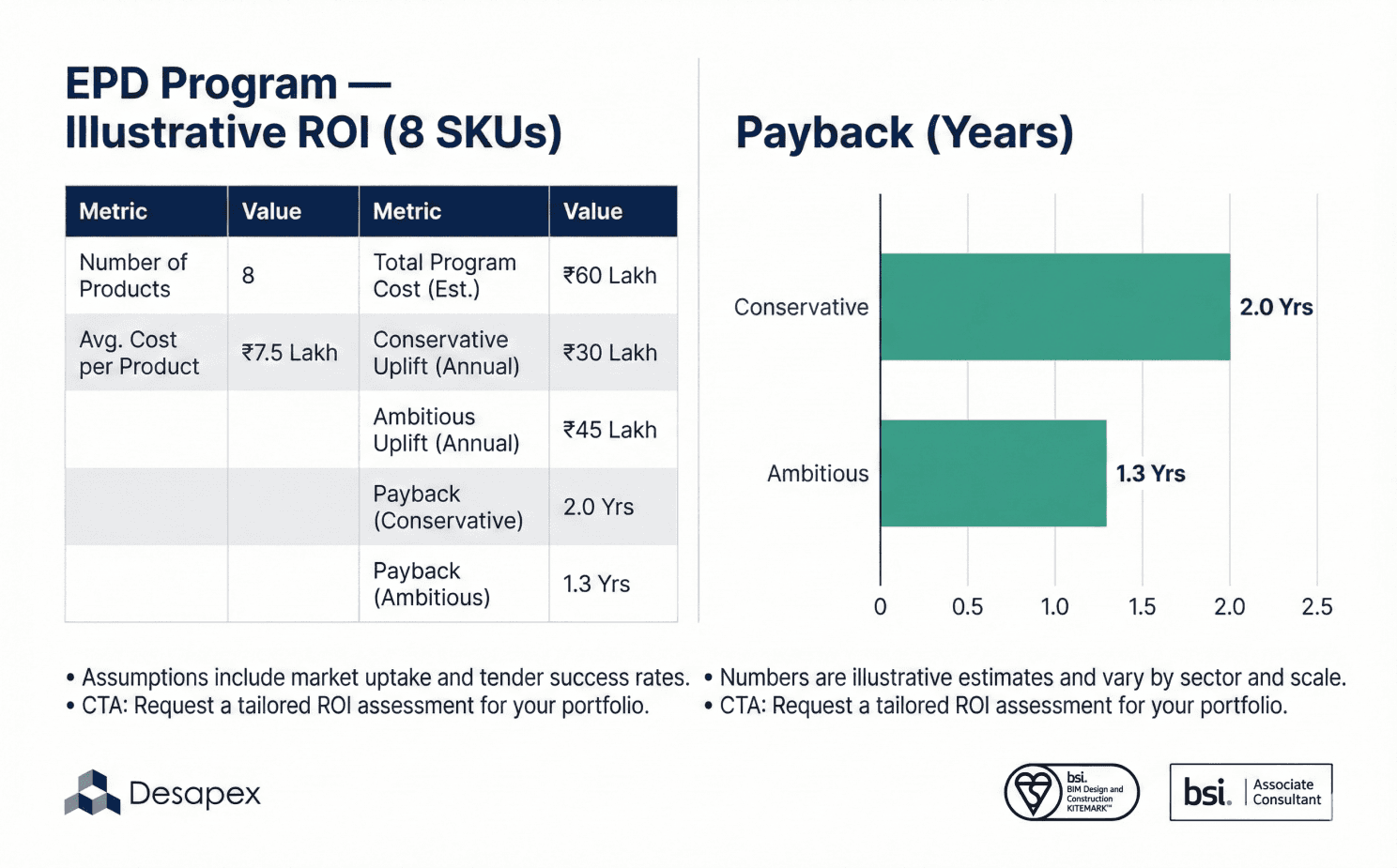
In public and private tenders where embodied carbon or lifecycle performance carries weight, having EN 15804-compliant, product-specific EPDs can contribute directly to technical scoring and qualification. For export-oriented manufacturers, EPDs also reduce friction in ESG questionnaires, speed up supplier onboarding, and signal readiness for future regulations such as the EU Digital Product Passport.
Two levers for margin improvement
1. Premium positioning: Low-carbon variants with verified performance are better placed to command modest price premiums or defend margins amid commoditization.
2. Cost and risk reduction: LCA and EPD work often reveal hotspots where resource efficiency projects and process changes can reduce energy, material, and waste costs while cutting emissions.
How India's Policy Landscape Interacts with EPD Selection
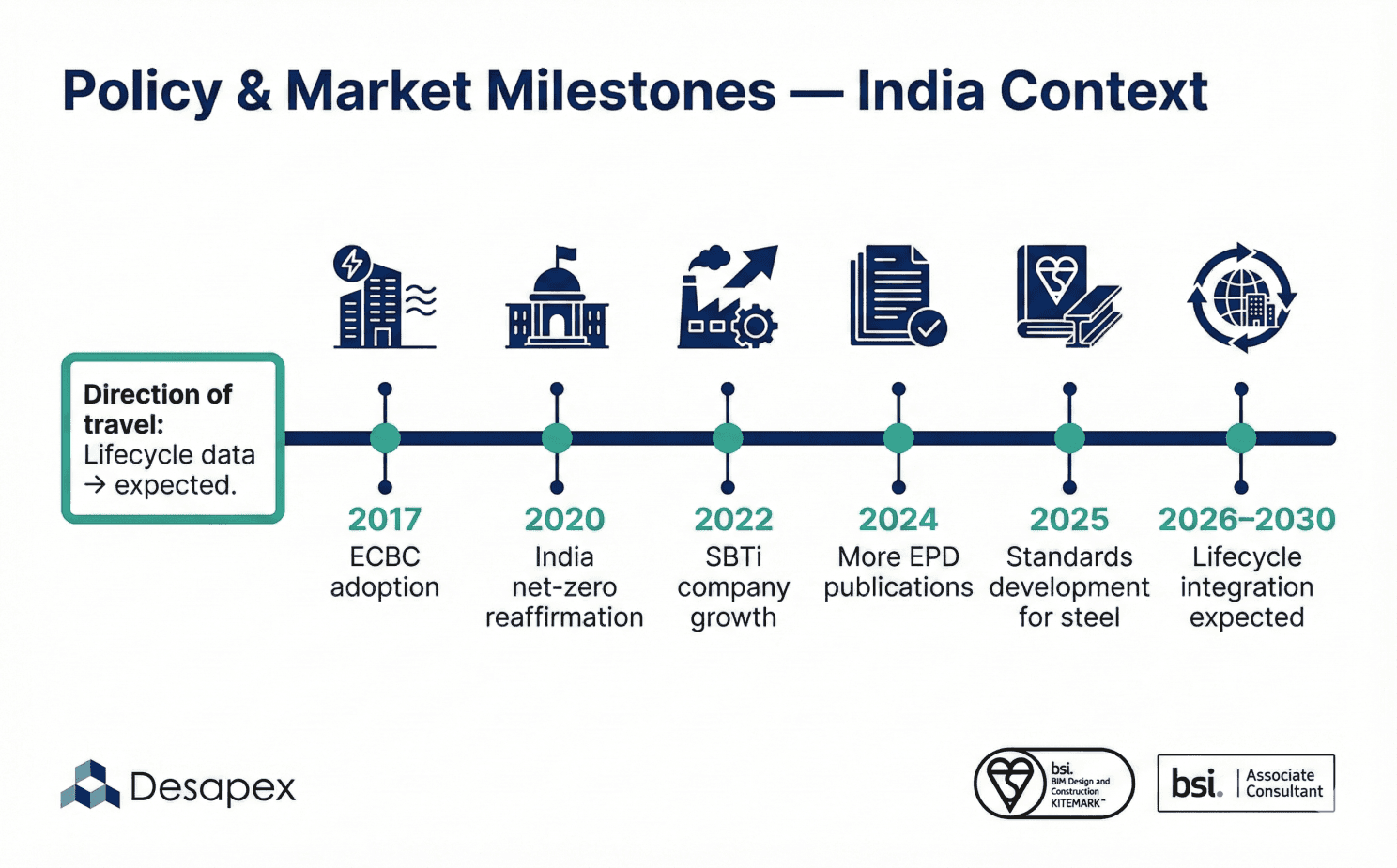
India's policy signals are gradually aligning with global low-carbon and lifecycle-based approaches, even if EPDs are not always named explicitly.
The Bureau of Indian Standards (BIS) and allied institutions, together with international agencies, are exploring standards for decarbonizing energy-intensive sectors such as iron and steel, which rely heavily on robust data and harmonized metrics. In buildings, codes and guidelines such as the Energy Conservation Building Code (ECBC) and its forthcoming updates are steadily tightening performance requirements and encouraging lifecycle-aware approaches.
Rising policy and market expectations
Green public procurement (GPP): Discussions at central and state levels increasingly reference lifecycle performance and environmental attributes of materials, creating a natural role for standardized declarations like EPDs as evidence.
Green building rating systems: Systems widely used in India (IGBC, GRIHA, LEED) already reward projects that use products with verified environmental declarations or equivalent documentation.
Science-based targets and Scope 3: Indian companies committing to near-term science-based targets under the SBTi face explicit expectations to engage suppliers and obtain better Scope 3 data, for which LCA/EPDs are a foundational tool.
How Desapex Helps: Practical Pathways & Service Offering
For Indian manufacturers, the main barrier is rarely intent it is capacity, data organization, and understanding which EPD type to prioritize.
Desapex supports clients end-to-end, translating international standards and buyer expectations into a practical, phased program that delivers commercial results.
Step-by-step EPD support
1. Strategic scoping and SKU selection
Identify 3–10 priority SKUs where EPDs can support current tenders, export ambitions, or buyer requests
Map target markets (EU, UK, Middle East, India) to select EN 15804 and programme operator requirements
2. PCR and programme selection
Select the most suitable Product Category Rules (e.g., construction products PCRs under International EPD System or other ECO-recognized programmes)
Advise on whether a manufacturer-specific EPD, sector EPD participation, or a process certification model is optimal
3. Primary data capture and QA
Design data collection templates for energy, materials, packaging, transport, and waste at plant level
Set up QA processes so that operational teams can update data annually with minimal burden
4. LCA modelling (ISO/EN-aligned)
Build product LCAs compliant with ISO 14040/44 and EN 15804, using recognized databases and tools
Identify hotspots and improvement options (e.g., fuel switch, clinker factor reduction, recycled content)
5. Verification coordination and publication
Liaise with accredited third-party verifiers and programme operators to streamline reviews and avoid rework
Support digital publication in relevant registries and integration with BIM/LCA tools where required
6. Scaling and portfolio management
Transition from single EPDs to portfolio-level process certification where feasible, to reduce marginal costs
Build internal capability through training and documentation so teams can maintain and extend the EPD set
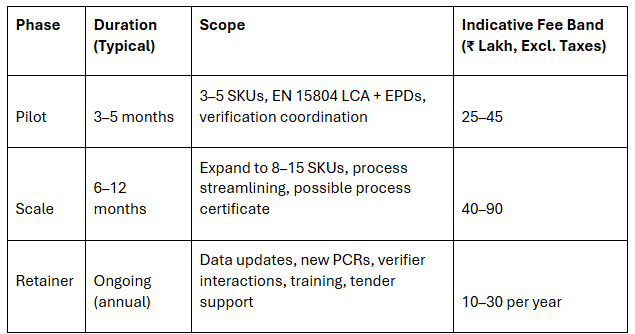
Action Plan & Checklist for Indian Manufacturers
To move from intent to execution, manufacturers can follow a simple, pragmatic sequence and plug in expert support where needed.
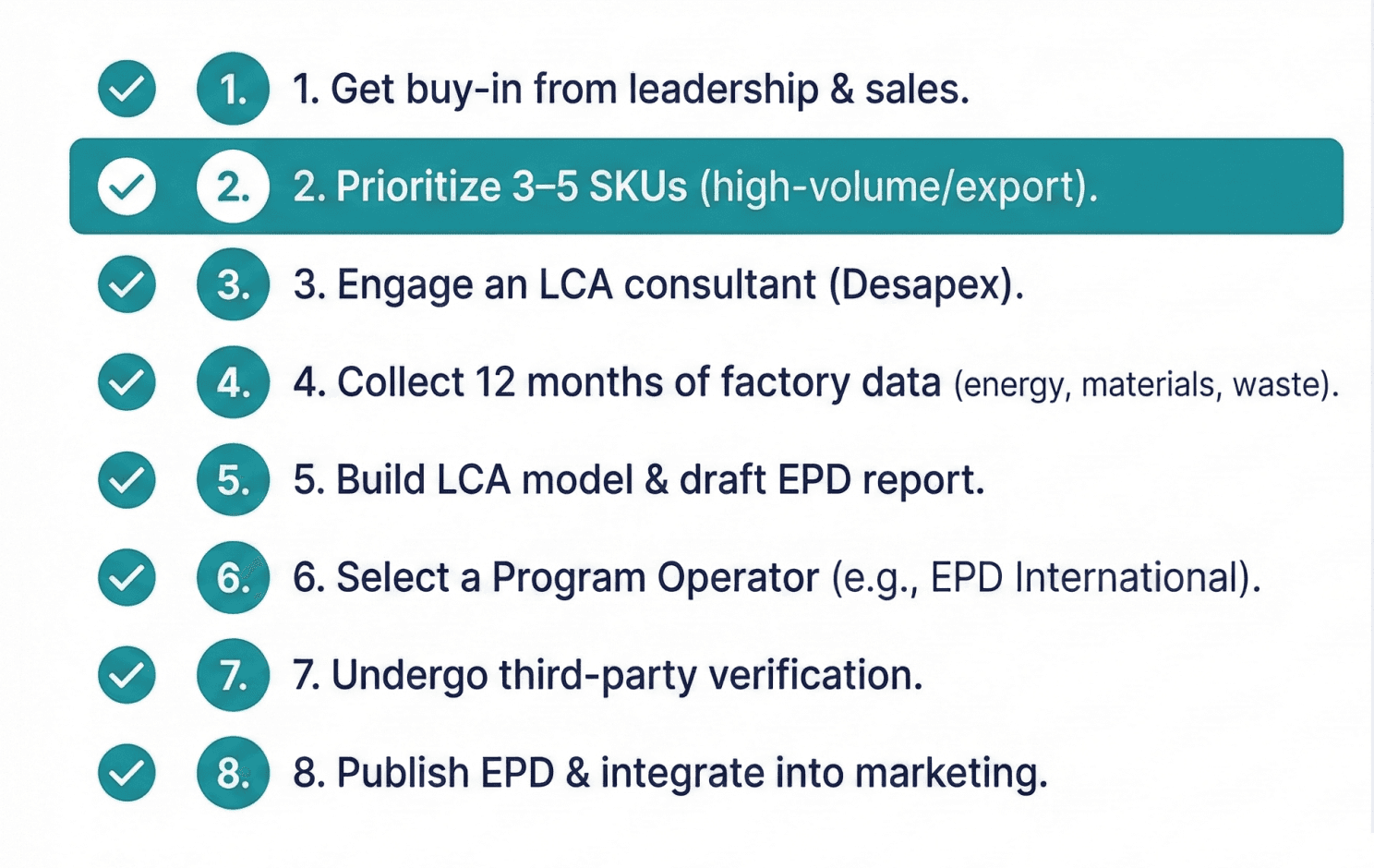
8-point EPD readiness checklist
Frame the business case Clarify which tenders, export markets, or key buyers could be unlocked or protected with EPDs.
Prioritize 3–5 SKUs Focus on high-revenue, high-volume, or strategically important products rather than the entire catalogue.
Confirm target markets and schemes Map EU CPR, green building systems, and buyer SBTi expectations to the right EPD type (EN 15804, cradle-to-gate vs. cradle-to-grave).
Select PCR and programme Choose appropriate PCRs and programme operators (e.g., ECO-recognized) to ensure acceptance in target markets.
Set up data collection Define roles, templates, and systems for gathering primary data (energy, materials, logistics, waste) at plant level.
Run LCAs and draft EPDs Conduct ISO 14040/44-aligned LCAs, compile EPDs, and review results internally for improvement opportunities.
Complete verification and publication Engage approved verifiers, address comments, and publish EPDs in recognized registries.
Integrate and communicate Embed EPD data into sales decks, tender responses, BIM/LCA workflows, and ESG reports; train commercial teams to use them effectively.