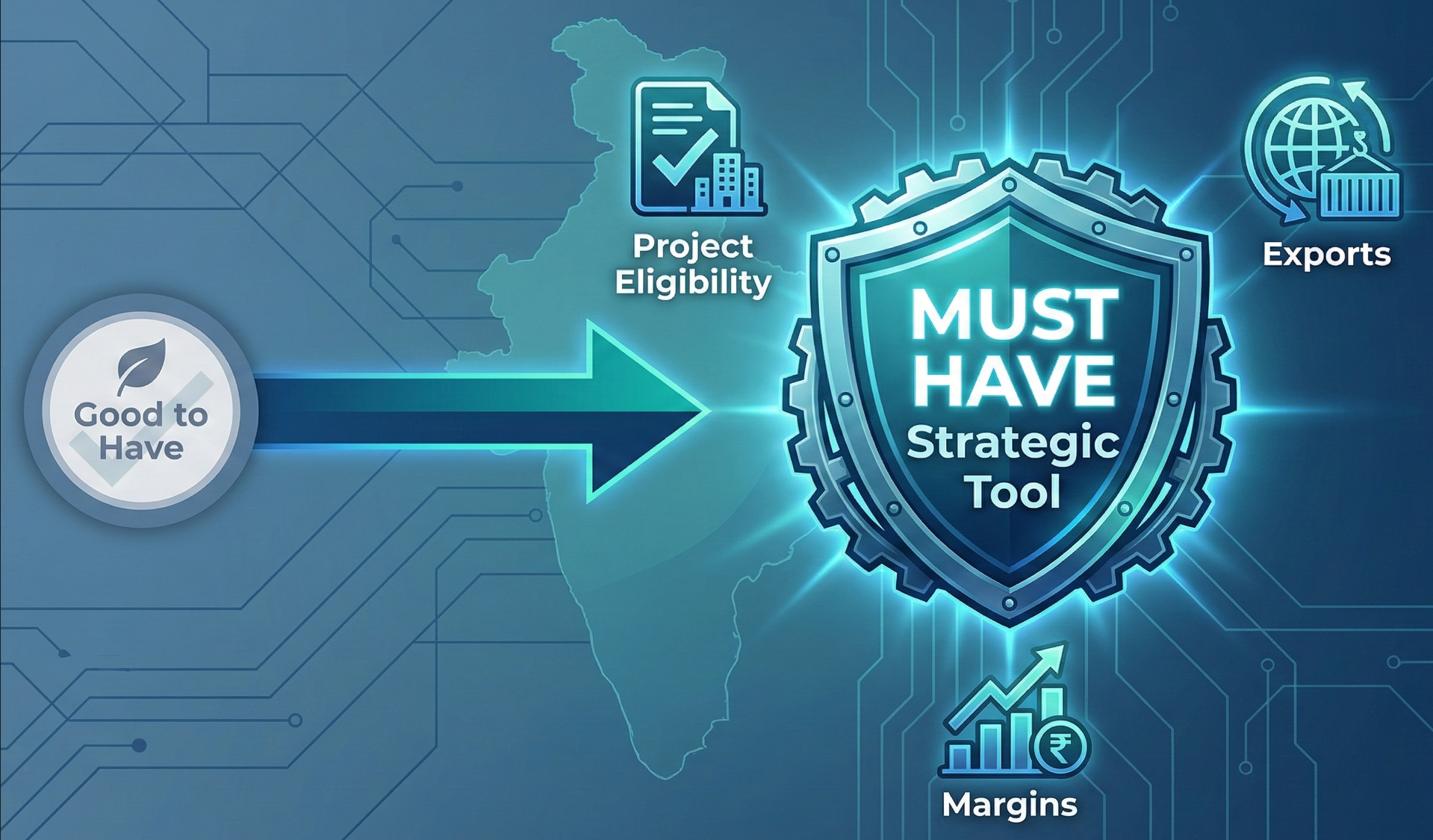
Environmental Product Declarations (EPDs) are moving from “good to have” to “must have” for anyone who manufactures, specifies, or buys building materials in India today. They directly influence project eligibility, export access, margins, ESG positioning, and green rating points making them a strategic business tool, not just a sustainability label.
Below is a complete, India focused guide written for manufacturers, developers, architects, consultants, and procurement leaders with a spotlight on how Desapex helps you go from “no EPD” to “published, market ready EPD” and beyond.
What an EPD Is (In Simple Terms)
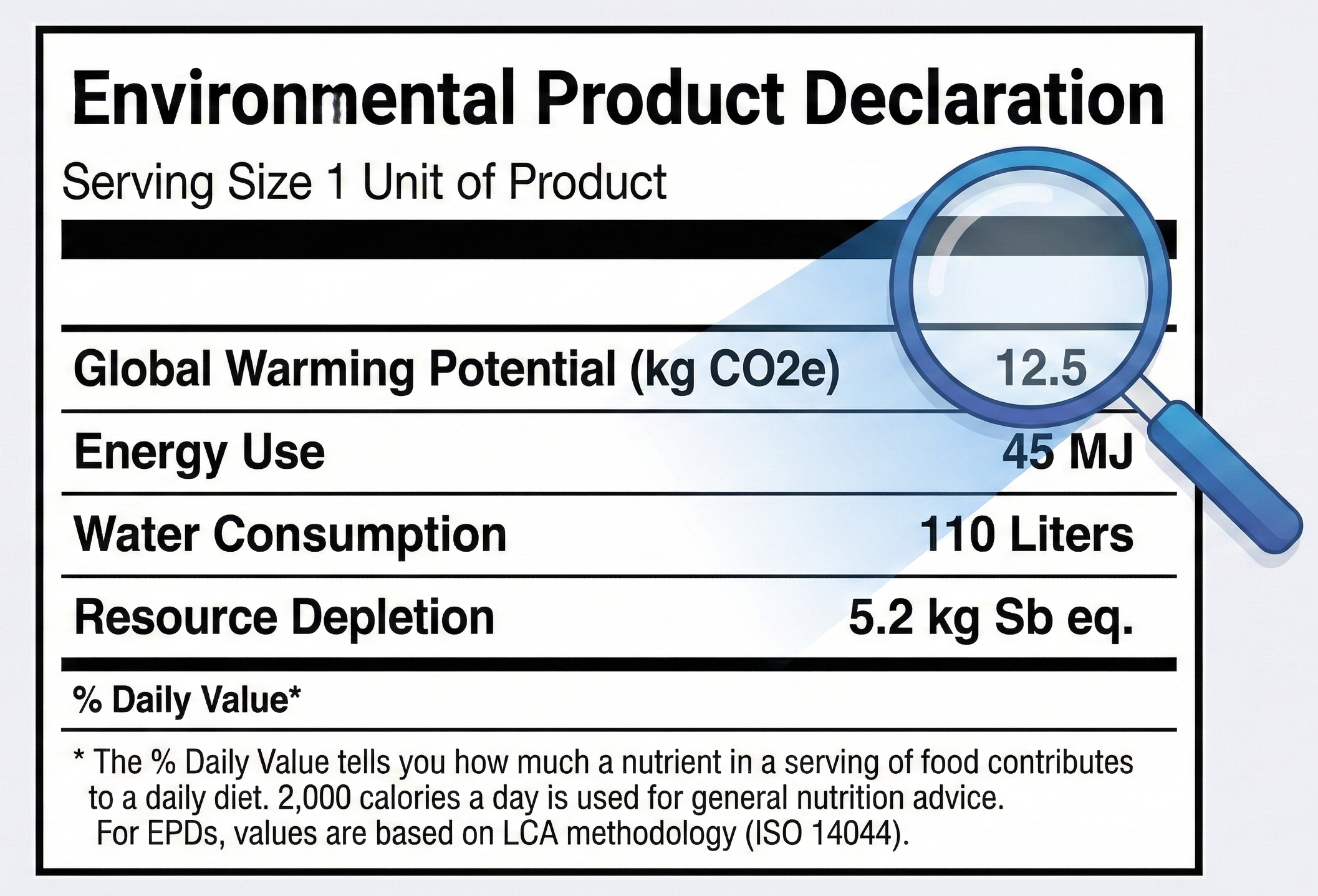
An Environmental Product Declaration is a standardized, third party verified document that reports the quantified environmental impacts of a product across its life cycle typically from raw material extraction to manufacturing, transport, use, and end of life. For construction products, EPDs follow ISO 14040/14044 for Life Cycle Assessment and EN 15804+A2 as the core standard for how results are structured and reported.
Think of an EPD as a “nutrition label for carbon and other impacts” that allows architects, developers, and buyers to compare products on facts, not claims.
Why the World Is Shifting to Transparent, Low Carbon Products
Global climate targets under the UNFCCC and national net zero commitments are pushing regulators and markets to cut emissions in hard to abate sectors like buildings and construction. As operational emissions from buildings drop through energy codes and efficiency measures, embodied carbon from materials like cement, steel, aluminium, glass, tiles, and blocks becomes a major part of total building emissions.
To manage embodied carbon, policymakers, investors, and rating systems increasingly demand product level transparency, and EPDs have become the global “currency” for this disclosure.
Why EPDs Are Required (Globally & in India)
Global decarbonization, ESG, and disclosure
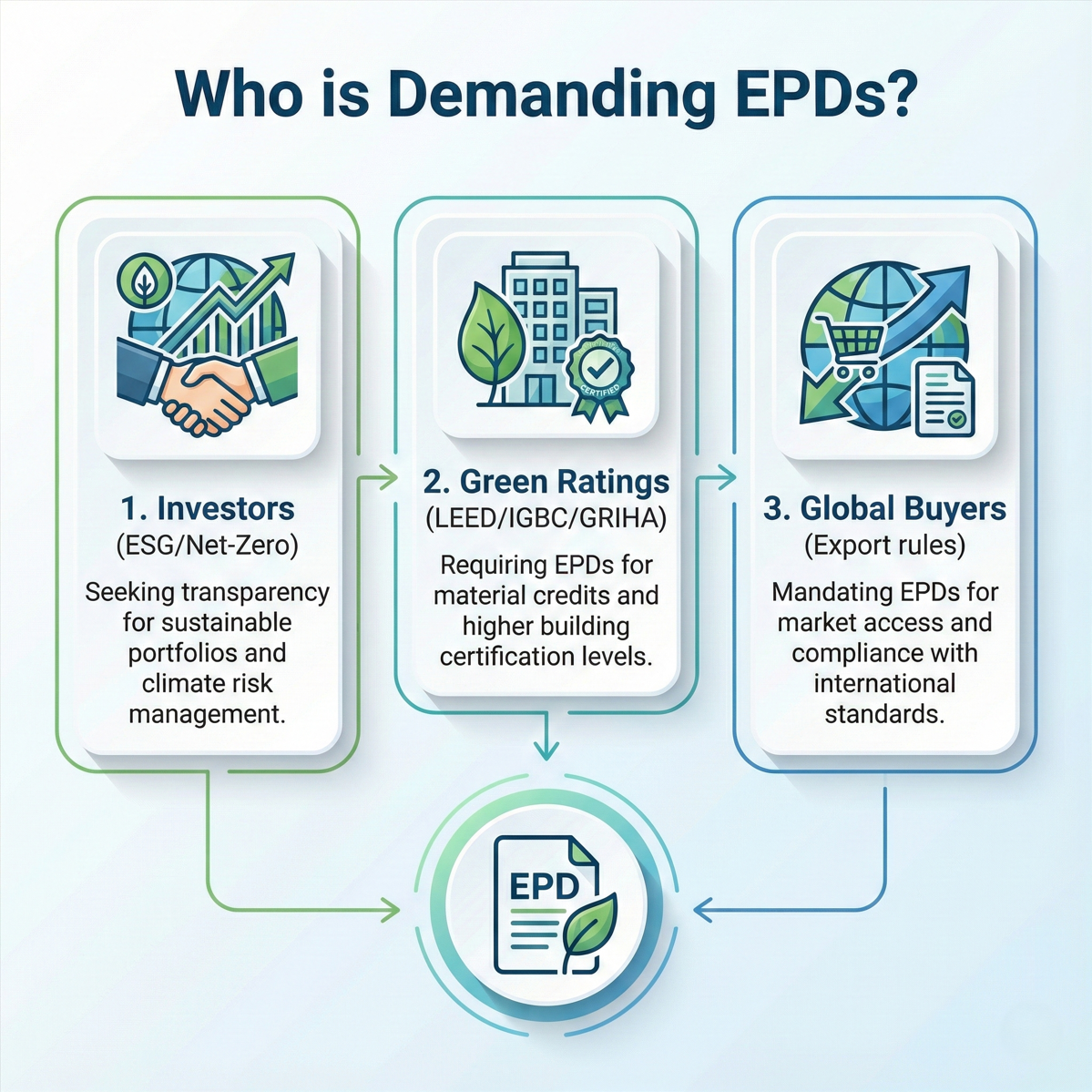
Net zero roadmaps, ESG reporting frameworks, and sustainable finance taxonomies all push large companies to measure and disclose supply chain (Scope 3) emissions.
EPDs give standardized data that feeds into corporate carbon accounting, ESG reports, and green finance disclosures for construction and real estate portfolios.
Green building rating systems
LEED, BREEAM, and other systems award points for using products with EPDs and for demonstrating embodied carbon reductions at whole building level.
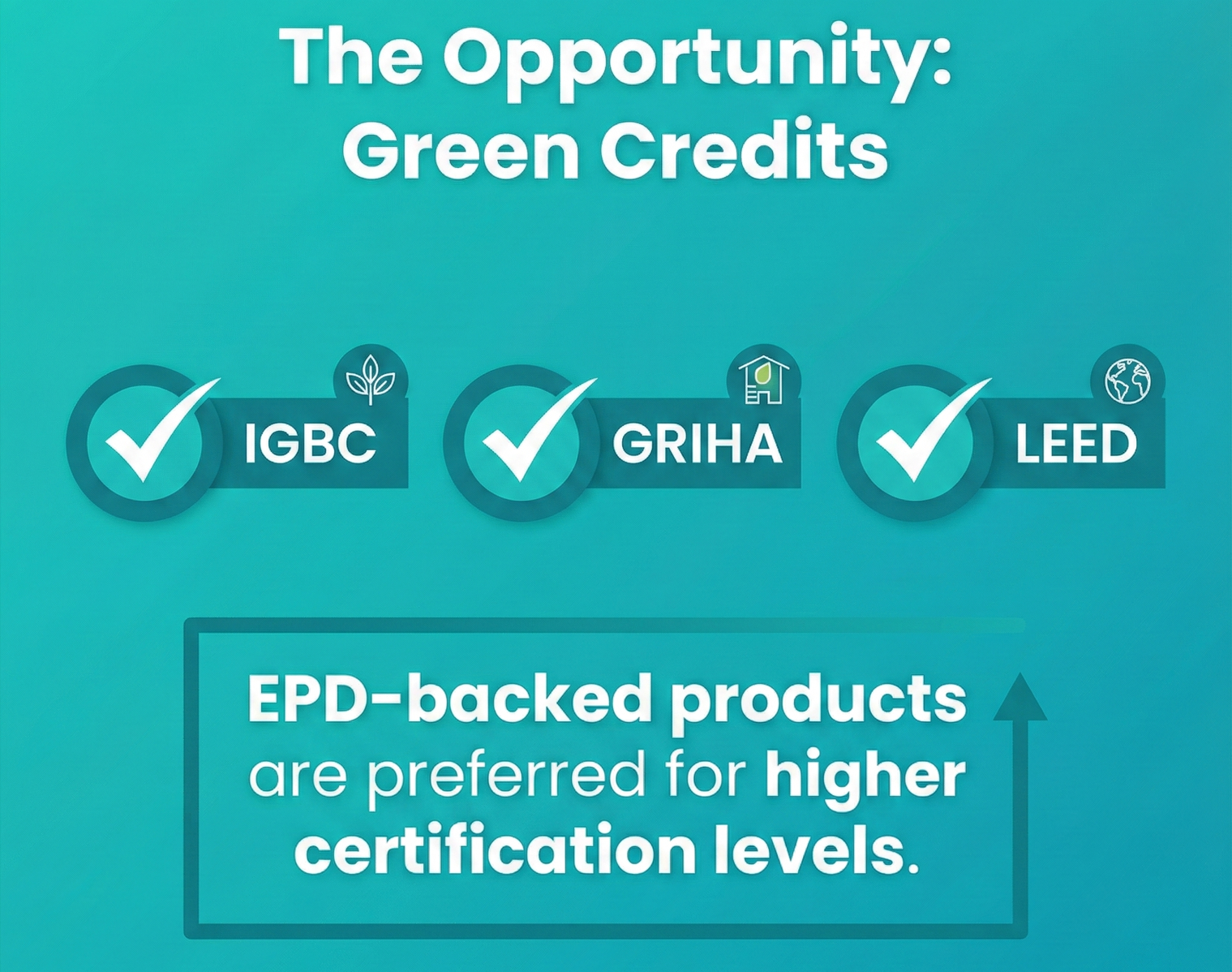
In India, IGBC and GRIHA increasingly emphasize use of low impact and transparently documented materials; EPD backed products give projects a clear edge in meeting material and life cycle credits.
Green and public procurement
Internationally, public clients under “Buy Clean” style policies often require EPDs for concrete, steel, asphalt, and other bulk materials in public projects.
Indian guidance on green public procurement and industrial green certifications is beginning to align with global disclosure practices, making EPD ready suppliers more attractive for large corporate and government buyers.
EPDs, LCA, and embodied carbon
Every EPD is built on a rigorous Life Cycle Assessment that quantifies impact categories like Global Warming Potential (GWP), acidification, eutrophication, resource depletion, and more.
These LCAs feed directly into building level LCA studies that many rating systems and investors now require, meaning that products without EPDs may simply not be considered.
Export markets and “no EPD = no entry”
The EU, UK, US, and Australia are tightening embodied carbon rules for public projects and large developments, often specifying minimum numbers or percentages of EPD verified products.
As this trend deepens, international contractors and developers increasingly treat “no EPD” as a red flag, effectively excluding such products from high value projects and global supply chains
Why Indian Manufacturers & Building Owners Must Pay Attention
1. Business risks of NOT having an EPD
Losing projects to EPD ready competitors: Developers and architects working on LEED/IGBC/GRIHA projects actively search for products with EPDs to secure material credits; suppliers without EPDs risk being replaced even if technically competitive.
Disqualification from global tenders: Many international infrastructure and real estate tenders now require disclosure of embodied carbon supported by EPDs, which can be a formal pre-qualification criterion.
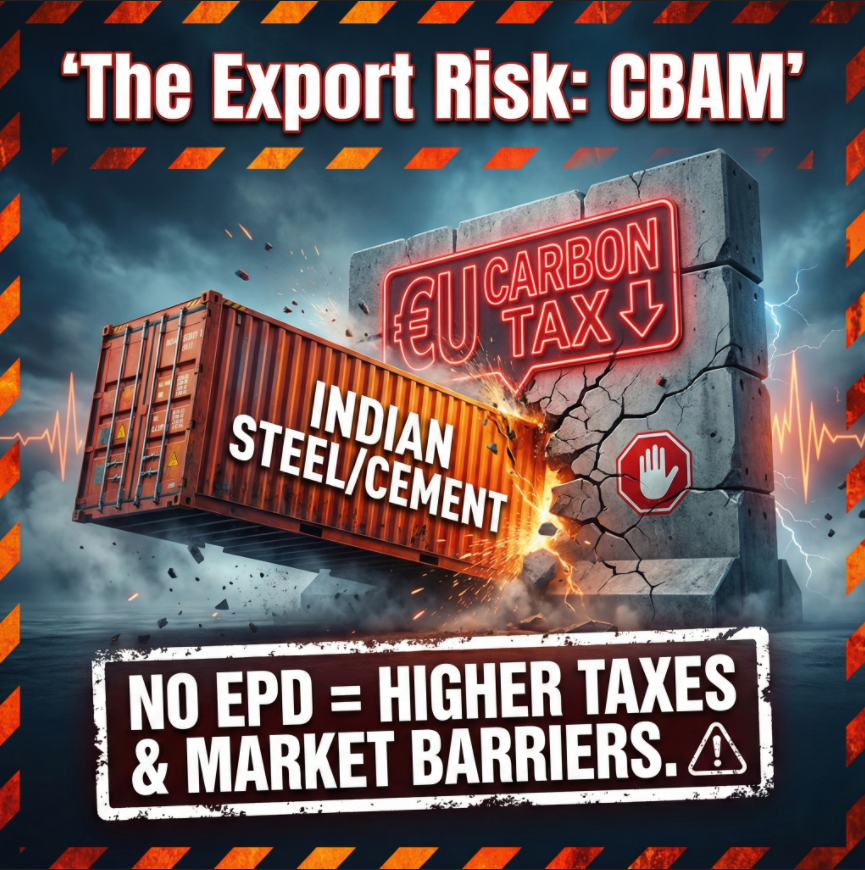
CBAM and export barriers: The EU Carbon Border Adjustment Mechanism will impose a carbon price on imports of steel, aluminium, cement, and other sectors, with reporting obligations already phasing in. Indian exporters relying on coal-based production face higher risks and will need robust, EPD quality data to negotiate, optimize, and remain competitive.
Misalignment with Indian sustainability codes: As India strengthens energy and environmental codes and expands use of IGBC and GRIHA, projects will increasingly preference manufacturers who can provide transparent, verified product data.
2. Business opportunities with EPDs
Competitive differentiation: Being among the first in your category (tiles, AAC blocks, admixtures, TMT steel, precast, insulation, etc.) with verified EPDs immediately sets your brand apart as a premium, future ready supplier.
Preferred supplier status: Developers and contractors delivering green portfolios prefer fewer, reliable suppliers that “tick all the sustainability boxes”; EPDs help you become a default choice in their procurement frameworks.
Support for LEED/IGBC/GRIHA credits: Products with EPDs directly support material and LCA related credits, which can help projects reach higher certification levels and justify using your product even at a modest cost premium.
Brand credibility and ESG alignment: Third party verification significantly boosts trust compared to unverified “green” claims, strengthening your ESG narrative with investors and institutional clients.
How EPDs Drive Financial Benefits and Growth
1. Increased sales and new market access
Manufacturers who obtain EPDs gain access to premium markets where sustainability and transparency are explicit purchasing criteria, including high end commercial, export oriented, and institutional projects. Case literature and industry experience show that EPD enabled access to new geographies and project types can translate into higher order volumes, particularly when sustainability is part of the client’s brand or financing conditions.
2. Ability to charge higher margins
Because EPDs are verified and comparable, many buyers accept paying a reasonable premium for lower carbon or transparently documented products, especially when they need green building points or ESG reporting benefits. Studies and case examples indicate that EPD backed construction products can command measurable price premiums or secure long term framework contracts that stabilize revenue.
3. Reduction in operational costs
EPD grade LCA maps environmental “hotspots” across energy use, raw materials, transport, and waste.
Manufacturers have used these insights to optimize material recipes, improve energy efficiency, and streamline logistics, leading to lower operating costs while also reducing impacts.
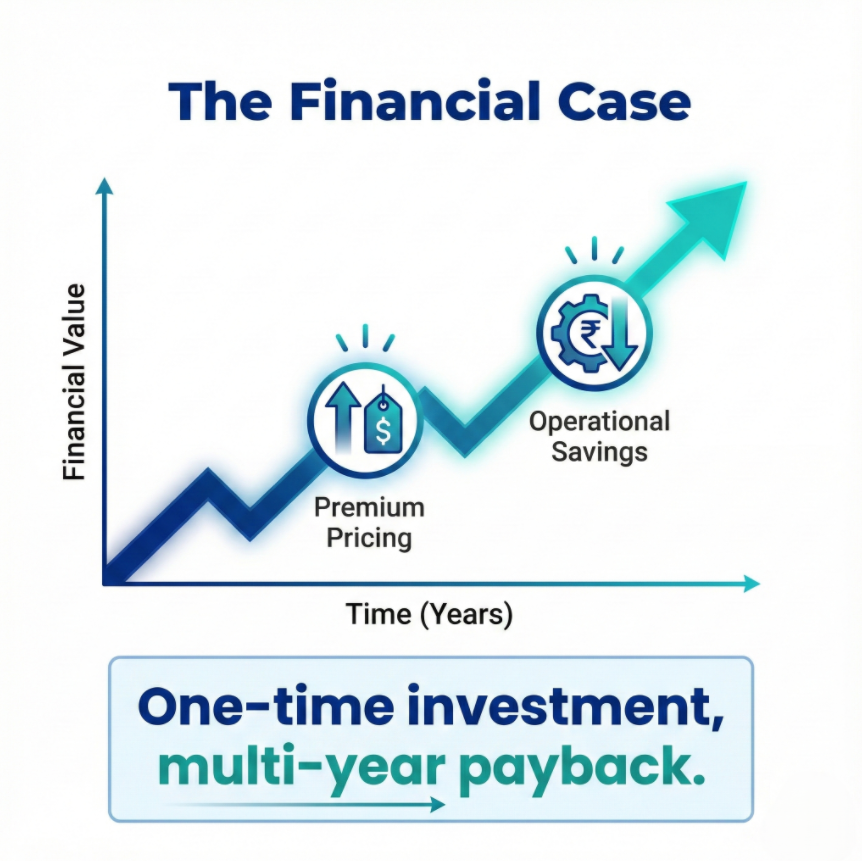
In many documented cases, the cost savings from process improvements identified through LCA outweigh the one-time cost of developing the EPD within a few years.
4. Eligibility for green procurement incentives
As corporate buyers and governments embed environmental criteria into tenders, EPDs become a gateway to participate in green procurement pipelines that often include volume commitments, better payment terms, or reputational benefits. For Indian manufacturers aiming to supply to multinational clients or public sector projects aligned with national climate goals, EPDs provide a structured way to demonstrate compliance and stand out.
5. Long term ROI (the key point)
EPD projects typically involve a one-time investment in LCA modelling, verification, and registration, with a validity period (often up to five years) during which the same EPD can be leveraged across multiple tenders and clients.
Global experiences suggest that first time EPD projects can start paying back in 1–3 years through a combination of higher win rates, access to new projects, and operational efficiencies.
For Indian manufacturers, starting early can lock in a multi-year advantage: as competitors rush later under regulatory pressure, your EPDs will already be in place, recognized, and integrated into client specifications.
How Desapex Supports the Entire EPD Journey
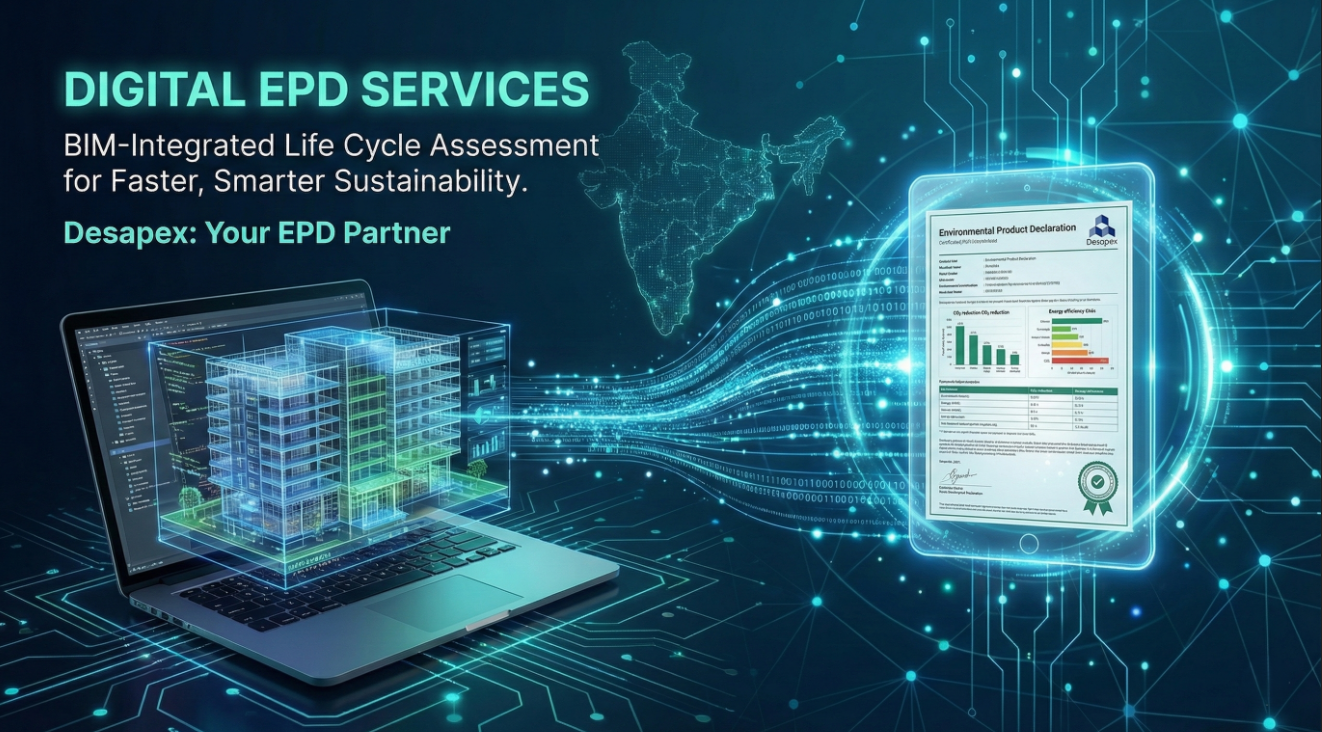
Desapex combines deep sustainability expertise with strong digital/BIM capabilities, making it a strategic partner for Indian manufacturers and building owners who want EPDs that are not only compliant, but commercially powerful.
1. Complete EPD & LCA service package
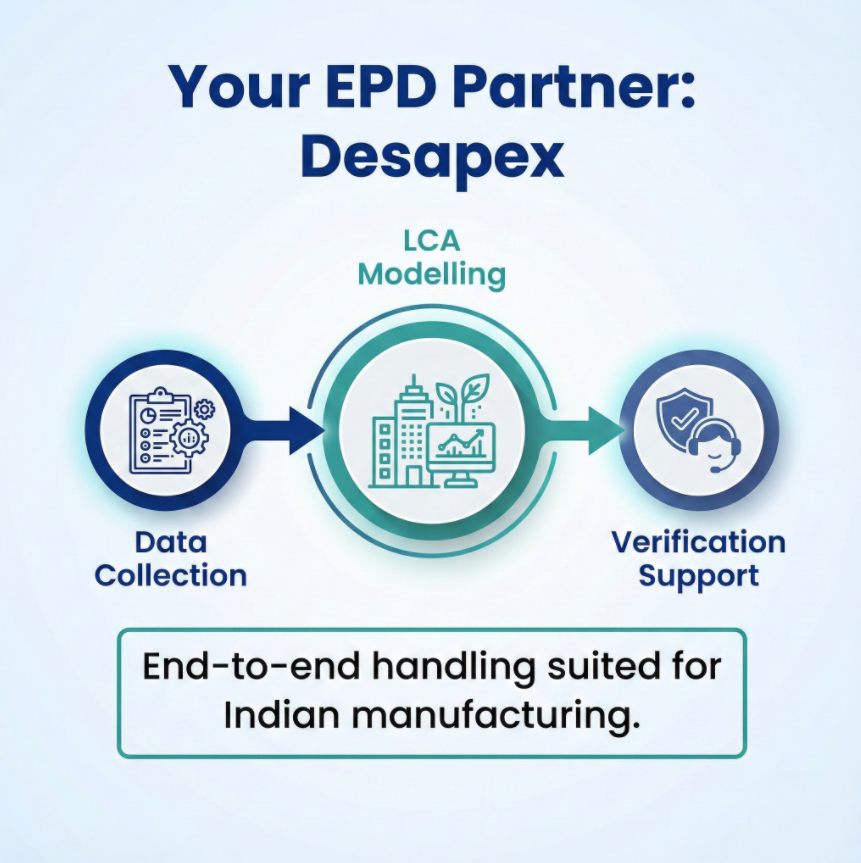
Desapex offers an end-to-end EPD and LCA solution tailored to Indian building products, including:
LCA modelling using tools like EandoX and Prodikt for robust, EN 15804 aligned product LCAs that can be integrated into global EPD programmes.
Data collection support through structured templates for raw materials, energy, transport, waste, packaging, and production volumes, designed for Indian plant realities.
System boundary definition (A1–A3, A4, A5, B, C, D) and scenario modelling aligned with relevant Product Category Rules (PCRs) and program operator requirements.
Impact calculations for key categories such as Global Warming Potential (GWP), acidification (AP), eutrophication (EP), abiotic resource depletion (ADP), and others required by EN 15804+A2.
Documentation as per ISO 14040, ISO 14044, EN 15804+A2 and ISO 14025, ensuring that your EPD is ready for independent verification and global publication.
Coordination with EPD program operators (e.g., international systems and regional operators) to streamline verification, registration, and publication.
2. Expertise of the Desapex team
Desapex’s team brings together sustainability consultants, architects, and material specialists with hands on experience in LCA, EPDs, and green building certifications. This combination allows Desapex to translate complex technical outputs into clear value propositions for developers, architects, and procurement teams.
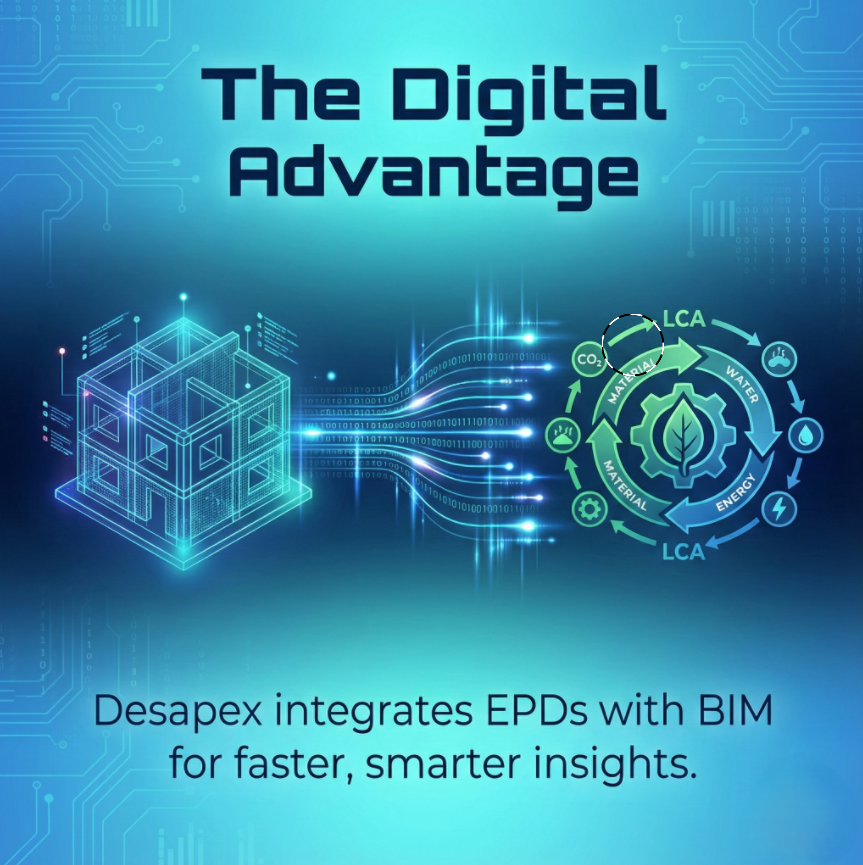
Additionally, Desapex is equipped to integrate EPD and LCA work with BIM based workflows, enabling more accurate quantity take offs and scalable, repeatable analyses for portfolios of buildings. The team also understands LEED, IGBC, and GRIHA requirements, so EPD strategies are aligned with the credits your clients need.
3. Desapex’s unique value add
Digital + sustainability integration: Desapex is not just an LCA consultant; it is a digital engineering firm that can plug EPD and LCA processes into BIM and digital twins for continuous, data driven decision making.
Faster LCA with BIM data: By extracting quantities and material data from BIM models, Desapex can speed up LCA modelling, reduce manual errors, and support scenario analysis for different material options.
Industry leading documentation quality: Clear, well-structured EPD and background reports help external verifiers, clients, and auditors quickly understand and trust your data.
Manufacturer friendly onboarding: Desapex designs practical data collection workflows that fit Indian manufacturing contexts, including ERP integration, on site measurements, and phased improvement roadmaps.
Support beyond the EPD:
Carbon reduction roadmaps using LCA insights to target the highest impact process improvements.
Material optimization strategies (e.g., mix design, alternative raw materials, logistics changes) that cut both cost and impact.
Market positioning strategies that use your EPD to strengthen bids, marketing, and ESG communication for domestic and export clients.
Case Examples and Lessons for Indian Businesses
1. European cement and steel: EPDs as a growth lever
European cement and steel manufacturers have used EPDs to demonstrate the benefits of clinker reduction, alternative fuels, and electric arc furnaces, enabling them to win low carbon procurement contracts and maintain EU market share under tightening regulations. In many reported cases, plants that invested early in EPDs and LCA driven process improvements saw both improved margins and stronger positions in public tenders.
2. Indian manufacturers eyeing EU markets under CBAM
Analysts expect India’s steel exports to Europe to face pressure as the EU’s carbon tax takes effect, especially for blast furnace-based products with higher embodied emissions. Indian manufacturers who prepare early with robust LCA data and EPDs will be better positioned to document improvements, optimise processes, and negotiate with European buyers sensitive to CBAM linked costs.
3. Developers gaining rating points and brand value
Construction case studies show that developers who systematically select EPD verified products can unlock additional points under LEED and similar systems, helping them reach higher certification levels and market their projects as genuinely low carbon. These added points often contribute directly to faster sales, better occupancy rates, and premium positioning in commercial and residential segments.
For Indian real estate developers working with Desapex, combining product EPDs with building level LCAs and BIM workflows can create a compelling narrative of measurable carbon performance across the entire project.
Why Indian Companies Should Act Now, with Desapex as Partner
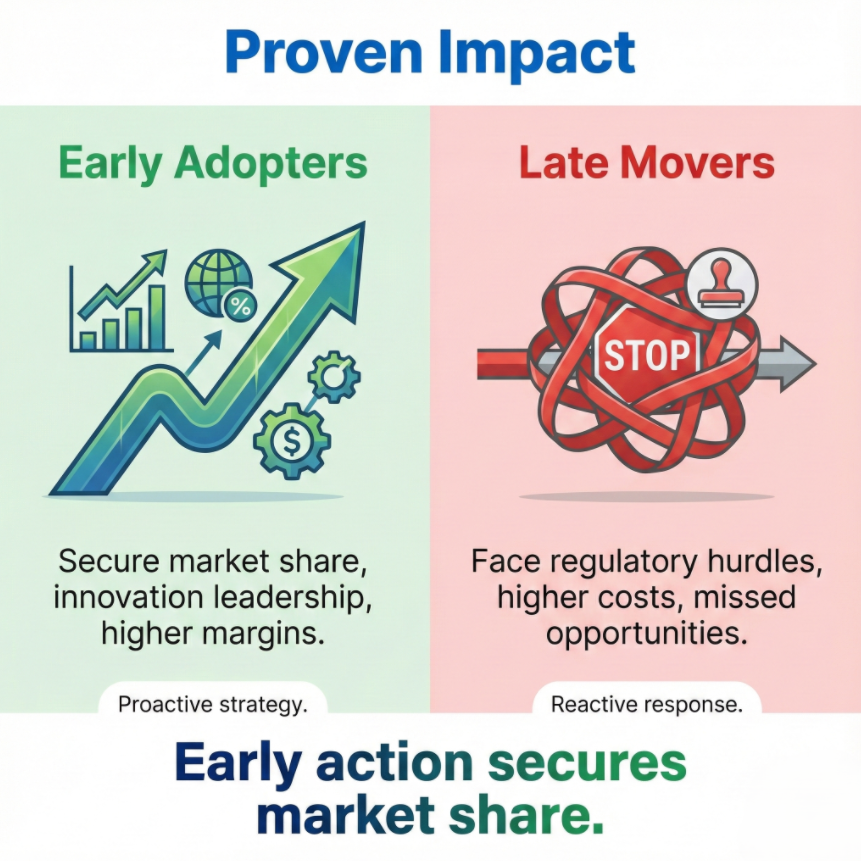
EPDs are rapidly becoming a gateway requirement for high value projects, export markets, green finance, and public procurement, not just a sustainability badge. Indian manufacturers and developers who move early will secure market share, better margins, and reputational advantages before regulations and competitors force a rushed, reactive transition.
Desapex offers Indian clients an end to end, digitally enabled EPD and LCA service from first scoping discussion to verified EPD publication and ongoing carbon reduction support making it a strong partner and arguably your best bet to build a future proof product and project portfolio.
Key Takeaways for Decision Makers
EPDs are now a strategic business tool, unlocking export access, green rating points, and ESG credibility while supporting operational efficiency.
“No EPD” increasingly means reduced eligibility for global tenders, CBAM exposed exports, and premium green building projects.
The cost of an EPD is typically one time and can pay back within a few years through improved win rates, price premiums, and process savings.
Indian manufacturers and developers that act early can secure a durable competitive edge in both domestic and international markets.
Desapex provides a turnkey, BIM integrated EPD and LCA solution tailored to Indian conditions, plus long-term carbon and market strategy support.
BIM for Beginners' is designed to give you the essential knowledge and skills you need to succeed in the dynamic world of BIM engineering. This course opens doors to a rewarding career path in the construction industry.
Basics of BIM
Fundamentals of AutoCAD 2D and 3D
Fundamentals of Revit Architecture and Interference check
Thank you! Your submission has been received!
Oops! Something went wrong while submitting the form.
BIM for Beginners' is designed to give you the essential knowledge and skills you need to succeed in the dynamic world of BIM engineering. This course opens doors to a rewarding career path in the construction industry.
An amazing new feature you will love
Incredible, groundbreaking feature
Something that just blows your mind
Thank you! Your submission has been received!
Oops! Something went wrong while submitting the form.


.png)