


Introduction
“The water pressure is too low.”
“The top floors aren't getting enough water.”
“The shower pressure keeps fluctuating.”
“The lower floors have excessive pressure.”
These sound like simple plumbing problems. But in complex buildings, they can indicate deeper issues in hydraulic design, pressure zoning, pump selection, pipe sizing, system configuration and building coordination.
The objective of a water-supply system is not to generate maximum pressure. It is to deliver the right pressure, reliably and efficiently, exactly where it is needed.
The 40-Storey Pressure Problem
Imagine a 40-storey residential tower.
A resident on the 35th floor complains that there is hardly any pressure in the shower. At the same time, a resident on the 5th floor complains that the tap pressure is too high.
The instinctive response may be to increase booster-pump discharge pressure.
That might improve performance on the upper floors but it can create excessive pressure at the lower floors.
The engineering team has moved the problem rather than solving it.
As elevation increases, available pressure reduces. Lower floors, meanwhile, can experience significantly higher static pressure.
Approximately every 10 metres of vertical water elevation creates about 1 bar of static pressure difference.
For high-rise buildings, managing this pressure difference is therefore a fundamental design challenge.

Why Water Pressure Matters
Pressure directly influences:
Fixture performance and water availability
Shower comfort and flow rate
Plumbing noise and water hammer
Leakage potential
Pump energy consumption
Pipe, valve and equipment performance
Occupant satisfaction
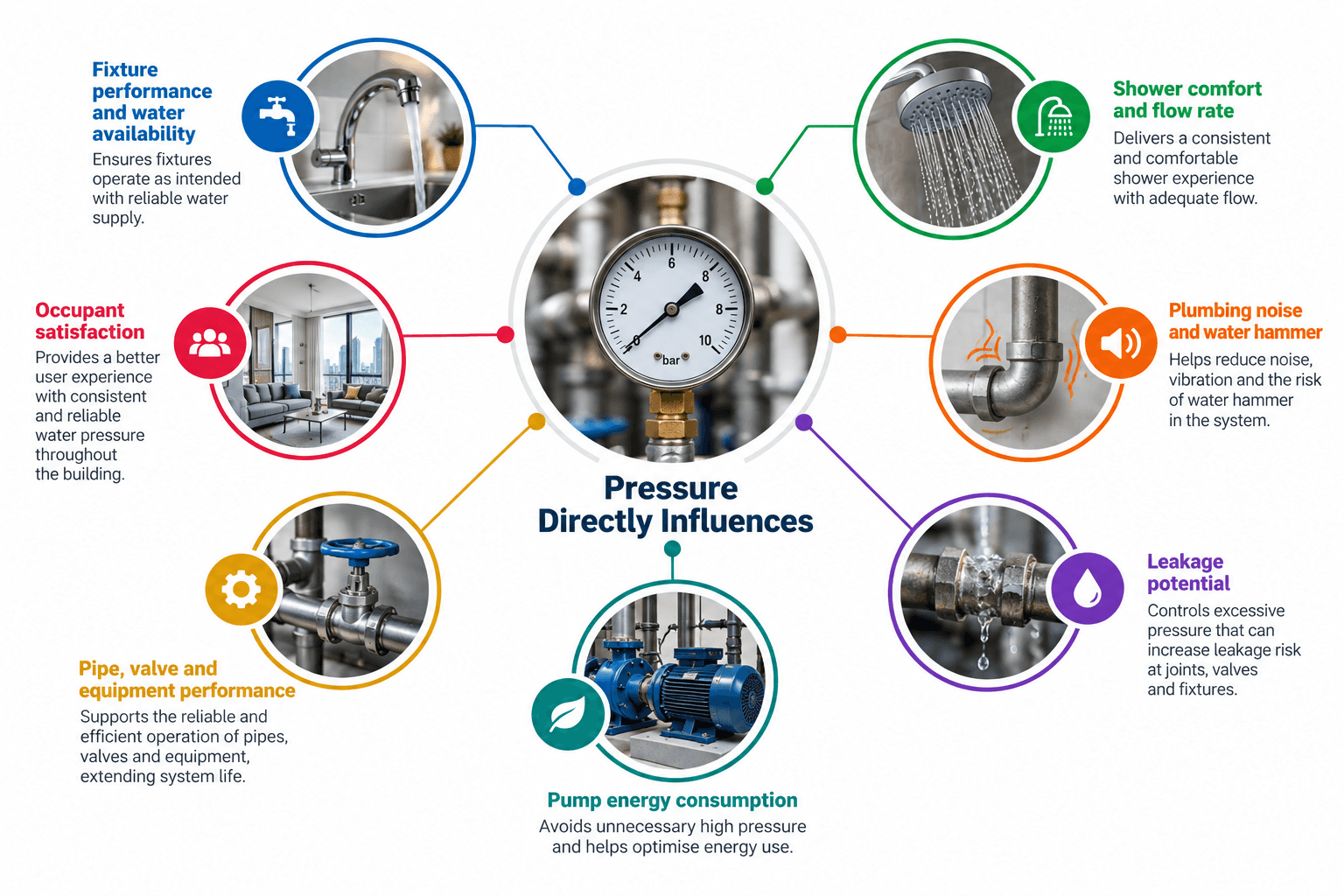
Too little pressure results in poor fixture performance.
Too much pressure can increase leakage risk, noise, water hammer, component stress and energy consumption.
The design target is therefore a controlled pressure envelope enough pressure for the most demanding fixture without unnecessarily pressurising the rest of the building.
Where Is the Pressure Being Lost?
When someone says, “The water pressure is low,” the first engineering question should be:
Where is the pressure being lost?
A simplified hydraulic relationship is:
Available pressure − elevation loss − friction loss − component losses = residual pressure
The pressure-loss path includes:
Available pressure
Elevation loss
Pipe friction
Fittings, valves and PRVs
Required residual pressure at the fixture
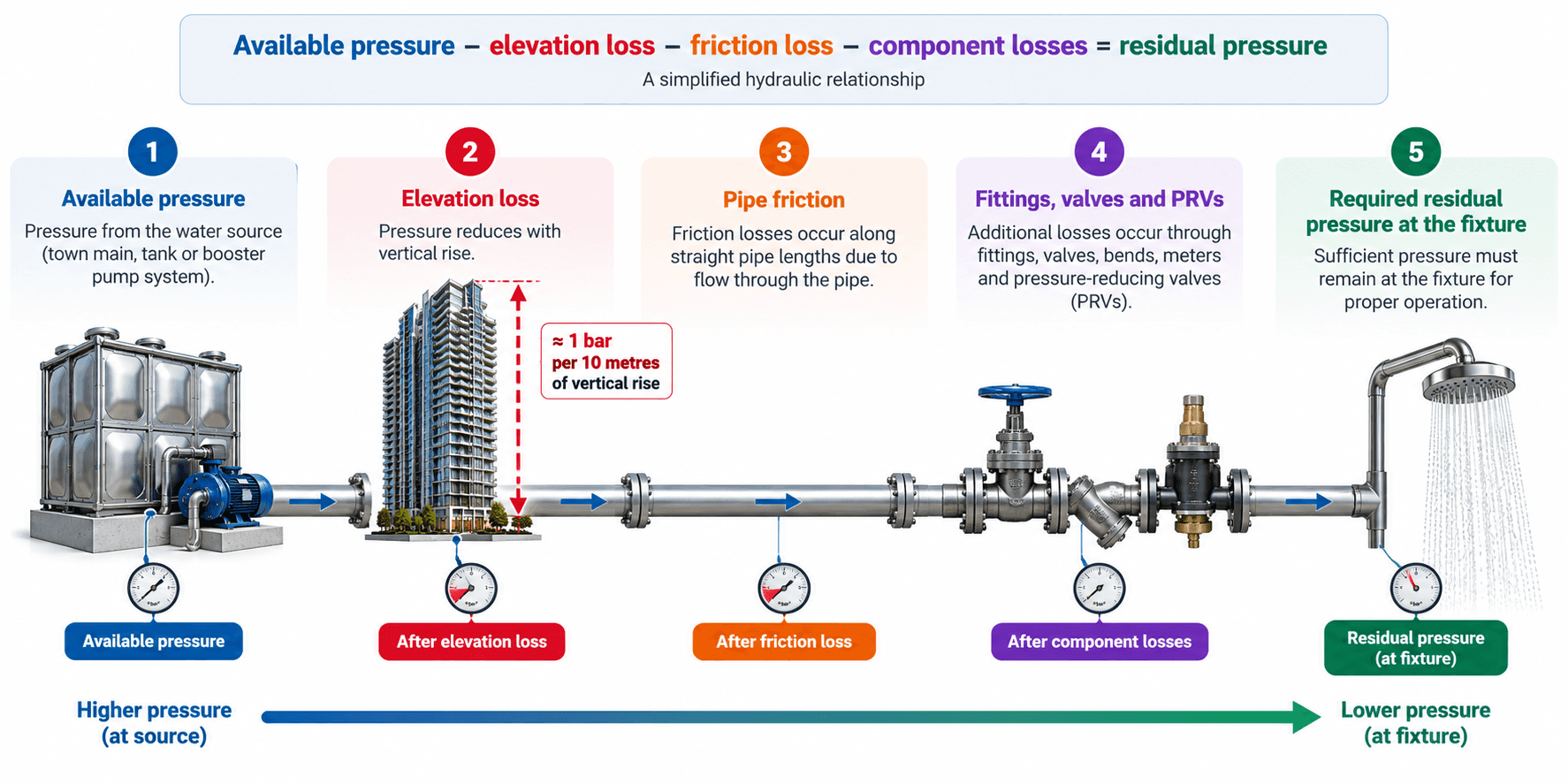
If residual pressure at the fixture is inadequate, occupants experience poor performance.
This is why pressure problems are usually system problems not simply pump problems.
Pressure Zoning: The Core High-Rise Strategy
One of the most effective strategies for tall buildings is pressure zoning.
Instead of treating the entire building as one hydraulic zone, it can be divided into manageable pressure zones.
Zone 1 - Lower Floors
Controlled through gravity, PRVs, booster systems or an appropriate combination.
Zone 2 - Intermediate Floors
Maintained within a defined pressure envelope.
Zone 3 - Upper Floors
Provided with adequate residual pressure without over-pressurising lower levels.
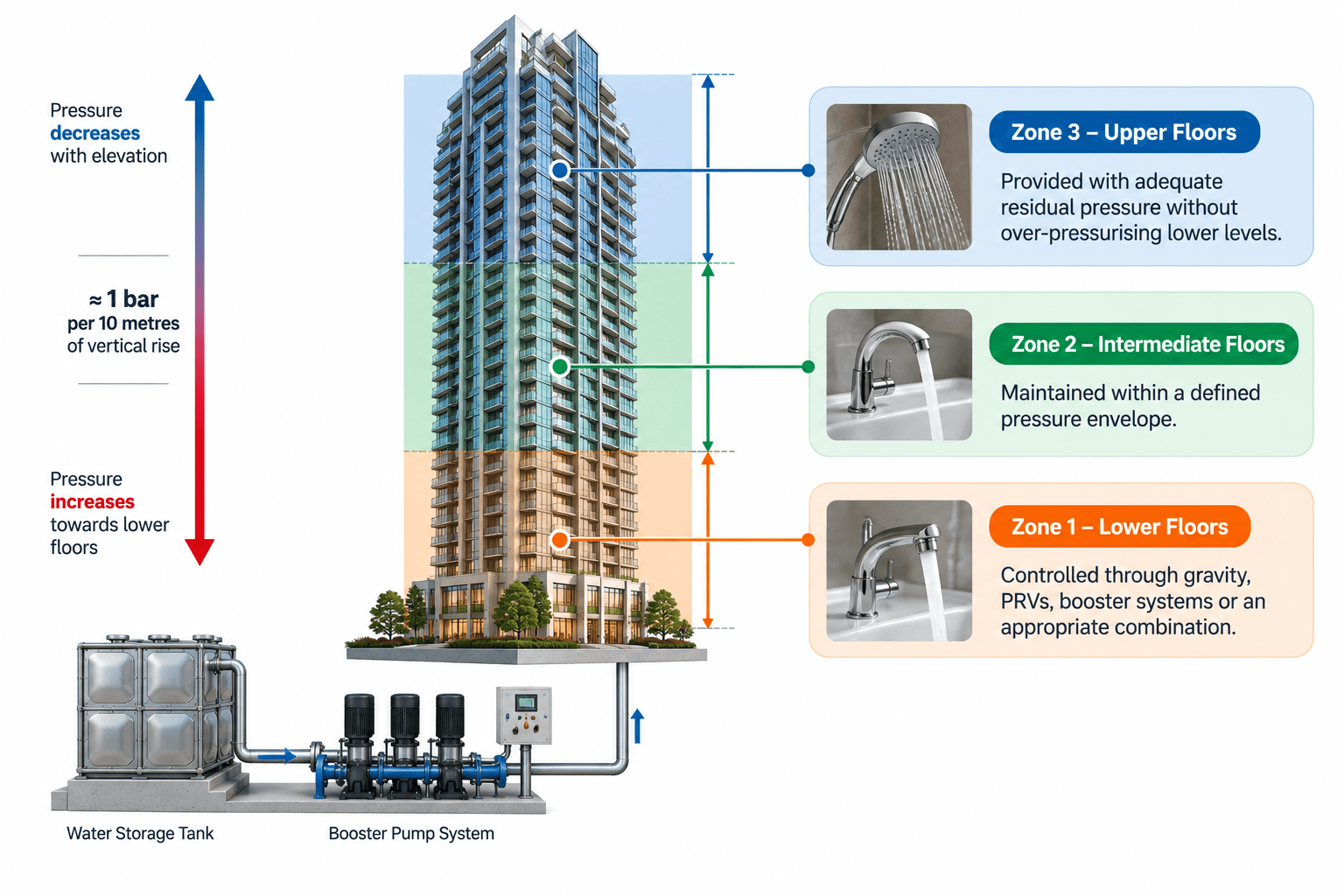
Each zone can have its own pressure requirement, pump duty, storage arrangement, PRV strategy, pipe sizing and hydraulic calculations.
Actual zone boundaries must be established through project-specific calculations and applicable codes.
The “Just Increase the Pump Pressure” Trap
Consider a high-rise residential project where upper floors are experiencing low pressure.
Increasing booster-pump discharge pressure may initially solve the issue. But it can also lead to:
Excessive pressure at lower floors
PRV instability
Flow noise
Higher leakage potential
Pressure fluctuations
Increased pump energy
Higher pressure on fixtures and components
The better response is to review the complete hydraulic strategy.
Is the pump correctly selected? Are the pipes appropriately sized? Are pressure zones correctly defined? Are component losses excessive? Is probable demand correctly calculated?
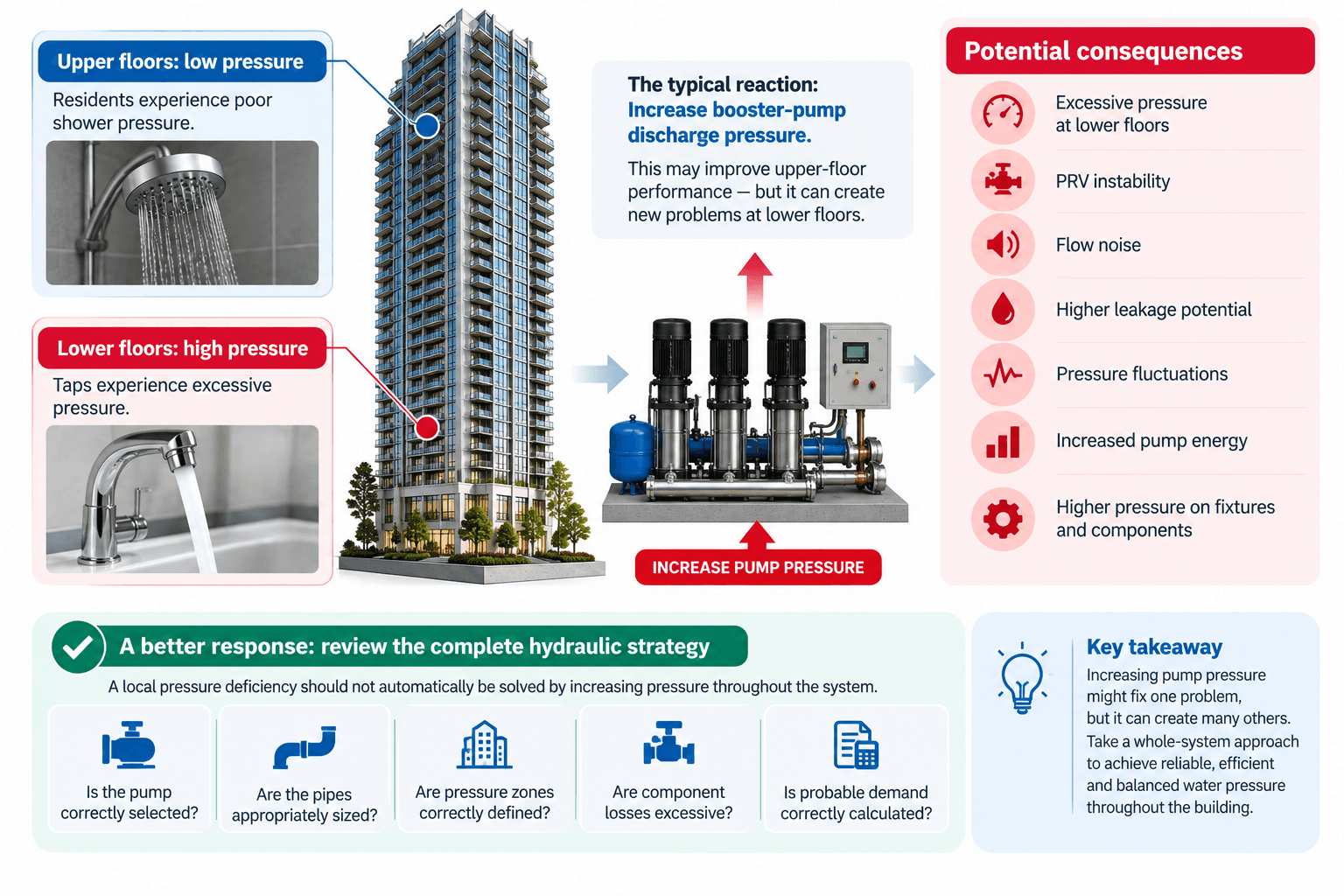
A local pressure deficiency should not automatically be solved by increasing pressure throughout the system.
Choosing the Pressure-Management Strategy
Common strategies include:
Break Tank + Booster: Better pressure control and reduced individual pump head, but requires additional tank space and maintenance.
PRVs: A practical pressure-reduction solution when correctly sized, selected, installed and maintained.
Variable-Speed Booster Pumps: Adjust pump output according to changing demand, supporting pressure stability and energy efficiency.
Intermediate Storage: Divides hydraulic head into manageable sections for very tall buildings, but adds equipment and space requirements.
The appropriate solution depends on the building, hydraulic requirements, available space and operating strategy.
Minimum Pressure vs Maximum Pressure
A good design must satisfy both ends of the pressure range.
Minimum pressure must be sufficient for the most demanding fixture.
Maximum pressure must remain within acceptable limits for fixtures, valves, appliances, pipes, flexible connections and equipment.
The objective is simple:
Maintain pressure within an acceptable operating envelope not provide the maximum possible pressure.
Pipe Sizing Is Part of Pressure Management
Not every low-pressure problem is a pump problem.
If a pipe is undersized, velocity and friction loss increase, reducing residual pressure downstream.
A hydraulic review should consider:
Flow
Velocity
Friction
Noise
Cost
Future operation
The right response may be correct pipe sizing + appropriate pump selection + an effective pressure strategy, rather than simply increasing pump pressure.
Why Fixture Diversity Matters
Buildings rarely operate with every fixture open simultaneously.
Water-supply design should therefore consider probable simultaneous demand rather than simply adding every fixture flow together.
Overestimating demand can result in:
Oversized pumps → excessive pressure → unnecessary energy
Underestimating demand can result in:
Low pressure → poor performance → occupant complaints
Right-sizing means balancing probable demand, pipework and pumping requirements.
Pressure Management Is a Multidisciplinary Design Issue
Water-pressure performance does not start and end with the plumbing calculation.
Architecture affects fixture locations, shafts and equipment space.
Structure affects floor-to-floor heights, transfer slabs and plant space.
Other MEP systems affect plant-room coordination, electrical supply, BMS interfaces and fire-system interfaces.
Operations also matter. Engineers need to consider isolation valves, PRV access, pump replacement routes, monitoring and maintainability.
Pressure management is therefore fundamentally a building design issue, not merely a plumbing calculation.
The Energy Connection
If a pump continuously generates more pressure than the building needs, energy is being consumed unnecessarily.
This is particularly relevant to high-rise residential towers, hotels, hospitals, large commercial buildings and mixed-use developments.
Even relatively small improvements in pump efficiency and pressure management can have a meaningful impact on lifecycle energy consumption.
The Future: Smart Water Pressure Management
Water-pressure management is moving beyond conventional pumps and valves.
A smarter approach can connect:
Sensors → BMS/Data → Analytics → Optimisation
Sensors can monitor pressure, flow, tank levels and pump performance.
BMS integration can provide trends, alarms and operating visibility.
Analytics can identify demand patterns, leak indicators and equipment behaviour.
Optimisation can connect pump speed, pressure, demand and energy.
Digital representations of water networks, BMS integration and data-driven analytics can help operators move from reactive maintenance towards more predictive, data-driven water-pressure management.
Practical PHE Designer's Checklist
Before finalising a water-supply design, ask:
Hydraulic
What pressure is required at the most demanding fixture?
What are the highest and lowest fixtures?
What are the static head, friction and component losses?
What is the peak/probable flow?
Pressure Management
Are pressure zones appropriately defined?
Where are PRVs required?
Is intermediate storage appropriate?
Is variable-speed boosting suitable?
Equipment
Is the pump duty correct?
Will it operate efficiently?
Is standby capacity defined?
Is the control philosophy clear?
Coordination & Operation
Are shafts and plant rooms adequate?
Is the system coordinated with structure and other MEP services?
Is maintenance access available?
Can zones be isolated?
Is pressure monitoring provided?
The Bigger Lesson
A water-supply system should never be designed around the pump alone.
The complete system is:
Source → Storage → Pump → Pipe → Zone → Control → Fixture → Monitor → Maintain
When these elements work together, occupants experience something simple:
Water comes out of the tap at the right pressure.
Achieving that simple experience requires considerable engineering behind the scenes.
Closing Thought
The better question is not:
“How much pressure can we generate?”
It is:
“How little pressure can we generate while still providing reliable performance at every fixture?”
That shift can lead to better design, lower energy consumption, improved occupant comfort, reduced operational problems and longer system life.
Ultimately, good PHE engineering is not about maximum pressure.
It is about controlled pressure.
How Desapex Approaches Water-Supply Engineering
At Desapex, we approach water-supply design as a complete hydraulic system rather than simply a network of pipes and pumps.
Our capabilities include:
High-rise water-supply design
Hydraulic pressure analysis
Pressure zoning
Booster pump systems
Variable-speed pumping
PRV strategies
Water storage & distribution
Hydraulic modelling
BIM & multidisciplinary coordination
Water-energy optimisation
Sustainable water management
Our focus is on developing systems that are hydraulically sound, coordinated, energy-efficient, maintainable and future-ready.
Need to evaluate your building's water-pressure performance? Connect with Desapex to discuss your PHE and water-supply engineering requirements.
FAQ
What is water pressure in buildings?
Water pressure in buildings is the force available to deliver water to fixtures and equipment. Good design maintains sufficient pressure at the most demanding fixture without excessively pressurising other parts of the system.
How is water pressure managed in high-rise buildings?
High-rise water pressure is commonly managed through pressure zoning, appropriately selected booster pumps, PRVs, intermediate storage and correctly sized pipework.
Why is water pressure low on upper floors?
Water pressure decreases with elevation because vertical water head creates a static pressure difference. Pipe friction, fittings, valves and other system losses further reduce residual pressure.
How do you fix low water pressure in a high-rise building?
The hydraulic system should first be assessed to identify whether the pressure loss is caused by elevation, pipe friction, fittings, valves, pump selection, demand or pressure-zone configuration before increasing pump pressure.