Client Segment:
Vertical:
Other Services
Service Overview
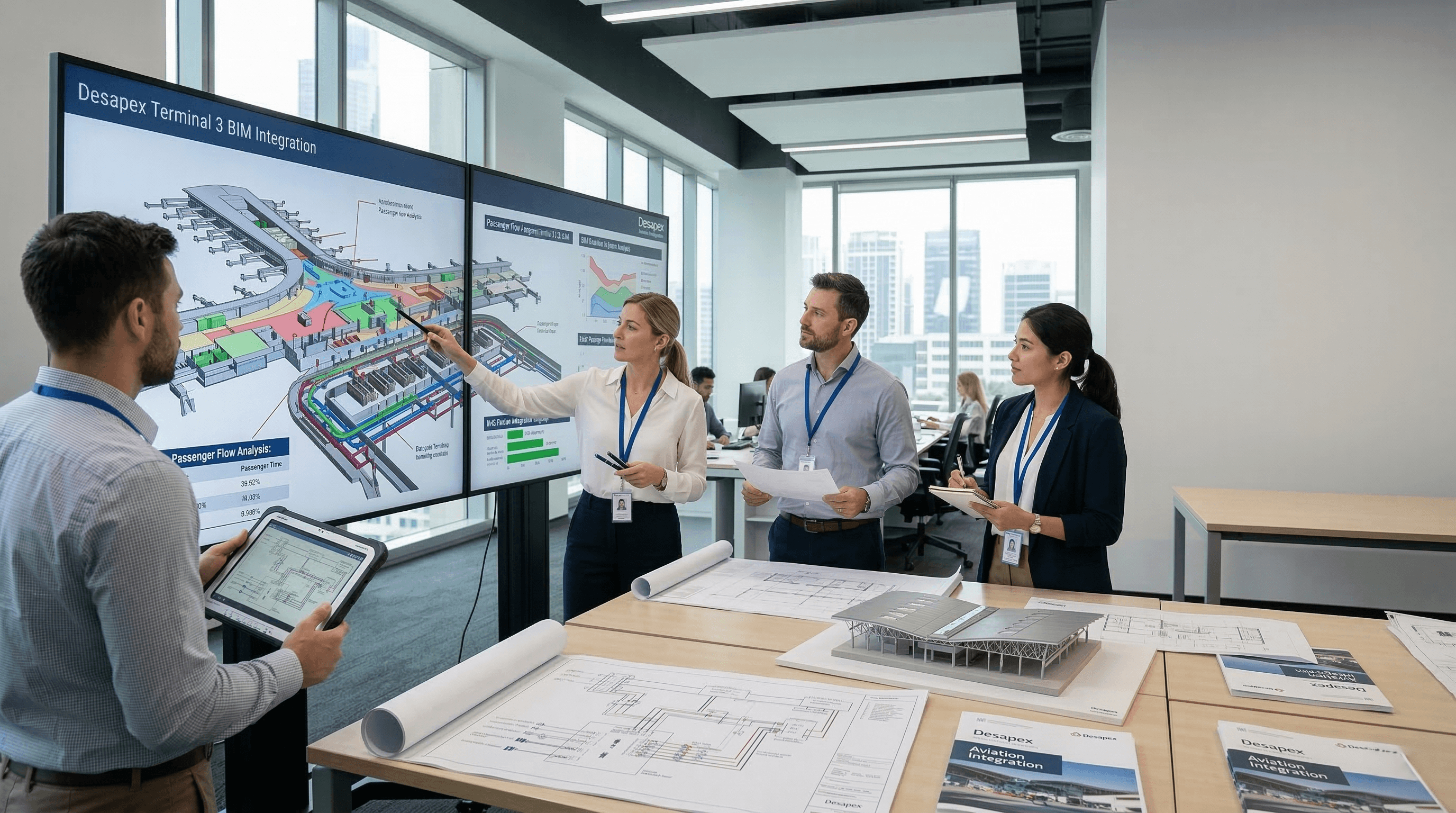
Terminal design is simultaneously an architectural experience, a logistics optimization problem, and a safety engineering challenge. Passenger flow from curb to gate must be intuitive and efficient, baggage handling systems (BHS) must integrate with structural and MEP systems in constrained voids, and security screening layouts must accommodate evolving threats. Desapex coordinates all of these complex requirements within a single BIM environment.
Our Digital-First Approach
Federate the Design
Our terminal design process integrates architectural massing, structural engineering, MEP systems, BHS routing, FIDS placement, security screening zone design, and wayfinding planning into a federated BIM model.
Core Deliverables
Terminal architectural design optimized for IATA Level of Service (LoS) C/B standards.
Structural long-span design for column-free departure lounges and arrival halls.
MEP design for large public volumes, including displacement ventilation and radiant cooling.
Baggage handling system (BHS) integration, security checkpoint design, and fire life safety engineering.
Why Choose Desapex
In traditional airport design, the most expensive and disruptive coordination failures occur between BHS equipment and structural/MEP systems in the constrained zones below departure floors. Desapex’s federated BIM approach ensures that BHS conveyor routing is coordinated with structural beams, HVAC ductwork, sprinkler piping, and cable trays simultaneously not sequentially. This has proven to reduce BHS-related construction RFIs by over 40% on comparable projects.
Unique Selling Proposition
Our USP is that Desapex brings the passenger journey into the design process through agent-based simulation linked to the BIM model. This means every design decision checkpoint placement, escalator positioning, gate allocation is tested against actual passenger flow performance, ensuring terminals work efficiently from day one.